



 Chat with AI
Exam 13: Chemical Kinetics: Reactions in the Atmosphere

Exam 1: Matter and Energy: The Origin of the Universe103 Questions
Exam 2: Atoms, Ions, and Molecules: Matter Starts Here144 Questions
Exam 3: Stoichiometry: Mass, Formulas, and Reactions141 Questions
Exam 4: Solution Chemistry: The Hydrosphere148 Questions
Exam 5: Thermochemistry: Energy Changes in Reactions139 Questions
Exam 6: Properties of Gases: The Air We Breathe164 Questions
Exam 7: A Quantum Model of Atoms: Waves and Particles166 Questions
Exam 8: Chemical Bonds: What Makes a Gas a Greenhouse Gas156 Questions
Exam 9: Molecular Geometry: Shape Determines Function188 Questions
Exam 10: Intermolecular Forces: The Uniqueness of Water165 Questions
Exam 11: Solutions: Properties and Behavior150 Questions
Exam 12: Solids: Crystals, Alloys, and Polymers130 Questions
Exam 13: Chemical Kinetics: Reactions in the Atmosphere155 Questions
Exam 14: Chemical Equilibrium: How Much Product Does a Reaction Really Make111 Questions
Exam 15: Acidbase Equilibria: Proton Transfer in Biological Systems122 Questions
Exam 16: Additional Aqueous Equilibria: Chemistry and the Oceans127 Questions
Exam 17: Thermodynamics: Spontaneous and Nonspontaneous Reactions and Processes186 Questions
Exam 18: Electrochemistry: The Quest for Clean Energy167 Questions
Exam 19: Nuclear Chemistry: Applications to Energy and Medicine165 Questions
Exam 20: Organic and Biological Molecules: the Compounds of Life168 Questions
Exam 21: The Main Group Elements: Life and the Periodic Table96 Questions
Exam 22: Transition Metals: Biological and Medical Applications142 Questions
Select questions type


The linear form of the Arrhenius equation is very useful, as it allows us to calculate the ________ from the slope and the ________ from the intercept.
(Multiple Choice)
4.8/5  (81)
(81) The following figure shows Arrhenius plots for four different reactions. Which reaction has the smallest frequency factor? 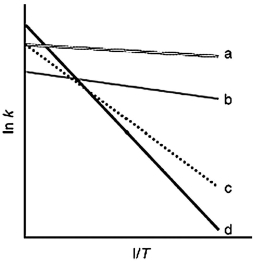
(Multiple Choice)
4.8/5 (85)
(85) N2O5 is used as a source of NO2 in chemical reactions. The compound decomposes in a first-order reaction. If the initial concentration of N2O5 0.400 M, and the concentration is 0.025 M after 120 seconds, what is the rate constant k of the reaction?
(Short Answer)
4.8/5 (76)
(76) A proposed mechanism for the photodecomposition of ozone in the atmosphere is: Step 1:  Step 2:
 Which of the following species is an intermediate?
Step 2: Which of the following species is an intermediate? (Multiple Choice)
4.8/5 (81)
(81) The mechanism for the reaction  in the presence of I(aq) is proposed to be: Step 1:
 Step 2:
 Which of the following species is a catalyst?
in the presence of I(aq) is proposed to be: Step 1: Step 2: Which of the following species is a catalyst? (Multiple Choice)
4.9/5 (80)
(80) Given the following data for the reaction A  B, determine the activation energy, Ea, of the reaction. k (M/s)
T (K)
0)681
500
0)715
1,000
B, determine the activation energy, Ea, of the reaction. k (M/s)
T (K)
0)681
500
0)715
1,000 (Multiple Choice)
5.0/5 (76)
(76) Given the following data for the reaction A  B, determine the frequency factor, A, of the reaction. k (M/s)
T (K)
0)681
500
0)715
1,000
B, determine the frequency factor, A, of the reaction. k (M/s)
T (K)
0)681
500
0)715
1,000 (Multiple Choice)
4.9/5 (80)
(80) The reaction CHCl3(g) Cl2(g)  CCl4(g) HCl(g) has the following rate law: Rate k[CHCl3][Cl2]. If the concentration of CHCl3 is increased by a factor of five while the concentration of Cl2 is kept the same, the rate will ________
 (Multiple Choice)
4.8/5 (73)
(73) Smog created by the interaction of sunlight with nitrogen oxides and volatile organic compounds is termed ________ smog.
(Multiple Choice)
4.7/5 (70)
(70) Which of the following statements must be true of an intermediate in a reaction mechanism?
I. is produced in an elementary step
II. is consumed in an elementary step
III. is included in the overall balanced reaction equation
(Multiple Choice)
4.9/5 (81)
(81) A catalyst that is in the same phase as the reactants and products is a(n) ________ catalyst.
(Multiple Choice)
4.8/5 (86)
(86) The linear form of the ________ is very useful, as a plot of ln k versus 1/T allows us to calculate the activation energy from the slope and the frequency factor from the intercept.
(Short Answer)
4.9/5 (70)
(70) Chlorine dioxide (ClO2) is used as a disinfectant in municipal water-treatment plants. It decomposes in a first-order reaction with a rate constant of 0.0714 s1. If the initial concentration were 0.12 M, what would the concentration be after 14.0 s has elapsed?
(Multiple Choice)
4.8/5 (82)
(82) The reaction  is first order in B and A. The overall order of the reaction is ________
 (Multiple Choice)
5.0/5 (80)
(80) Which of the following statements must be true of a catalyst in a reaction mechanism?
I. is consumed in an elementary step
II. is regenerated in an elementary step after it is consumed
III. is included in the overall balanced reaction equation
(Multiple Choice)
4.9/5 (72)
(72) Chlorofluorocarbons released into the atmosphere from refrigerants and aerosol sprays were found to catalyze the decomposition of ozone, leading to the formation of an ozone hole over the South Pole. The catalyzed reaction was found to have an activation energy of 2.2 kJ/mol compared with an activation energy of 17.7 kJ/mol for the uncatalyzed reaction. By what factor is the decomposition rate constant increased in the catalyzed reaction at 300 K?
(Multiple Choice)
4.9/5 (76)
(76) In a rate law, the partial orders are determined by ________
(Multiple Choice)
4.9/5 (81)
(81) If the reaction 3A B  C
 2D E is first order overall, which of these could be the units of its rate constant, k?
C 2D E is first order overall, which of these could be the units of its rate constant, k? (Multiple Choice)
4.8/5 (72)
(72) The linear form of ________ is very useful, as it allows us to calculate the activation energy and the frequency factor.
(Multiple Choice)
4.9/5 (79)
(79) In the combustion of methane,  , which reactant has the greatest rate of disappearance?
 (Multiple Choice)
4.8/5 (75)
(75) 
Filters
- Essay(0)
- Multiple Choice(0)
- Short Answer(0)
- True False(0)
- Matching(0)