



 Chat with AI
Exam 13: Chemical Kinetics: Reactions in the Atmosphere

Exam 1: Matter and Energy: The Origin of the Universe103 Questions
Exam 2: Atoms, Ions, and Molecules: Matter Starts Here144 Questions
Exam 3: Stoichiometry: Mass, Formulas, and Reactions141 Questions
Exam 4: Solution Chemistry: The Hydrosphere148 Questions
Exam 5: Thermochemistry: Energy Changes in Reactions139 Questions
Exam 6: Properties of Gases: The Air We Breathe164 Questions
Exam 7: A Quantum Model of Atoms: Waves and Particles166 Questions
Exam 8: Chemical Bonds: What Makes a Gas a Greenhouse Gas156 Questions
Exam 9: Molecular Geometry: Shape Determines Function188 Questions
Exam 10: Intermolecular Forces: The Uniqueness of Water165 Questions
Exam 11: Solutions: Properties and Behavior150 Questions
Exam 12: Solids: Crystals, Alloys, and Polymers130 Questions
Exam 13: Chemical Kinetics: Reactions in the Atmosphere155 Questions
Exam 14: Chemical Equilibrium: How Much Product Does a Reaction Really Make111 Questions
Exam 15: Acidbase Equilibria: Proton Transfer in Biological Systems122 Questions
Exam 16: Additional Aqueous Equilibria: Chemistry and the Oceans127 Questions
Exam 17: Thermodynamics: Spontaneous and Nonspontaneous Reactions and Processes186 Questions
Exam 18: Electrochemistry: The Quest for Clean Energy167 Questions
Exam 19: Nuclear Chemistry: Applications to Energy and Medicine165 Questions
Exam 20: Organic and Biological Molecules: the Compounds of Life168 Questions
Exam 21: The Main Group Elements: Life and the Periodic Table96 Questions
Exam 22: Transition Metals: Biological and Medical Applications142 Questions
Select questions type


The reaction profiles for four reactions are shown below. Which one has the largest activation energy? 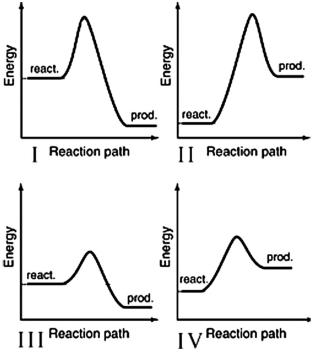
(Multiple Choice)
4.8/5  (79)
(79) In a catalyzed reaction, the ________ of the transition state is lowered while the enthalpy change for the reaction remains the same, leading to a faster reaction.
(Short Answer)
4.9/5 (68)
(68) Indicate which of the following compounds is not a component of photochemical smog.
(Multiple Choice)
4.7/5 (88)
(88) In a catalyzed reaction, the activation energy of the ________ is lowered while the enthalpy change for the reaction remains the same, leading to a faster reaction.
(Short Answer)
4.9/5 (63)
(63) The following graph shows the kinetics curves for the reaction of oxygen with hydrogen to form water:  . Which curve is water?
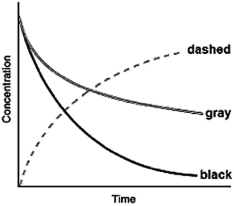
. Which curve is water? (Multiple Choice)
4.8/5 (82)
(82) Which of the following is not a possible graph of concentration versus time for a reactant?
(Multiple Choice)
4.7/5 (77)
(77) Given the following data for the reaction A  B, determine the activation energy, Ea, of the reaction. k (M/s)
T (°C)
0)282
277
0)291
627
B, determine the activation energy, Ea, of the reaction. k (M/s)
T (°C)
0)282
277
0)291
627 (Multiple Choice)
4.8/5 (86)
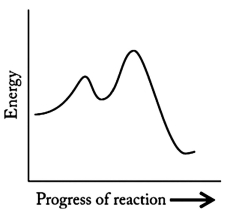
(86) 
For the reaction 2A  4B 3D, the rate of the reaction in terms of B would be written as ________.
 (Short Answer)
4.9/5 (74)
(74) For the reaction 2A 3B →4C 5D, the rate of the reaction in terms of D would be written as ________
(Multiple Choice)
4.7/5 (75)
(75) Sodium hypochlorite (NaClO) is used as a common disinfectant. It decomposes in a first-order process with a rate constant of 0.10 s1. How long would it take for an initial concentration of 0.20 M to decrease to 0.07 M ?
(Multiple Choice)
4.8/5 (84)
(84) Nitric oxide and nitrogen dioxide are found in photochemical smog. Nitrogen dioxide is formed from nitrogen monoxide in the exhaust of automobile engines. A possible mechanism for this reaction is given below, where equilibrium is quickly established in steps 1 and 2. What is the rate law predicted by this mechanism? Reaction:  Step 1 (fast): NO NO
 N2O2
Step 2 (fast): N2O2
 N NO2
Step 3 (slow): N O2
 NO2
Step 1 (fast): NO NO N2O2
Step 2 (fast): N2O2 N NO2
Step 3 (slow): N O2 NO2 (Multiple Choice)
4.9/5 (81)
(81) The device in automobiles that has decreased NO and partially oxidized hydrocarbons from exhaust gases is termed a ________
(Multiple Choice)
4.9/5 (68)
(68) Identify the order of each of the following reactions, based on the supplied graphs. 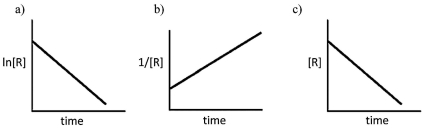
(Essay)
4.8/5 (88)
(88) The mechanism for the reaction  in the presence of I(aq) is proposed to be: Step 1:
 Step 2:
 Which of the following species is an intermediate?
in the presence of I(aq) is proposed to be: Step 1: Step 2: Which of the following species is an intermediate? (Multiple Choice)
4.7/5 (74)
(74) 
Filters
- Essay(0)
- Multiple Choice(0)
- Short Answer(0)
- True False(0)
- Matching(0)