



 Chat with AI
Exam 2: Atoms, Ions, and Molecules: Matter Starts Here

Exam 1: Matter and Energy: The Origin of the Universe103 Questions
Exam 2: Atoms, Ions, and Molecules: Matter Starts Here144 Questions
Exam 3: Stoichiometry: Mass, Formulas, and Reactions141 Questions
Exam 4: Solution Chemistry: The Hydrosphere148 Questions
Exam 5: Thermochemistry: Energy Changes in Reactions139 Questions
Exam 6: Properties of Gases: The Air We Breathe164 Questions
Exam 7: A Quantum Model of Atoms: Waves and Particles166 Questions
Exam 8: Chemical Bonds: What Makes a Gas a Greenhouse Gas156 Questions
Exam 9: Molecular Geometry: Shape Determines Function188 Questions
Exam 10: Intermolecular Forces: The Uniqueness of Water165 Questions
Exam 11: Solutions: Properties and Behavior150 Questions
Exam 12: Solids: Crystals, Alloys, and Polymers130 Questions
Exam 13: Chemical Kinetics: Reactions in the Atmosphere155 Questions
Exam 14: Chemical Equilibrium: How Much Product Does a Reaction Really Make111 Questions
Exam 15: Acidbase Equilibria: Proton Transfer in Biological Systems122 Questions
Exam 16: Additional Aqueous Equilibria: Chemistry and the Oceans127 Questions
Exam 17: Thermodynamics: Spontaneous and Nonspontaneous Reactions and Processes186 Questions
Exam 18: Electrochemistry: The Quest for Clean Energy167 Questions
Exam 19: Nuclear Chemistry: Applications to Energy and Medicine165 Questions
Exam 20: Organic and Biological Molecules: the Compounds of Life168 Questions
Exam 21: The Main Group Elements: Life and the Periodic Table96 Questions
Exam 22: Transition Metals: Biological and Medical Applications142 Questions
Select questions type


Nitrogen and oxygen combine to form several different nitrogen oxides. In one case, 8.4 g of nitrogen reacted completely with 4.8 g of oxygen. In another case, 4.2 g of nitrogen reacted with 9.6 g of oxygen. Which pair of nitrogen oxides is consistent with these data?
(Multiple Choice)
4.8/5  (76)
(76) Identify the letter of the group that contains the most metalloids. 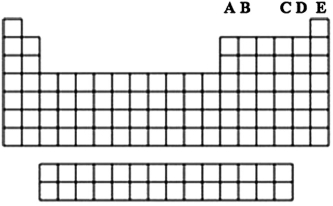
(Multiple Choice)
4.8/5 (71)
(71) Locate each element in the periodic table and identify which statement is not correct. The common ion of ________ has ________ electrons and a charge of ________.
(Multiple Choice)
4.8/5 (80)
(80) There are three major isotopes of silicon: silicon-28, silicon-29, and silicon-30. Given the average atomic mass of silicon is 28.10 amu, estimate the percent abundance of the most abundant isotope of silicon.
(Multiple Choice)
4.9/5 (85)
(85) Radium often is found in uranium ores and can be separated from solutions by precipitation as radium sulfate. What is the formula for radium sulfate?
(Multiple Choice)
4.8/5 (77)
(77) In the atoms in the Rutherford-Geiger-Marsden experiment, the alpha particles were repelled by ________
(Multiple Choice)
4.9/5 (82)
(82) Which statement about isotopes of the same element is not correct?
(Multiple Choice)
4.9/5 (84)
(84) Enriched weapons-grade uranium consists of 80% uranium-235 (235.044 amu) and 20% uranium-238 (238.051 amu). What is the average atomic mass of weapons-grade uranium, assuming the percentages are exact?
(Multiple Choice)
4.7/5 (70)
(70) The following salts are used in fireworks. Which one has an incorrect formula or is not named correctly?
(Multiple Choice)
4.8/5 (82)
(82) Which one of the following acids has an incorrect formula or is not named correctly?
(Multiple Choice)
4.8/5 (63)
(63) Which one of the following acids has an incorrect formula or is not named correctly?
(Multiple Choice)
4.9/5 (90)
(90) 
Filters
- Essay(0)
- Multiple Choice(0)
- Short Answer(0)
- True False(0)
- Matching(0)