



 Chat with AI
Exam 17: Thermodynamics: Spontaneous and Nonspontaneous Reactions and Processes

Exam 1: Matter and Energy: The Origin of the Universe103 Questions
Exam 2: Atoms, Ions, and Molecules: Matter Starts Here144 Questions
Exam 3: Stoichiometry: Mass, Formulas, and Reactions141 Questions
Exam 4: Solution Chemistry: The Hydrosphere148 Questions
Exam 5: Thermochemistry: Energy Changes in Reactions139 Questions
Exam 6: Properties of Gases: The Air We Breathe164 Questions
Exam 7: A Quantum Model of Atoms: Waves and Particles166 Questions
Exam 8: Chemical Bonds: What Makes a Gas a Greenhouse Gas156 Questions
Exam 9: Molecular Geometry: Shape Determines Function188 Questions
Exam 10: Intermolecular Forces: The Uniqueness of Water165 Questions
Exam 11: Solutions: Properties and Behavior150 Questions
Exam 12: Solids: Crystals, Alloys, and Polymers130 Questions
Exam 13: Chemical Kinetics: Reactions in the Atmosphere155 Questions
Exam 14: Chemical Equilibrium: How Much Product Does a Reaction Really Make111 Questions
Exam 15: Acidbase Equilibria: Proton Transfer in Biological Systems122 Questions
Exam 16: Additional Aqueous Equilibria: Chemistry and the Oceans127 Questions
Exam 17: Thermodynamics: Spontaneous and Nonspontaneous Reactions and Processes186 Questions
Exam 18: Electrochemistry: The Quest for Clean Energy167 Questions
Exam 19: Nuclear Chemistry: Applications to Energy and Medicine165 Questions
Exam 20: Organic and Biological Molecules: the Compounds of Life168 Questions
Exam 21: The Main Group Elements: Life and the Periodic Table96 Questions
Exam 22: Transition Metals: Biological and Medical Applications142 Questions
Select questions type


The standard entropy of diamond is 2.4 J/mol K. Calculate the entropy per carbon atom in diamond and the number of microstates for each atom. Discuss the number of microstates in terms of the molecular motions accessible to each carbon atom.
(Essay)
5.0/5  (69)
(69) The equilibrium constant for a reaction is determined at several temperatures by measuring concentrations of reactants and products. To determine the standard enthalpy and entropy changes for the reactions, you need to plot ________ on the y-axis and ________ on the x-axis and fit the data to a linear equation. The slope of this line is equal to ________, and the intercept provides a value for ________.
(Multiple Choice)
4.7/5 (83)
(83) In an experiment, 1.00 atm of N2(g) in a 10.0 L container at 25C was reacted under standard state conditions with a stoichiometric quantity of H2(g) to form ammonia:  .
What is the entropy change for the reaction?
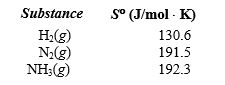
.
What is the entropy change for the reaction? (Short Answer)
4.8/5 (83)
(83) Rank the following compounds from smallest to largest standard molar entropy (S).
CH4(g), CH3CH2OH(l ), CO2(s), Na(s), NH3(l )
(Essay)
4.9/5 (78)
(78) Ssys can be directly related to the heat, q. Which of statements A-D is not true regarding this relationship?
(Multiple Choice)
4.9/5 (91)
(91) Suppose G is 25.0 kJ/mol for a hypothetical reaction in which A converts into B. Under the reaction conditions, the free-energy change is larger, G 30.0 kJ/mol. Which of the following statements describes this mixture of A and B?
(Multiple Choice)
4.9/5 (86)
(86) Hydrochloric acid (HCl) reacts with sodium hydroxide (NaOH) to form sodium chloride (NaCl) and water. If H 56.13 kJ/mol and S 79.11 J/mol K, what is G for this reaction at 20C?
(Multiple Choice)
4.9/5 (86)
(86) Hydrochloric acid (HCl) reacts with sodium hydroxide (NaOH) to form sodium chloride (NaCl) and water. If H 56.13 kJ/mol and S 79.11 J/mol K, what is the temperature (in C) of the reaction if G 80.89 kJ/mol?
(Short Answer)
4.9/5 (78)
(78) When a molecule of ethylenediamine replaces two molecules of NH3 in Co(NH3)  , the entropy of the system ________
 (Multiple Choice)
4.7/5 (95)
(95) Indicate which one of the following reactions most certainly does not result in a decrease in entropy.
(Multiple Choice)
4.9/5 (78)
(78) Processes are always spontaneous when ________ (H and S refer to the system).
(Multiple Choice)
4.9/5 (74)
(74) For a chemical reaction that is not spontaneous, it is found that Ssys 0. Which of the following could not be true?
(Multiple Choice)
4.7/5 (75)
(75) An oxygen molecule can have several different modes of motions. One type of motion is ________
(Multiple Choice)
4.7/5 (69)
(69) A qualitative interpretation of the effect of temperature on equilibrium views heat as a reactant or product and explains shifts in equilibrium with temperature as responses to stress to the equilibrium. How does van 't Hoff's equation refine this view?
(Multiple Choice)
4.8/5 (82)
(82) At constant T and P, any reaction will be spontaneous if ________
(Multiple Choice)
4.9/5 (81)
(81) Given the following data, determine the molar free energy of combustion for propane gas, C3H8.  (C3H8, g)23.5 kJ/mol
 (CO2, g)394.4 kJ/mol
 (H2O, g)105.6 kJ/mol
(C3H8, g)23.5 kJ/mol (CO2, g)394.4 kJ/mol (H2O, g)105.6 kJ/mol (Multiple Choice)
5.0/5 (81)
(81) As the temperature of an endothermic reaction is increased, the equilibrium constant ________
(Multiple Choice)
4.9/5 (72)
(72) Suppose G is -2.0 kJ/mol for a hypothetical reaction in which A converts into B. Which of the following statements describes an equilibrium mixture of A and B?
(Multiple Choice)
4.9/5 (79)
(79) What are the signs of H , S , and G for the conversion of liquid water to ice at 10C and 1 atm? Briefly explain each answer.
(Essay)
4.9/5 (86)
(86) 
Filters
- Essay(0)
- Multiple Choice(0)
- Short Answer(0)
- True False(0)
- Matching(0)