



 Chat with AI
Exam 17: Thermodynamics: Spontaneous and Nonspontaneous Reactions and Processes

Exam 1: Matter and Energy: The Origin of the Universe103 Questions
Exam 2: Atoms, Ions, and Molecules: Matter Starts Here144 Questions
Exam 3: Stoichiometry: Mass, Formulas, and Reactions141 Questions
Exam 4: Solution Chemistry: The Hydrosphere148 Questions
Exam 5: Thermochemistry: Energy Changes in Reactions139 Questions
Exam 6: Properties of Gases: The Air We Breathe164 Questions
Exam 7: A Quantum Model of Atoms: Waves and Particles166 Questions
Exam 8: Chemical Bonds: What Makes a Gas a Greenhouse Gas156 Questions
Exam 9: Molecular Geometry: Shape Determines Function188 Questions
Exam 10: Intermolecular Forces: The Uniqueness of Water165 Questions
Exam 11: Solutions: Properties and Behavior150 Questions
Exam 12: Solids: Crystals, Alloys, and Polymers130 Questions
Exam 13: Chemical Kinetics: Reactions in the Atmosphere155 Questions
Exam 14: Chemical Equilibrium: How Much Product Does a Reaction Really Make111 Questions
Exam 15: Acidbase Equilibria: Proton Transfer in Biological Systems122 Questions
Exam 16: Additional Aqueous Equilibria: Chemistry and the Oceans127 Questions
Exam 17: Thermodynamics: Spontaneous and Nonspontaneous Reactions and Processes186 Questions
Exam 18: Electrochemistry: The Quest for Clean Energy167 Questions
Exam 19: Nuclear Chemistry: Applications to Energy and Medicine165 Questions
Exam 20: Organic and Biological Molecules: the Compounds of Life168 Questions
Exam 21: The Main Group Elements: Life and the Periodic Table96 Questions
Exam 22: Transition Metals: Biological and Medical Applications142 Questions
Select questions type


Which of the following statements is/are correct? A large equilibrium constant means that ________
I.the standard free-energy change for the reaction is large and negative.
II. the standard free-energy change for the reaction is large and positive.
III. the reaction greatly favors formation of the products.
IV. only a small amount of product is produced at equilibrium.
(Multiple Choice)
5.0/5  (84)
(84) Boltzmann derived the relationship S k ln W, where W is the ________
(Multiple Choice)
4.8/5 (80)
(80) What is the value of the equilibrium constant at 425 K for a chemical equilibrium that has a H value of 150 kJ/mol and a S value of 86 J/mol K?
(Multiple Choice)
4.7/5 (91)
(91) 

 given
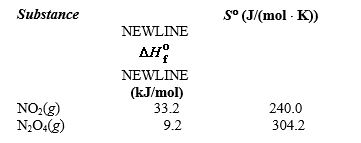
The entropy change in a system (Ssys) during a spontaneous process must be ________
(Multiple Choice)
4.8/5 (69)
(69) Determine the normal melting point of benzoic acid in degrees centigrade given the following data:  18.02 kJ/mol
 45.56 J/mol K
18.02 kJ/mol 45.56 J/mol K (Short Answer)
4.9/5 (69)
(69) For the following endothermic reaction, predict under which conditions the reaction will be spontaneous. 
(Multiple Choice)
4.8/5 (82)
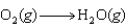
(82) Using the thermodynamic data below, determine the equilibrium constant for the conversion of hydrogen and oxygen to water at 500 K. 

 Compound
 (kJ/mol) S [J/(mol K)]
H2 (g)
0)0
130)6
O2 (g)
0)0
205)0
H2O (g)241.8
188)8
Compound (kJ/mol) S [J/(mol K)]
H2 (g)
0)0
130)6
O2 (g)
0)0
205)0
H2O (g)241.8
188)8 (Multiple Choice)
5.0/5 (71)
(71)  Given
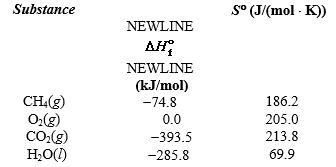
A sketch of the free energy for a hypothetical chemical equilibrium is shown here. What part of the plot on the axis representing the relative quantities of reactants and products corresponds to a value of G that is greater than zero? 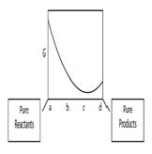
(Multiple Choice)
4.8/5 (76)
(76) The standard molar entropy of silver chloride (AgCl) is 96.2 J/(mol K). What is the entropy of 1.78 g of AgCl?
(Multiple Choice)
4.8/5 (80)
(80) During a spontaneous chemical reaction, it is found that Ssys 0. This means ________
(Multiple Choice)
4.9/5 (97)
(97) What is the overall standard free-energy change for the following two reactions? 
 G1

 G2
G1 G2 (Multiple Choice)
4.7/5 (75)
(75) Which statement characterizes the following table? Temperature Dependence of Reaction Spontaneity 
(Multiple Choice)
5.0/5 (84)
(84) Calculate the equilibrium constant at 500 K for the following reaction given the data below. 

 K c (298 K) 6.1 105
 (NH3, g) 16.5 kJ/mol
 (NH3, g) 46.1 kJ/mol
K c (298 K) 6.1 105 (NH3, g) 16.5 kJ/mol (NH3, g) 46.1 kJ/mol (Multiple Choice)
4.9/5 (79)
(79) For a particular hypothetical reaction,  , the value of G is 125 kJ/mol. What is the value of G for this reaction at 35C when [A] 0.10 M, [B] 0.05 M, and [C] 2.0 101 M ?
 (Multiple Choice)
4.9/5 (83)
(83) The heat of fusion for water is 333.6 J/g. What is the entropy change for the universe when 1.00 L of water at 0C freezes at 5C? Comment on the sign.
(Essay)
4.8/5 (89)
(89) The entropy of vaporization of water is 109.0 J/mol · K. What is the enthalpy of vaporization of water at its normal boiling point?
(Multiple Choice)
4.8/5 (90)
(90) 
Filters
- Essay(0)
- Multiple Choice(0)
- Short Answer(0)
- True False(0)
- Matching(0)