



 Chat with AI
Exam 14: Chemical Equilibrium: How Much Product Does a Reaction Really Make

Exam 1: Matter and Energy: The Origin of the Universe103 Questions
Exam 2: Atoms, Ions, and Molecules: Matter Starts Here144 Questions
Exam 3: Stoichiometry: Mass, Formulas, and Reactions141 Questions
Exam 4: Solution Chemistry: The Hydrosphere148 Questions
Exam 5: Thermochemistry: Energy Changes in Reactions139 Questions
Exam 6: Properties of Gases: The Air We Breathe164 Questions
Exam 7: A Quantum Model of Atoms: Waves and Particles166 Questions
Exam 8: Chemical Bonds: What Makes a Gas a Greenhouse Gas156 Questions
Exam 9: Molecular Geometry: Shape Determines Function188 Questions
Exam 10: Intermolecular Forces: The Uniqueness of Water165 Questions
Exam 11: Solutions: Properties and Behavior150 Questions
Exam 12: Solids: Crystals, Alloys, and Polymers130 Questions
Exam 13: Chemical Kinetics: Reactions in the Atmosphere155 Questions
Exam 14: Chemical Equilibrium: How Much Product Does a Reaction Really Make111 Questions
Exam 15: Acidbase Equilibria: Proton Transfer in Biological Systems122 Questions
Exam 16: Additional Aqueous Equilibria: Chemistry and the Oceans127 Questions
Exam 17: Thermodynamics: Spontaneous and Nonspontaneous Reactions and Processes186 Questions
Exam 18: Electrochemistry: The Quest for Clean Energy167 Questions
Exam 19: Nuclear Chemistry: Applications to Energy and Medicine165 Questions
Exam 20: Organic and Biological Molecules: the Compounds of Life168 Questions
Exam 21: The Main Group Elements: Life and the Periodic Table96 Questions
Exam 22: Transition Metals: Biological and Medical Applications142 Questions
Select questions type


Calculate K for the following reaction, provided the concentration versus time graph shown below. 3A  B 2C
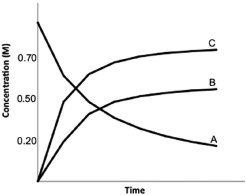
B 2C (Multiple Choice)
4.8/5  (88)
(88) A chemical equilibrium may be established by starting a reaction with ________
(Multiple Choice)
4.7/5 (82)
(82) The equilibrium constant for the formation of hydrogen iodide from hydrogen and iodine is 45.0 at a certain temperature. H2(g) I2(s)  2 HI(g)
Which of the following is true regarding this equilibrium?
I.The reaction is product-favored.
II.The reaction is reactant-favored.
III.Equilibrium lies to the right.
IV.Equilibrium lies to the left.
2 HI(g)
Which of the following is true regarding this equilibrium?
I.The reaction is product-favored.
II.The reaction is reactant-favored.
III.Equilibrium lies to the right.
IV.Equilibrium lies to the left. (Multiple Choice)
4.9/5 (71)
(71) Chemical equilibrium arises from the ________ of chemical reactions and is reached when the ________ of the forward reaction is equal to the ________ of the reverse reaction.
(Short Answer)
4.9/5 (77)
(77) A chemical equilibrium A  3B
Has a forward rate constant, s1 5 M 1s1, and a reverse rate constant, M 2s1 0.5 s1. What is the value of the equilibrium constant for this system?
3B
Has a forward rate constant, s1 5 M 1s1, and a reverse rate constant, M 2s1 0.5 s1. What is the value of the equilibrium constant for this system? (Multiple Choice)
4.8/5 (95)
(95) For the following hypothetical equilibrium, what is the value of the equilibrium constant if the concentrations at equilibrium are as shown? A 2 B  C
[A] 4.5 105 M
[B] 2.2 102 M
[C] 9.4 103 M
C
[A] 4.5 105 M
[B] 2.2 102 M
[C] 9.4 103 M (Multiple Choice)
4.9/5 (92)
(92) The equilibrium constant for the acid ionization of mercaptoethanol (HSCH2CH2OH ) is 1.91 1010. HSCH2CH2OH(aq)  H(aq) SCH2CH2OH(aq)
Which of the following is true regarding this equilibrium?
I.The reaction is product-favored.
II.The reaction is reactant-favored.
III.Equilibrium lies far to the right.
IV.Equilibrium lies far to the left.
H(aq) SCH2CH2OH(aq)
Which of the following is true regarding this equilibrium?
I.The reaction is product-favored.
II.The reaction is reactant-favored.
III.Equilibrium lies far to the right.
IV.Equilibrium lies far to the left. (Multiple Choice)
4.8/5 (81)
(81) Which of the following is true for a chemical reaction at equilibrium?
(Multiple Choice)
4.8/5 (77)
(77) The equilibrium constants for the two reactions are known:
Mm 4L  [ML4]m4 Ka
HL
 H L Kb
What must be the value of the equilibrium constant, Koverall, for the following overall reaction?,
Mm 4HL
 [ML4]m4 4H Koverall
[ML4]m4 Ka
HL H L Kb
What must be the value of the equilibrium constant, Koverall, for the following overall reaction?,
Mm 4HL [ML4]m4 4H Koverall (Short Answer)
4.7/5 (89)
(89) To solve an equation of the form  for values of x, use ________
 (Multiple Choice)
4.8/5 (60)
(60) In a reversible reaction A  B at a particular temperature, the rate constant for the reverse reaction is 4 times the rate constant for the forward reaction. What is the value of the equilibrium constant at that temperature?
 (Multiple Choice)
4.9/5 (80)
(80) A decrease in the number of moles of gas as the reaction goes from reactants to products in a gas-phase equilibrium results in ________
(Multiple Choice)
4.9/5 (77)
(77) Addition of reactants to a chemical reaction in solution or gas phase at equilibrium results in ________
(Multiple Choice)
4.9/5 (86)
(86) A 10.0 L flask at 500 K is filled with 0.30 mol of hydrogen and 0.30 mol of iodine. They react as indicated below. The equilibrium constant Kc 45.0. What are the equilibrium concentrations of the three gases? H2(g) I2(g)  2HI(g)
 (Multiple Choice)
4.8/5 (71)
(71) In a reversible reaction A  B at a particular temperature, the rate constant for the reverse reaction is twice the rate constant for the forward reaction. At equilibrium, how are the concentrations of A and B related?
 (Multiple Choice)
4.9/5 (81)
(81) Which expression corresponds to the equilibrium constant Kc for the reaction written as 2NH3(g) 2O2(g)  N2O(g) 3H2O2(g)
 (Multiple Choice)
5.0/5 (73)
(73) Given the following reactions and associated equilibrium constants 
 2NO(g) K1 1.70 1013

 NO2(g)
K2 6.83 106
What is the equilibrium constant for the following reaction?
2N2O(g) 3O2(g)
 4NO2(g) Knew ?
2NO(g) K1 1.70 1013 NO2(g)
K2 6.83 106
What is the equilibrium constant for the following reaction?
2N2O(g) 3O2(g) 4NO2(g) Knew ? (Multiple Choice)
4.7/5 (83)
(83) Calculate K for the following reaction, provided the concentration versus time graph shown below.
2A  2B 3C
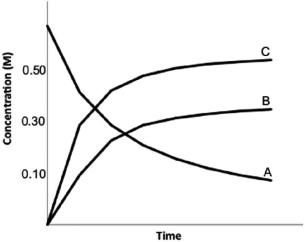
2B 3C (Short Answer)
4.9/5 (73)
(73) Which one of the following is the equilibrium expression, KP, for the reaction that produces lime, CaO, from limestone, CaCO3? CaCO3(s)  CaO(s) CO2(g)
 (Multiple Choice)
4.7/5 (71)
(71) Given the reaction below, which of the following would cause an increase in the concentration of products? 4NH3(g) 3O2(g)  2N2(g) 6H2O(g)
I. addition of water
II. removal of ammonia
III. decrease of the volume of the container
IV. addition of oxygen
2N2(g) 6H2O(g)
I. addition of water
II. removal of ammonia
III. decrease of the volume of the container
IV. addition of oxygen (Multiple Choice)
4.7/5 (74)
(74) 
Filters
- Essay(0)
- Multiple Choice(0)
- Short Answer(0)
- True False(0)
- Matching(0)