



 Chat with AI
Exam 14: Chemical Equilibrium: How Much Product Does a Reaction Really Make

Exam 1: Matter and Energy: The Origin of the Universe103 Questions
Exam 2: Atoms, Ions, and Molecules: Matter Starts Here144 Questions
Exam 3: Stoichiometry: Mass, Formulas, and Reactions141 Questions
Exam 4: Solution Chemistry: The Hydrosphere148 Questions
Exam 5: Thermochemistry: Energy Changes in Reactions139 Questions
Exam 6: Properties of Gases: The Air We Breathe164 Questions
Exam 7: A Quantum Model of Atoms: Waves and Particles166 Questions
Exam 8: Chemical Bonds: What Makes a Gas a Greenhouse Gas156 Questions
Exam 9: Molecular Geometry: Shape Determines Function188 Questions
Exam 10: Intermolecular Forces: The Uniqueness of Water165 Questions
Exam 11: Solutions: Properties and Behavior150 Questions
Exam 12: Solids: Crystals, Alloys, and Polymers130 Questions
Exam 13: Chemical Kinetics: Reactions in the Atmosphere155 Questions
Exam 14: Chemical Equilibrium: How Much Product Does a Reaction Really Make111 Questions
Exam 15: Acidbase Equilibria: Proton Transfer in Biological Systems122 Questions
Exam 16: Additional Aqueous Equilibria: Chemistry and the Oceans127 Questions
Exam 17: Thermodynamics: Spontaneous and Nonspontaneous Reactions and Processes186 Questions
Exam 18: Electrochemistry: The Quest for Clean Energy167 Questions
Exam 19: Nuclear Chemistry: Applications to Energy and Medicine165 Questions
Exam 20: Organic and Biological Molecules: the Compounds of Life168 Questions
Exam 21: The Main Group Elements: Life and the Periodic Table96 Questions
Exam 22: Transition Metals: Biological and Medical Applications142 Questions
Select questions type


A chemical equilibrium 2 A  B
Has a forward rate constant, kf 10 M 1 s1, and a reverse rate constant, kr 5 s1. If the system has a concentration of [A] 0.10 M at equilibrium, what must be the concentration of B at equilibrium?
B
Has a forward rate constant, kf 10 M 1 s1, and a reverse rate constant, kr 5 s1. If the system has a concentration of [A] 0.10 M at equilibrium, what must be the concentration of B at equilibrium? (Multiple Choice)
4.9/5  (84)
(84) A chemical equilibrium 2 A  B
Has a forward rate constant, kf 10 M 1s1, and a reverse rate constant, kr 5.0 s1. What is the value of the equilibrium constant for this system?
B
Has a forward rate constant, kf 10 M 1s1, and a reverse rate constant, kr 5.0 s1. What is the value of the equilibrium constant for this system? (Multiple Choice)
4.8/5 (80)
(80) For the following reaction, Kc = 0.500 at 300K. What is the value of Kp? 2A(g) B(g)  2C(g) D(g)
 (Multiple Choice)
4.7/5 (74)
(74) In the following reaction, calculate Q, given the concentrations of each species, and predict what must occur (if anything) for the reaction to achieve equilibrium.
N2(g) 3H2(g)  2NH3(g) K 9.60
[N2] [H2] 0.100 M and [NH3] 0.352 M
2NH3(g) K 9.60
[N2] [H2] 0.100 M and [NH3] 0.352 M (Essay)
4.9/5 (95)
(95) For a chemical reaction at equilibrium, which of the following will change the value of the equilibrium constant K?
I.changing the temperature
II.changing the total concentration of reactants and products
III.changing the reaction coefficients
(Multiple Choice)
4.7/5 (80)
(80) Addition of products to a chemical reaction in solution or gas phase at equilibrium results in ________
(Multiple Choice)
4.9/5 (83)
(83) Sulfur dioxide, gaseous water, and oxygen gas react to prepare sulfuric acid in the following unbalanced equation. 

 Under equilibrium conditions, the partial pressures of the components are PSO2 0.1 atm, PH2O 0.05 atm, PO2 0.25 atm, PH2SO4 2.75 atm.
What is the value of the equilibrium constant, Kp, for the reaction?
Under equilibrium conditions, the partial pressures of the components are PSO2 0.1 atm, PH2O 0.05 atm, PO2 0.25 atm, PH2SO4 2.75 atm.
What is the value of the equilibrium constant, Kp, for the reaction? (Multiple Choice)
4.7/5 (87)
(87) Two students measured an equilibrium constant for the same chemical reaction. Ken obtained a value of 130 for the equilibrium constant, but Barbie obtained a value of 11.4. The instructor checked their results and said they were both correct. How can that be?
(Multiple Choice)
4.7/5 (92)
(92) In a simple equilibrium A B  C, will there be any stress to the system if both B and C are added to the equilibrium system simultaneously and in the same amount?
 (Multiple Choice)
4.8/5 (80)
(80) In the Reaction, Initial, Change, Equilibrium (RICE) table started for calculating equilibrium concentrations of the reaction shown, the terms in the "change" row are ________ 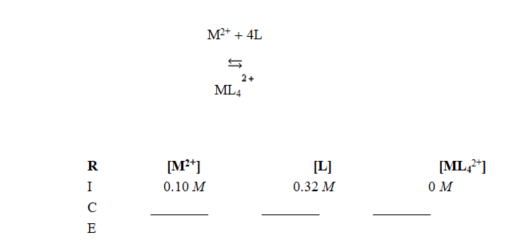
(Multiple Choice)
4.8/5 (83)
(83) For an equilibrium reaction with K 1.2 108, the forward rate constant was found to be 3.5 105. What is the value of the reverse rate constant?
(Multiple Choice)
4.7/5 (79)
(79) Students often write expressions for the equilibrium constant Kc and reaction quotient Qc in exactly the same way. To avoid confusion, you must remember that Kc uses concentrations under ________ conditions, while Qc uses concentrations under ________ conditions.
(Short Answer)
4.9/5 (83)
(83) Which of the following occurs when products are removed from a chemical reaction in solution or the gas phase at equilibrium?
(Multiple Choice)
4.8/5 (80)
(80) For an equilibrium reaction with K 4.3 103, the reverse rate constant was found to be 2.1 102. What is the value of the forward rate constant?
(Multiple Choice)
4.9/5 (90)
(90) The reaction of nitrogen gas with oxygen gas, shown here, has a Kp value of 0.25. If a closed vessel was charged with the two reactants, each at an initial partial pressure of 0.250 atm, what would be the equilibrium partial pressure of NO(g)? N2(g) O2(g)  2NO(g)
 (Multiple Choice)
4.9/5 (68)
(68) Which of the following is true for a chemical reaction at equilibrium regarding the concentration of products?
(Multiple Choice)
4.8/5 (85)
(85) Cylinders of NO gas may contain small quantities of oxygen as an impurity, leading to the formation of NO2 in equilibrium with the NO and the oxygen. Is this contamination by NO2 dependent on the pressure in the tank?
(Multiple Choice)
4.8/5 (71)
(71) 
Filters
- Essay(0)
- Multiple Choice(0)
- Short Answer(0)
- True False(0)
- Matching(0)