



 Chat with AI
Exam 16: Additional Aqueous Equilibria: Chemistry and the Oceans

Exam 1: Matter and Energy: The Origin of the Universe103 Questions
Exam 2: Atoms, Ions, and Molecules: Matter Starts Here144 Questions
Exam 3: Stoichiometry: Mass, Formulas, and Reactions141 Questions
Exam 4: Solution Chemistry: The Hydrosphere148 Questions
Exam 5: Thermochemistry: Energy Changes in Reactions139 Questions
Exam 6: Properties of Gases: The Air We Breathe164 Questions
Exam 7: A Quantum Model of Atoms: Waves and Particles166 Questions
Exam 8: Chemical Bonds: What Makes a Gas a Greenhouse Gas156 Questions
Exam 9: Molecular Geometry: Shape Determines Function188 Questions
Exam 10: Intermolecular Forces: The Uniqueness of Water165 Questions
Exam 11: Solutions: Properties and Behavior150 Questions
Exam 12: Solids: Crystals, Alloys, and Polymers130 Questions
Exam 13: Chemical Kinetics: Reactions in the Atmosphere155 Questions
Exam 14: Chemical Equilibrium: How Much Product Does a Reaction Really Make111 Questions
Exam 15: Acidbase Equilibria: Proton Transfer in Biological Systems122 Questions
Exam 16: Additional Aqueous Equilibria: Chemistry and the Oceans127 Questions
Exam 17: Thermodynamics: Spontaneous and Nonspontaneous Reactions and Processes186 Questions
Exam 18: Electrochemistry: The Quest for Clean Energy167 Questions
Exam 19: Nuclear Chemistry: Applications to Energy and Medicine165 Questions
Exam 20: Organic and Biological Molecules: the Compounds of Life168 Questions
Exam 21: The Main Group Elements: Life and the Periodic Table96 Questions
Exam 22: Transition Metals: Biological and Medical Applications142 Questions
Select questions type


The bonds between the zinc ion and the nitrogen atoms in the complex Zn(NH3)42 are best described as ________
(Multiple Choice)
4.9/5  (65)
(65) To simulate the pH of blood, which is 7.4, an undergraduate researcher in a biology lab produced a buffer solution by dissolving sodium dihydrogen phosphate (Ka 6.2 108) and disodium hydrogen phosphate (Ka 3.6 1013) together in an aqueous solution. What mole ratio of Na2HPO4/NaH2PO4 did she need to use?
(Short Answer)
4.8/5 (76)
(76) Given the following titration curves, provide a potential reaction that describes each titration.
a) 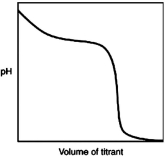 b)
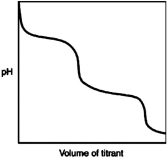
b) (Essay)
4.8/5 (84)
(84) Describe the similarities and differences between a covalent bond and a coordinate covalent bond.
(Essay)
4.7/5 (78)
(78) The pKa of a weak acid was determined to be 3.39 by measuring the pH of a solution containing the weak acid at 0.20 M and its conjugate base. The measured pH was 3.27. What was the concentration of the conjugate base?
(Multiple Choice)
4.8/5 (76)
(76) Explain how a buffer solution manages to stabilize the pH against the addition of acid, base, or additional solvent (dilution).
(Essay)
4.9/5 (84)
(84) Glycolic acid, which is a monoprotic acid and a constituent in sugar cane, has a pKa of 3.9. A 25.0 mL solution of glycolic acid is titrated to the equivalence point with 35.8 mL of 0.020 M sodium hydroxide solution. What is the pH of the resulting solution at the equivalence point?
(Short Answer)
4.8/5 (85)
(85) Phenylephrine (PE, see the structure below) is a nasal decongestant and is the active ingredient in Sudafed, which contains phenylephrine hydrochloride (PEHCl). This conjugate acid of phenylephrine (PEH) has a pKa 5.5. At a physiological pH of 7.4, what is the ratio of concentrations, [PE]/[PEH]? 
(Multiple Choice)
4.8/5 (88)
(88) A solution of hydrofluoric acid (0.27 M, 10.00 mL) was titrated with 15.0 mL of 0.13 M sodium hydroxide (Ka of hydrofluoric acid 7.20 104). What is the final pH of this solution?
(Multiple Choice)
4.7/5 (87)
(87) What is the molar concentration of Ag(aq) in a 1.00 M solution of Ag(NH3)2 with no excess ammonia? Given: Kf 1.70 107 for Ag (NH3)2.
(Multiple Choice)
4.8/5 (87)
(87) 
A solution of benzoic acid (0.21 M, 25.00 mL), a monoprotic acid, was titrated with 53.10 mL of 0.10 M sodium hydroxide (Ka of benzoic acid 6.46 105). What is the final pH of this solution?
(Short Answer)
4.8/5 (84)
(84) When an acetic acid solution is titrated with sodium hydroxide, the slope of the titration curve (pH versus volume of NaOH added) increases when sodium hydroxide is first added. This change shows that ________
(Multiple Choice)
4.8/5 (80)
(80) Derive the Henderson-Hasselbalch equation from the acid ionization constant expression.
(Essay)
4.8/5 (63)
(63) The solubility of PbI2 is 0.756 g per 100 mL of solution at 20C. Determine the value of the solubility product constant for this compound at 20C. Lead(II) iodide does not react with water.
(Multiple Choice)
4.7/5 (67)
(67) A buffer system is set up with [HA] 2[A]. If pKa 5.5, what is the pH of the buffer?
(Multiple Choice)
4.8/5 (85)
(85) Aqueous solutions of many metal cations have a pH different from 7. Which one of the following statements about these cations is not correct?
(Multiple Choice)
4.8/5 (95)
(95) A solution of hydrochloric acid (HCl, 25.00 mL) was titrated to completion with 34.55 mL of 0.1020 M sodium hydroxide. What was the concentration of the hydrochloric acid?
(Multiple Choice)
4.8/5 (85)
(85) Write the reaction equation and the equilibrium constant expression that describes lead chloride (PbCl2) dissolving in water.
(Essay)
4.8/5 (79)
(79) 
Filters
- Essay(0)
- Multiple Choice(0)
- Short Answer(0)
- True False(0)
- Matching(0)