



 Chat with AI
Exam 25: World War I and Its Aftermath, 1914-1929

Exam 1: Early Western Civilization, 400,000-1000 B.C.E65 Questions
Exam 2: Near East Empires and the Reemergence of Civilization in Greece, 1000-500 B.C.E64 Questions
Exam 3: The Greek Golden Age, C 500-C 400 B.C.E65 Questions
Exam 4: From the Classical to the Hellenistic World, 400-30 B.C.E65 Questions
Exam 5: The Rise of Rome and Its Republic, 753-44 B.C.E64 Questions
Exam 6: The Creation of the Roman Empire, 44 B.C.E-284 C.E65 Questions
Exam 7: The Transformation of the Roman Empire, 284-600 C.E64 Questions
Exam 8: The Heirs of Rome: Islam, Byzantium, and Europe, 600-75065 Questions
Exam 9: From Centralization to Fragmentation, 750-105065 Questions
Exam 10: Commercial Quickening and Religious Reform, 1050-115065 Questions
Exam 11: The Flowering of the Middle Ages, 1150-121565 Questions
Exam 12: The Medieval Synthesis and Its Cracks, 1215-134065 Questions
Exam 13: Crisis and Renaissance, 1340-149265 Questions
Exam 14: Global Encounters and the Shock of the Reformation, 1492-156065 Questions
Exam 15: Wars of Religion and the Clash of Worldviews, 1560-164865 Questions
Exam 16: Absolutism, Constitutionalism, and the Search for Order, 1640-170065 Questions
Exam 17: The Atlantic System and Its Consequences, 1700-175065 Questions
Exam 18: The Promise of Enlightenment, 1750-178965 Questions
Exam 19: The Cataclysm of Revolution, 1789-179965 Questions
Exam 20: Napoleon and the Revolutionary Legacy, 1800-183065 Questions
Exam 21: Industrialization and Social Ferment, 1830-185064 Questions
Exam 22: Politics and Culture of the Nation-State, 1850-187065 Questions
Exam 23: Empire, Industry, and Everyday Life, 1870-189065 Questions
Exam 24: Modernity and the Road to War, 1890-191465 Questions
Exam 25: World War I and Its Aftermath, 1914-192965 Questions
Exam 26: The Great Depression and World War II, 1929-194565 Questions
Exam 27: The Cold War and the Remaking of Europe, 1945-1960s64 Questions
Exam 28: Postindustrial Society and the End of the Cold War Order, 1960s-198965 Questions
Exam 29: A New Globalism, 1989 to the Present65 Questions
Select questions type


In many European countries, women were "rewarded" for their efforts in World War I with which of the following new rights?
(Multiple Choice)
4.9/5  (87)
(87) Which of the following statements regarding World War I is supported by this map?
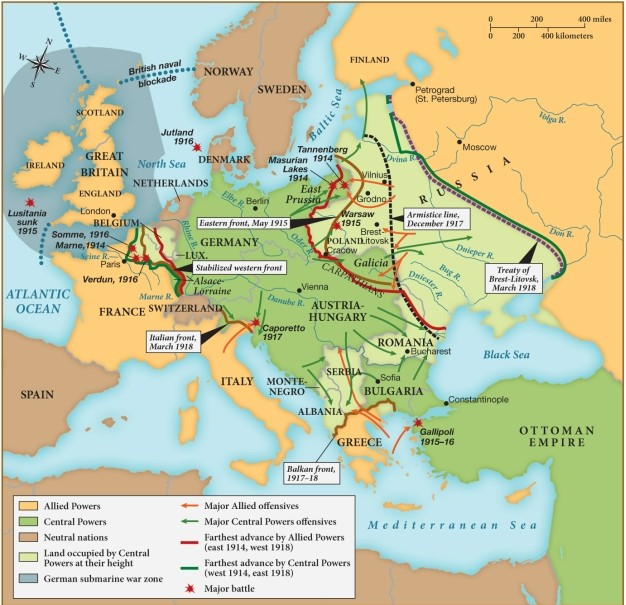
(Multiple Choice)
4.9/5 (85)
(85) Which of the following best describes the new republics of eastern Europe during the 1920s?
(Multiple Choice)
4.8/5 (77)
(77) Although women's work was necessary to the war effort in virtually every European country, many people opposed it. Why?
(Essay)
4.8/5 (90)
(90) What changes did Lenin and the Bolshevik government institute in Russia after the Bolshevik Revolution in the fall of 1917?
(Multiple Choice)
4.9/5 (64)
(64) Why did Russia's Provisional Government lose popular support?
(Multiple Choice)
4.9/5 (89)
(89) Which of the following countries was an original member of the League of Nations?
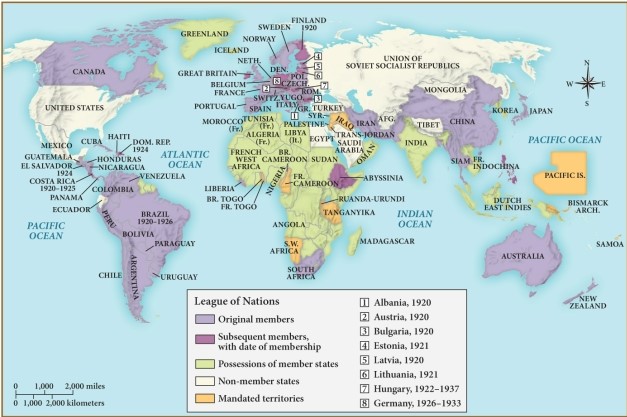
(Multiple Choice)
4.7/5 (81)
(81) Explain how the efforts of France and Belgium to secure reparations by seizing the Ruhr basin in 1923 led to the virtual economic collapse of Germany.
(Essay)
4.9/5 (76)
(76) The Treaty of Brest-Litovsk, signed by Germany and Russia early in 1918,
(Multiple Choice)
4.8/5 (71)
(71) Which country initially sided with the Central Powers but ended up joining the Allies in 1915 in hopes of postwar gain?
(Multiple Choice)
4.9/5 (94)
(94) How did Lenin's New Economic Policy (NEP) break with his war communism policy?
(Multiple Choice)
4.9/5 (83)
(83) In 1921, after three years of fighting Irish republicans, the British drew up a treaty that
(Multiple Choice)
4.7/5 (78)
(78) The Italian Fascist movement led by Benito Mussolini (1883-1945) placed its greatest emphasis on which of the following principles?
(Multiple Choice)
4.8/5 (72)
(72) What do historians mean when they refer to a war as a "total war"? How was World War I a total war? What would a total war look like today? In your opinion, would such a war be possible? Explain why or why not.
(Essay)
4.9/5 (77)
(77) What techniques did soldiers in the trenches adopt to manage the extreme conditions and miseries of prolonged trench warfare?
(Multiple Choice)
4.7/5 (91)
(91) Which of the following was true of post-World War I European economies?
(Multiple Choice)
5.0/5 (68)
(68) Describe the various ways in which Europeans expressed both their rage and frustration with the war, which they saw as the failure of European civilization, and the sense of optimism and idea of postwar utopia that existed in the 1920s. In your answer, be sure to consider artistic, social, and political responses to these dual impulses.
(Essay)
4.7/5 (74)
(74) At the outbreak of World War I, France, Great Britain, and which other country made up the Allied Powers?
(Multiple Choice)
4.9/5 (77)
(77) What was the major tactical strategy at the heart of the German military's Schlieffen Plan?
(Multiple Choice)
4.8/5 (76)
(76) 
Filters
- Essay(0)
- Multiple Choice(0)
- Short Answer(0)
- True False(0)
- Matching(0)