



 Chat with AI
Exam 25: World War I and Its Aftermath, 1914-1929


How did Lenin and the Bolsheviks use discontent in Russia to their advantage? Why were they able to overcome "White" resistance to their revolution?

 (86)
 Verified
Answer would ideally include the following. After taking power, the Provisional Government had to compete with several different groups for political support, including the soviets, which had the strength of the workers and soldiers behind them. The Provisional Government was not able to succeed in winning victories on the battlefield or in controlling the peasants, who were devastating the food supply by withholding produce to protest the lack of consumer goods in Russia, so the Bolsheviks were able to take advantage of a weakened government. Once Lenin and the Bolshevik leaders arrived in Russia in April 1917, they called for the soviets to overthrow the Provisional Government, drawing on popular discontent to gather support for their coup. In the first elections after the revolution, however, the Bolsheviks failed to gain a plurality of seats in the constituent assembly, and they turned to force to enact their policies. The Russian civil war pitted the Bolshevik forces (the "Reds") against an array of antirevolutionary groups (the "Whites"). The counterrevolutionary movement lacked a strong leader and unified goals, however, and was too diverse to be effective. These disparate groups joined together with non-Russian nationalities who had been forced to join the Russian Empire through force and Russification and who mainly fought the Bolsheviks because they saw it as a chance to gain independence. The Bolsheviks were able to draw on anti-aristocratic discontent within the Russian population to rally the Reds against the White forces.
How did European governments mobilize the home front to sustain the war effort during World War I? How did wartime conditions affect the political, economic, and social landscape of European societies? What consequences did these conditions have on postwar society?
(88) VerifiedAnswer would ideally include the following. World War I was a total war because entire societies, not just military forces, were mobilized to fight it. Because so many men had been mobilized on the front lines, European governments enlisted women to take their place in industrial factories. In general, the government took control of nearly every aspect of civilian life, regulating not only labor and consumer goods but also transportation, and even people's opinions. At the beginning of the war there was little dissent, and most political parties put aside their differences to support the patriotic fervor that had swept through Europe, but it was not long before criticism of the war began to emerge. To maintain support and morale, governments across Europe passed sedition laws that made it a crime to criticize wartime policies. To ensure civilian acceptance of longer working hours and shortages of consumer goods, governments created propaganda agencies to advertise the war as a patriotic mission against villainous enemies. In the spring of 1917, as casualties continued to mount and living conditions deteriorated on the home front throughout Europe, civilians revolted against the war, and in cities in Italy, Russia, Germany, and Austria, women rioted to get food for their families. In the end, despite laws against sedition, governments could only go so far to suppress dissent. The economic mobilization of civilians in industry was the key aspect of the home front's participation in the war effort. Governments took control of industrial production of war-related items, including armaments such as shells, machine guns, poison gas, bombs, airplanes, and eventually tanks. They drafted women as laborers, and governments used allocated and forced labor, often of colonial subjects. Governments also gave industrialists financial incentives to encourage productivity and, in some cases, allowed businesses a high rate of profit, which made the cost of living surge and contributed to social tensions. Governments took almost complete control of national economies, suspending liberal policies of free trade, which under normal circumstances would evoke enormous protest but under war conditions was deemed completely acceptable. One of the most visible changes to the social sphere was the reshaping of gender roles due to the mobilization of women on the home front. No longer confined to the domestic sphere, or even to feminized jobs, women took over what had traditionally been men's jobs. Suddenly factories were filled with women workers, and women drove trucks and streetcars and even were visible on the front lines, driving ambulances and nursing the wounded. Although some praised women for their patriotism, their assumption of men's jobs looked to others like a sign of social disorder. Many claimed that women were losing their femininity, and men feared that women would remain in men's jobs after the war and refuse to return to the domestic sphere, robbing men of their roles as breadwinners. Indeed, after the war, many women did expect to participate more fully in society and resented the need to return to a prewar gender order, a fact that made veterans' return home more complex. The consequences of the home front mobilization began to appear as soon as the war ended and were especially evident in the uneasy return of veterans to postwar society. Many European countries faced massive unrest in the immediate postwar period, and four governments had collapsed as a result of the war. The return to civilian life was difficult for soldiers, many of whom faced skyrocketing unemployment and resented civilians who had protested wartime conditions instead of just patriotically enduring them. Returning soldiers had come to expect that conditions after the war would be fairer, particularly as class divisions had broken down in the trenches, but those expectations were often disappointed by the reality of postwar life. One of the major shocks was the shift in gender roles and women's behavior, as women now worked in men's jobs, cut their hair short, dressed in sleeker clothes, smoked, and lived independently of men. Women had also been rewarded for their war work in many cases (the exceptions being France and Italy) by being granted the right to vote. Veterans and women felt alienated from one another, as veterans struggled to integrate themselves back into civilian life. In Germany and Italy, those who could not reintegrate often joined paramilitary bands like the Freikorps who roamed the streets in search of violence, mostly aimed at left-wing groups. These ex-soldiers were among the first to join the Fascist and Nazi movements.
Although the combatants in the Great War had individual objectives, in the end they all had which common aim?
(95) VerifiedA
The abdication of Tsar Nicholas II in March 1917 and the collapse of the Romanov dynasty in Russia led to
(76) Why did right-wing parties have less influence in France and Britain than elsewhere in Europe?
(83) In his last will and testament, Lenin asked his comrades to find a way to remove which Communist Party leader from power?
(69) Which of the following is an example of how European governments mobilized civilians on the home front to help fight World War I?
(79) How did the horrific nature of fighting in the Great War create bonds of camaraderie between soldiers (and even between enemies), while at the same time creating alienation from civilians back home?
(79) According to this map, which of the following countries was negatively impacted by the peace settlements reached after World War I in terms of territorial control?
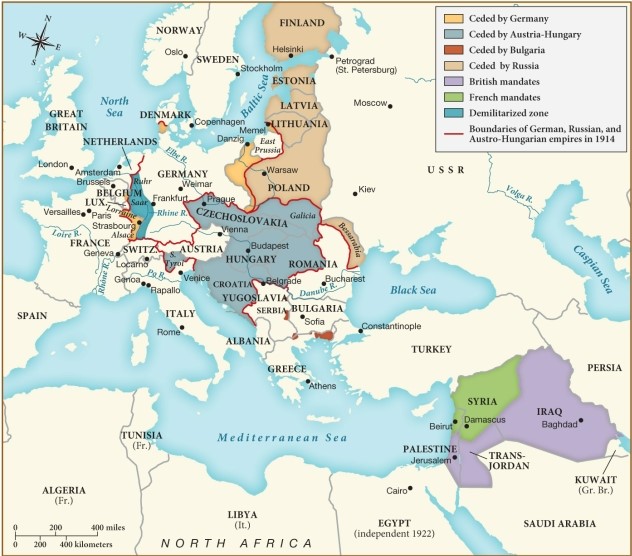
(86) Future German leader Adolf Hitler first gained attention in Germany for what political event?
(70) In an effort to spur postwar economic recovery in the 1920s, many businesses turned to efficiency experts to increase productivity. How did their recommendations both threaten to worsen the lives of workers and promise to improve them?
(99) What major issue challenged the stability of the Weimar Republic from the beginning?
(82) The recreation of Poland after World War I, as evidenced by this map, brought with it
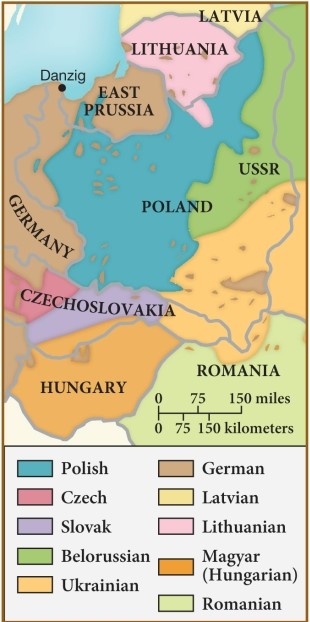
(87) U.S. president Woodrow Wilson's Fourteen Points called for
(101) Following the official end of hostilities on November 11, 1918, the world experienced another devastating blow with the death of some one hundred million more people as a result of
(74) 
Filters
- Essay(0)
- Multiple Choice(0)
- Short Answer(0)
- True False(0)
- Matching(0)