



 Chat with AI
Exam 21: Industrialization and Social Ferment, 1830-1850

Exam 1: Early Western Civilization, 400,000-1000 B.C.E65 Questions
Exam 2: Near East Empires and the Reemergence of Civilization in Greece, 1000-500 B.C.E64 Questions
Exam 3: The Greek Golden Age, C 500-C 400 B.C.E65 Questions
Exam 4: From the Classical to the Hellenistic World, 400-30 B.C.E65 Questions
Exam 5: The Rise of Rome and Its Republic, 753-44 B.C.E64 Questions
Exam 6: The Creation of the Roman Empire, 44 B.C.E-284 C.E65 Questions
Exam 7: The Transformation of the Roman Empire, 284-600 C.E64 Questions
Exam 8: The Heirs of Rome: Islam, Byzantium, and Europe, 600-75065 Questions
Exam 9: From Centralization to Fragmentation, 750-105065 Questions
Exam 10: Commercial Quickening and Religious Reform, 1050-115065 Questions
Exam 11: The Flowering of the Middle Ages, 1150-121565 Questions
Exam 12: The Medieval Synthesis and Its Cracks, 1215-134065 Questions
Exam 13: Crisis and Renaissance, 1340-149265 Questions
Exam 14: Global Encounters and the Shock of the Reformation, 1492-156065 Questions
Exam 15: Wars of Religion and the Clash of Worldviews, 1560-164865 Questions
Exam 16: Absolutism, Constitutionalism, and the Search for Order, 1640-170065 Questions
Exam 17: The Atlantic System and Its Consequences, 1700-175065 Questions
Exam 18: The Promise of Enlightenment, 1750-178965 Questions
Exam 19: The Cataclysm of Revolution, 1789-179965 Questions
Exam 20: Napoleon and the Revolutionary Legacy, 1800-183065 Questions
Exam 21: Industrialization and Social Ferment, 1830-185064 Questions
Exam 22: Politics and Culture of the Nation-State, 1850-187065 Questions
Exam 23: Empire, Industry, and Everyday Life, 1870-189065 Questions
Exam 24: Modernity and the Road to War, 1890-191465 Questions
Exam 25: World War I and Its Aftermath, 1914-192965 Questions
Exam 26: The Great Depression and World War II, 1929-194565 Questions
Exam 27: The Cold War and the Remaking of Europe, 1945-1960s64 Questions
Exam 28: Postindustrial Society and the End of the Cold War Order, 1960s-198965 Questions
Exam 29: A New Globalism, 1989 to the Present65 Questions
Select questions type


After the revolutions of 1848, political power across most of Europe belonged to which of the following?

Free
(Multiple Choice)
4.9/5  (102)
(102) Correct Answer: Verified
C
Which of the following factors contributed to the emergence of England as the first site of the Industrial Revolution?
Free
(Multiple Choice)
4.8/5 (76)
(76) Correct Answer:Verified
VerifiedA
Which candidate won the first presidential election after the French revolution of 1848?
Free
(Multiple Choice)
4.8/5 (78)
(78) Correct Answer:Verified
VerifiedD
How did British religious reformers attempt to combat religious indifference among the working classes?
(Multiple Choice)
4.7/5 (66)
(66) The Magyar nationalist Lajos Kossuth, who founded the Protective Association in 1844, was representative of the effort to promote what ideology in eastern Europe?
(Multiple Choice)
4.9/5 (74)
(74) In the early nineteenth century, in what way did peasant households fail to conform to notions of traditional family life?
(Multiple Choice)
4.9/5 (74)
(74) What was Britain's goal in establishing a regular opium trade with China? How did this goal produce conflict with China, and how did the conflict end?
(Essay)
4.8/5 (88)
(88) Pierre-Joseph Proudhon (1809-1865), one of the most influential of the early socialists, argued in What Is Property? that property
(Multiple Choice)
4.8/5 (71)
(71) What nineteenth-century novelist, writing under the male pseudonym George Sand, expressed her social criticism through both her writing and her independent lifestyle?
(Multiple Choice)
4.8/5 (86)
(86) What was the term used for English workers who wrecked machinery and burned mills in order to protest industrialization?
(Multiple Choice)
4.8/5 (74)
(74) What concerns drove middle-class social reformers to form temperance societies throughout Europe and the United States?
(Multiple Choice)
4.7/5 (75)
(75) This map portraying European industrialization in the middle of the nineteenth century indicates a strong geographic connection between
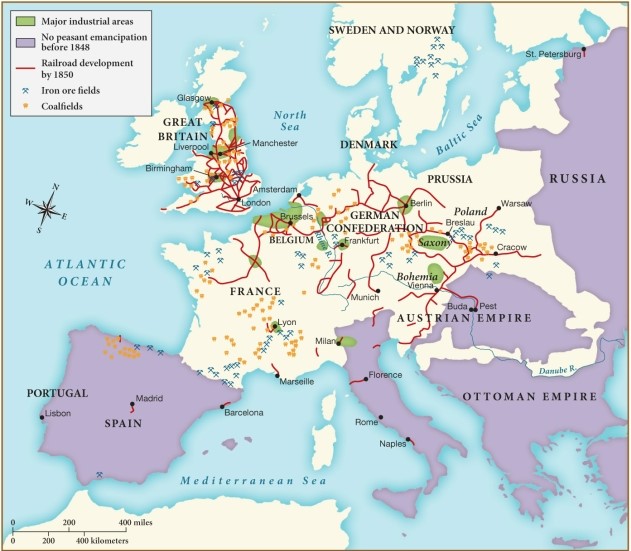
(Multiple Choice)
4.8/5 (64)
(64) What caused the rapid growth of European cities in the early nineteenth century, and how did this affect the poor working classes who lived there?
(Essay)
4.8/5 (79)
(79) How did socialist and communist ideology develop and change from the time of Saint-Simon and Owen in the early nineteenth century to that of Marx and Engels in the mid-nineteenth century?
(Essay)
5.0/5 (81)
(81) In addition to forming worker cooperatives and agricultural communes, Saint-Simonians were known for their outspoken views on
(Multiple Choice)
4.9/5 (74)
(74) In the early nineteenth century, middle-class reformers were extremely concerned with the "social question," or, more specifically, the social changes arising from industrialization and urbanization. What were these changes, and how did the middle classes attempt to address them with social reforms?
(Essay)
4.9/5 (77)
(77) Historians attribute the massive population growth of European cities in the mid-nineteenth century to
(Multiple Choice)
4.9/5 (83)
(83) Between 1800 and 1840, many European countries began to close the industrial gap with Great Britain,
(Multiple Choice)
4.9/5 (62)
(62) The road to German political unification in the nineteenth century began with which of the following?
(Multiple Choice)
4.9/5 (74)
(74) The 1842 Treaty of Nanking forced China to permit a continuation of which of the following?
(Multiple Choice)
4.8/5 (87)
(87) 
Filters
- Essay(0)
- Multiple Choice(0)
- Short Answer(0)
- True False(0)
- Matching(0)