



 Chat with AI
Exam 10: Commercial Quickening and Religious Reform, 1050-1150

Exam 1: Early Western Civilization, 400,000-1000 B.C.E65 Questions
Exam 2: Near East Empires and the Reemergence of Civilization in Greece, 1000-500 B.C.E64 Questions
Exam 3: The Greek Golden Age, C 500-C 400 B.C.E65 Questions
Exam 4: From the Classical to the Hellenistic World, 400-30 B.C.E65 Questions
Exam 5: The Rise of Rome and Its Republic, 753-44 B.C.E64 Questions
Exam 6: The Creation of the Roman Empire, 44 B.C.E-284 C.E65 Questions
Exam 7: The Transformation of the Roman Empire, 284-600 C.E64 Questions
Exam 8: The Heirs of Rome: Islam, Byzantium, and Europe, 600-75065 Questions
Exam 9: From Centralization to Fragmentation, 750-105065 Questions
Exam 10: Commercial Quickening and Religious Reform, 1050-115065 Questions
Exam 11: The Flowering of the Middle Ages, 1150-121565 Questions
Exam 12: The Medieval Synthesis and Its Cracks, 1215-134065 Questions
Exam 13: Crisis and Renaissance, 1340-149265 Questions
Exam 14: Global Encounters and the Shock of the Reformation, 1492-156065 Questions
Exam 15: Wars of Religion and the Clash of Worldviews, 1560-164865 Questions
Exam 16: Absolutism, Constitutionalism, and the Search for Order, 1640-170065 Questions
Exam 17: The Atlantic System and Its Consequences, 1700-175065 Questions
Exam 18: The Promise of Enlightenment, 1750-178965 Questions
Exam 19: The Cataclysm of Revolution, 1789-179965 Questions
Exam 20: Napoleon and the Revolutionary Legacy, 1800-183065 Questions
Exam 21: Industrialization and Social Ferment, 1830-185064 Questions
Exam 22: Politics and Culture of the Nation-State, 1850-187065 Questions
Exam 23: Empire, Industry, and Everyday Life, 1870-189065 Questions
Exam 24: Modernity and the Road to War, 1890-191465 Questions
Exam 25: World War I and Its Aftermath, 1914-192965 Questions
Exam 26: The Great Depression and World War II, 1929-194565 Questions
Exam 27: The Cold War and the Remaking of Europe, 1945-1960s64 Questions
Exam 28: Postindustrial Society and the End of the Cold War Order, 1960s-198965 Questions
Exam 29: A New Globalism, 1989 to the Present65 Questions
Select questions type


The map reproduced here tells us what about the First Crusade (1096-1099)?
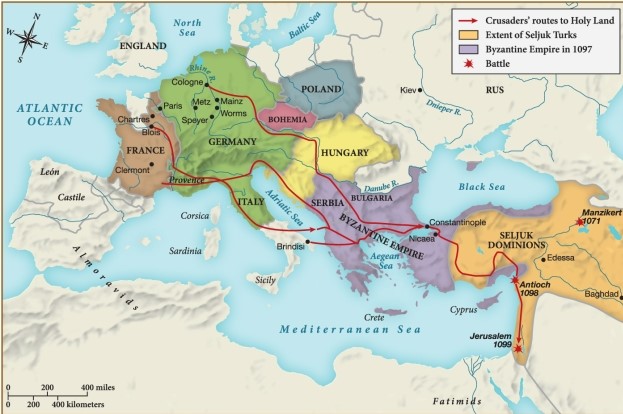

Free
(Multiple Choice)
4.7/5  (75)
(75) Correct Answer: Verified
B
What did the battle of Manzikert (1071) signify?
Free
(Multiple Choice)
4.9/5 (83)
(83) Correct Answer:Verified
VerifiedA
Which of the following was a characteristic of the Concordat of Worms?
Free
(Multiple Choice)
4.8/5 (65)
(65) Correct Answer:Verified
VerifiedC
What was the Concordat of Worms (1122)? What impact did it have on church-state relations in the empire?
(Essay)
4.8/5 (78)
(78) The widespread use of money, corporations, banks, and urban centers that thrived on economic success was characteristic of the
(Multiple Choice)
4.8/5 (76)
(76) Why is the battle of Hastings (1066) referred to as one of history's rare decisive battles?
(Multiple Choice)
4.8/5 (89)
(89) How did the Norman kings organize and administer England after the conquest?
(Essay)
5.0/5 (75)
(75) In northern and central Italy, most long-term business ventures were structured as
(Multiple Choice)
4.8/5 (70)
(70) Explain why townspeople seemed different both to themselves and to outsiders.
(Essay)
4.9/5 (75)
(75) Describe and explain the attack on Jews by members of the First Crusade.
(Essay)
4.8/5 (92)
(92) Why did many church reformers make clerical celibacy a centerpiece of their reforms?
(Multiple Choice)
4.8/5 (81)
(81) The centers of commerce that developed during the commercial revolution tended to grow fastest and most densely
(Multiple Choice)
4.7/5 (72)
(72) Which of the following statements describe William's rule in England?
(Multiple Choice)
4.7/5 (82)
(82) Which of the following statements is supported by this map of the crusader states in 1109?
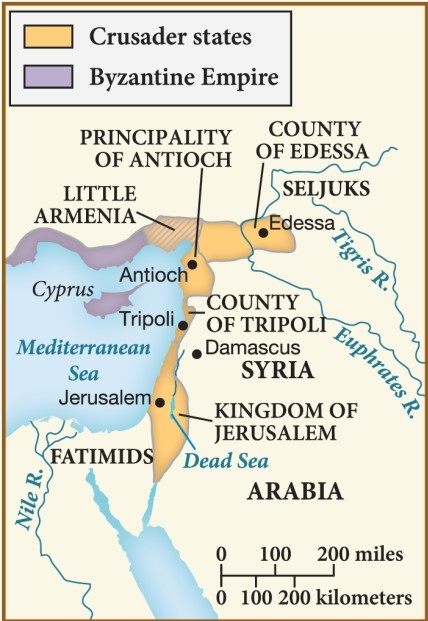
(Multiple Choice)
5.0/5 (90)
(90) What belief drove monastic movements for religious reform in the tenth and eleventh centuries?
(Multiple Choice)
4.9/5 (69)
(69) 
Filters
- Essay(0)
- Multiple Choice(0)
- Short Answer(0)
- True False(0)
- Matching(0)