



 Chat with AI
Exam 11: The Flowering of the Middle Ages, 1150-1215

Exam 1: Early Western Civilization, 400,000-1000 B.C.E65 Questions
Exam 2: Near East Empires and the Reemergence of Civilization in Greece, 1000-500 B.C.E64 Questions
Exam 3: The Greek Golden Age, C 500-C 400 B.C.E65 Questions
Exam 4: From the Classical to the Hellenistic World, 400-30 B.C.E65 Questions
Exam 5: The Rise of Rome and Its Republic, 753-44 B.C.E64 Questions
Exam 6: The Creation of the Roman Empire, 44 B.C.E-284 C.E65 Questions
Exam 7: The Transformation of the Roman Empire, 284-600 C.E64 Questions
Exam 8: The Heirs of Rome: Islam, Byzantium, and Europe, 600-75065 Questions
Exam 9: From Centralization to Fragmentation, 750-105065 Questions
Exam 10: Commercial Quickening and Religious Reform, 1050-115065 Questions
Exam 11: The Flowering of the Middle Ages, 1150-121565 Questions
Exam 12: The Medieval Synthesis and Its Cracks, 1215-134065 Questions
Exam 13: Crisis and Renaissance, 1340-149265 Questions
Exam 14: Global Encounters and the Shock of the Reformation, 1492-156065 Questions
Exam 15: Wars of Religion and the Clash of Worldviews, 1560-164865 Questions
Exam 16: Absolutism, Constitutionalism, and the Search for Order, 1640-170065 Questions
Exam 17: The Atlantic System and Its Consequences, 1700-175065 Questions
Exam 18: The Promise of Enlightenment, 1750-178965 Questions
Exam 19: The Cataclysm of Revolution, 1789-179965 Questions
Exam 20: Napoleon and the Revolutionary Legacy, 1800-183065 Questions
Exam 21: Industrialization and Social Ferment, 1830-185064 Questions
Exam 22: Politics and Culture of the Nation-State, 1850-187065 Questions
Exam 23: Empire, Industry, and Everyday Life, 1870-189065 Questions
Exam 24: Modernity and the Road to War, 1890-191465 Questions
Exam 25: World War I and Its Aftermath, 1914-192965 Questions
Exam 26: The Great Depression and World War II, 1929-194565 Questions
Exam 27: The Cold War and the Remaking of Europe, 1945-1960s64 Questions
Exam 28: Postindustrial Society and the End of the Cold War Order, 1960s-198965 Questions
Exam 29: A New Globalism, 1989 to the Present65 Questions
Select questions type


The Gothic style was first associated with which of the following?

Free
(Multiple Choice)
5.0/5  (85)
(85) Correct Answer: Verified
A
Modern scholars now believe that many aristocratic women in southern France in the twelfth century were
Free
(Multiple Choice)
4.9/5 (102)
(102) Correct Answer:Verified
VerifiedA
What were the basic beliefs of the Cathars, or Albigensians?
Free
(Essay)
4.9/5 (75)
(75) Correct Answer:Verified
VerifiedAnswer would ideally include the following. The Cathars were dualists. They believed that the world was a battleground between the forces of evil and the forces of good. Believing that the devil had created the material world, they sought a life of purity. They foreswore prosperity, meat, and sexual relations. Seeing themselves as followers of Christ's original message, they challenged the authority of what they saw as a corrupt church hierarchy.
The defeat of Frederick Barbarossa at the battle of Legnano in 1176 marked the
(Multiple Choice)
4.9/5 (86)
(86) What did the twelfth-century heretics known as dualists believe?
(Multiple Choice)
4.9/5 (79)
(79) Although Frederick I subdued the northern Italian communes, he began the reversal of his own fortune when he
(Multiple Choice)
4.8/5 (83)
(83) Why were the Cathars declared heretical, while the Franciscans, who were also concerned about the excess of wealth, were not?
(Multiple Choice)
4.9/5 (69)
(69) What disastrous event in 1204 drastically and permanently undercut the power of the Byzantine Empire?
(Multiple Choice)
4.9/5 (72)
(72) Schools and universities were set up in Europe in the Middle Ages to do which of the following?
(Multiple Choice)
4.8/5 (66)
(66) Friar was a name used to describe the monks of which of the following monastic orders?
(Multiple Choice)
4.8/5 (86)
(86) Describe Henry II of England's new judicial visitation (eyres) system. What were its advantages, and for whom?
(Essay)
4.8/5 (86)
(86) The Northern Crusades, although less well known than the crusades to the Holy Land, produced longer lasting results, such as the
(Multiple Choice)
4.8/5 (77)
(77) At the close of the twelfth century, western Europeans saw their monarchs not as rulers of a people but rather as
(Multiple Choice)
4.8/5 (84)
(84) What significance did Henry II's marriage to Eleanor have for future European dynastic holdings?
(Multiple Choice)
4.8/5 (67)
(67) Describe and explain the emergence of troubadours, the various types of literature they wrote in the vernacular, and the values and themes they expressed in elite secular culture. Why did troubadours emerge in the twelfth and thirteenth centuries?
(Essay)
4.9/5 (81)
(81) In the twelfth century, royal justices toured England making visits called eyres, at which they
(Multiple Choice)
4.9/5 (76)
(76) Based on this map, which region of Spain had the greatest success during the reconquest in reclaiming territory from the Al-Andalus?
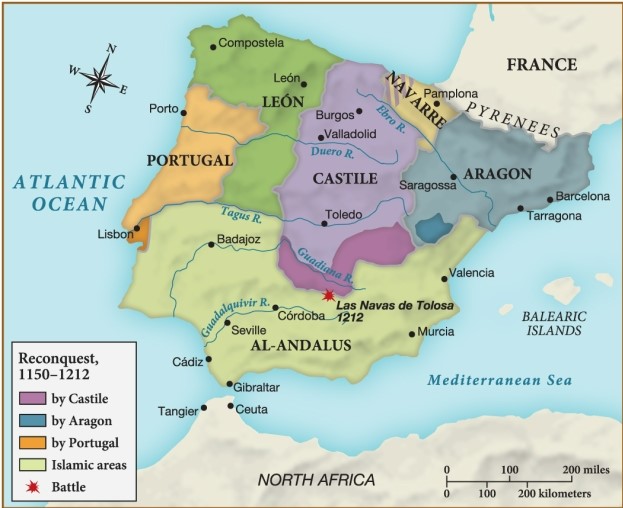
(Multiple Choice)
4.9/5 (84)
(84) 
Filters
- Essay(0)
- Multiple Choice(0)
- Short Answer(0)
- True False(0)
- Matching(0)