



 Chat with AI
Exam 27: The Cold War and the Remaking of Europe, 1945-1960s

Exam 1: Early Western Civilization, 400,000-1000 B.C.E65 Questions
Exam 2: Near East Empires and the Reemergence of Civilization in Greece, 1000-500 B.C.E64 Questions
Exam 3: The Greek Golden Age, C 500-C 400 B.C.E65 Questions
Exam 4: From the Classical to the Hellenistic World, 400-30 B.C.E65 Questions
Exam 5: The Rise of Rome and Its Republic, 753-44 B.C.E64 Questions
Exam 6: The Creation of the Roman Empire, 44 B.C.E-284 C.E65 Questions
Exam 7: The Transformation of the Roman Empire, 284-600 C.E64 Questions
Exam 8: The Heirs of Rome: Islam, Byzantium, and Europe, 600-75065 Questions
Exam 9: From Centralization to Fragmentation, 750-105065 Questions
Exam 10: Commercial Quickening and Religious Reform, 1050-115065 Questions
Exam 11: The Flowering of the Middle Ages, 1150-121565 Questions
Exam 12: The Medieval Synthesis and Its Cracks, 1215-134065 Questions
Exam 13: Crisis and Renaissance, 1340-149265 Questions
Exam 14: Global Encounters and the Shock of the Reformation, 1492-156065 Questions
Exam 15: Wars of Religion and the Clash of Worldviews, 1560-164865 Questions
Exam 16: Absolutism, Constitutionalism, and the Search for Order, 1640-170065 Questions
Exam 17: The Atlantic System and Its Consequences, 1700-175065 Questions
Exam 18: The Promise of Enlightenment, 1750-178965 Questions
Exam 19: The Cataclysm of Revolution, 1789-179965 Questions
Exam 20: Napoleon and the Revolutionary Legacy, 1800-183065 Questions
Exam 21: Industrialization and Social Ferment, 1830-185064 Questions
Exam 22: Politics and Culture of the Nation-State, 1850-187065 Questions
Exam 23: Empire, Industry, and Everyday Life, 1870-189065 Questions
Exam 24: Modernity and the Road to War, 1890-191465 Questions
Exam 25: World War I and Its Aftermath, 1914-192965 Questions
Exam 26: The Great Depression and World War II, 1929-194565 Questions
Exam 27: The Cold War and the Remaking of Europe, 1945-1960s64 Questions
Exam 28: Postindustrial Society and the End of the Cold War Order, 1960s-198965 Questions
Exam 29: A New Globalism, 1989 to the Present65 Questions
Select questions type


In 1949, German centrist politicians came to power in the new state of the German Federal Republic, whose first chancellor was which Catholic politician?

Free
(Multiple Choice)
4.7/5  (95)
(95) Correct Answer: Verified
C
Briefly describe the twentieth-century philosophy of existentialism. How did Simone de Beauvoir apply this philosophy to the condition of women?
Free
(Essay)
5.0/5 (80)
(80) Correct Answer:Verified
VerifiedAnswer would ideally include the following. Existentialists explored the meaning-or the lack of meaning-of existence in an unethical and sometimes evil world; they believed there was no God and that no one was born with spiritual goodness. Instead, they argued, the individual creates an "authentic" existence through actions and choice. Sartre emphasized such actions and choices in the political sphere. In The Second Sex, Simone de Beauvoir applied this philosophy to women's lives, saying that most women had failed to take considered actions that would give them an authentic existence. By unquestioningly fulfilling traditional roles, women became an object, or "Other."
Which of the following characterized U.S. president Harry Truman's policies toward the Soviet Union?
Free
(Multiple Choice)
4.9/5 (85)
(85) Correct Answer:Verified
VerifiedB
What advantages for the European Economic Community (the Common Market) were supposed to exist in using international "technocrats" to make expert decisions that would affect all member states?
(Essay)
4.7/5 (94)
(94) How did Europeans experience what some called the "Americanization" of Europe in the postwar period?
(Essay)
4.8/5 (67)
(67) Which of the following statements best describes the movement of Russians after World War II?
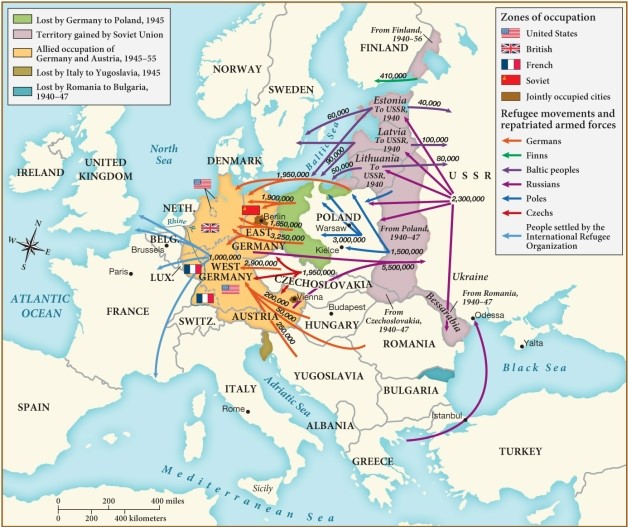
(Multiple Choice)
4.8/5 (77)
(77) 
In 1949, the Soviet Union created regional economic organizations in order to
(Multiple Choice)
4.9/5 (74)
(74) How did western European states rebuild with some success in the decade or so after World War II?
(Essay)
4.9/5 (85)
(85) From 1949 to 1954, a wave of anti-Communist hysteria that included book burnings and investigations of over six million people spread across which country?
(Multiple Choice)
4.9/5 (80)
(80) Why were many Russians surprised by Joseph Stalin's post-World War II domestic policies, and how did these policies affect industry, agriculture, the military, and women?
(Essay)
4.8/5 (87)
(87) Explain how the Marshall Plan, the establishment of NATO and the Warsaw Pact, and the founding of the European Economic Community all can be seen to reflect Europe's position between two nuclear superpowers.
(Essay)
4.8/5 (77)
(77) Which of the following characterized postwar European welfare states?
(Multiple Choice)
4.8/5 (82)
(82) Many Jewish concentration camp survivors returned to their countries in Europe to find that
(Multiple Choice)
4.8/5 (80)
(80) The Cuban missile crisis began in 1962 immediately after the
(Multiple Choice)
4.8/5 (81)
(81) How did the United States respond when, in 1948, the Soviets blockaded Berlin, which was situated more than one hundred miles inside the Soviet zone?
(Multiple Choice)
4.9/5 (88)
(88) What notable change ensured the United Nations a greater chance of success than its predecessor, the League of Nations?
(Multiple Choice)
4.9/5 (86)
(86) 
Filters
- Essay(0)
- Multiple Choice(0)
- Short Answer(0)
- True False(0)
- Matching(0)