



 Chat with AI
Exam 23: Empire, Industry, and Everyday Life, 1870-1890

Exam 1: Early Western Civilization, 400,000-1000 B.C.E65 Questions
Exam 2: Near East Empires and the Reemergence of Civilization in Greece, 1000-500 B.C.E64 Questions
Exam 3: The Greek Golden Age, C 500-C 400 B.C.E65 Questions
Exam 4: From the Classical to the Hellenistic World, 400-30 B.C.E65 Questions
Exam 5: The Rise of Rome and Its Republic, 753-44 B.C.E64 Questions
Exam 6: The Creation of the Roman Empire, 44 B.C.E-284 C.E65 Questions
Exam 7: The Transformation of the Roman Empire, 284-600 C.E64 Questions
Exam 8: The Heirs of Rome: Islam, Byzantium, and Europe, 600-75065 Questions
Exam 9: From Centralization to Fragmentation, 750-105065 Questions
Exam 10: Commercial Quickening and Religious Reform, 1050-115065 Questions
Exam 11: The Flowering of the Middle Ages, 1150-121565 Questions
Exam 12: The Medieval Synthesis and Its Cracks, 1215-134065 Questions
Exam 13: Crisis and Renaissance, 1340-149265 Questions
Exam 14: Global Encounters and the Shock of the Reformation, 1492-156065 Questions
Exam 15: Wars of Religion and the Clash of Worldviews, 1560-164865 Questions
Exam 16: Absolutism, Constitutionalism, and the Search for Order, 1640-170065 Questions
Exam 17: The Atlantic System and Its Consequences, 1700-175065 Questions
Exam 18: The Promise of Enlightenment, 1750-178965 Questions
Exam 19: The Cataclysm of Revolution, 1789-179965 Questions
Exam 20: Napoleon and the Revolutionary Legacy, 1800-183065 Questions
Exam 21: Industrialization and Social Ferment, 1830-185064 Questions
Exam 22: Politics and Culture of the Nation-State, 1850-187065 Questions
Exam 23: Empire, Industry, and Everyday Life, 1870-189065 Questions
Exam 24: Modernity and the Road to War, 1890-191465 Questions
Exam 25: World War I and Its Aftermath, 1914-192965 Questions
Exam 26: The Great Depression and World War II, 1929-194565 Questions
Exam 27: The Cold War and the Remaking of Europe, 1945-1960s64 Questions
Exam 28: Postindustrial Society and the End of the Cold War Order, 1960s-198965 Questions
Exam 29: A New Globalism, 1989 to the Present65 Questions
Select questions type


The discovery of which medicine removed a roadblock to European conquest of Africa?

Free
(Multiple Choice)
4.9/5  (75)
(75) Correct Answer: Verified
A
Many European advocates of imperialism believed that whites had a "civilizing mission"; what did this mission entail?
Free
(Multiple Choice)
4.8/5 (85)
(85) Correct Answer:Verified
VerifiedC
Women's massive entry into the service sector in the late nineteenth century accelerated what social change?
Free
(Multiple Choice)
4.8/5 (77)
(77) Correct Answer:Verified
VerifiedA
What were the most frequent destinations for international migrants who left Europe seeking economic opportunity?
(Multiple Choice)
5.0/5 (78)
(78) Of the working-class parties that developed out of socialism, which of the following was the largest after 1890?
(Multiple Choice)
4.9/5 (84)
(84) In the 1880s, Dutch physician Aletta Jacobs opened the first clinic in Europe to provide
(Multiple Choice)
4.9/5 (71)
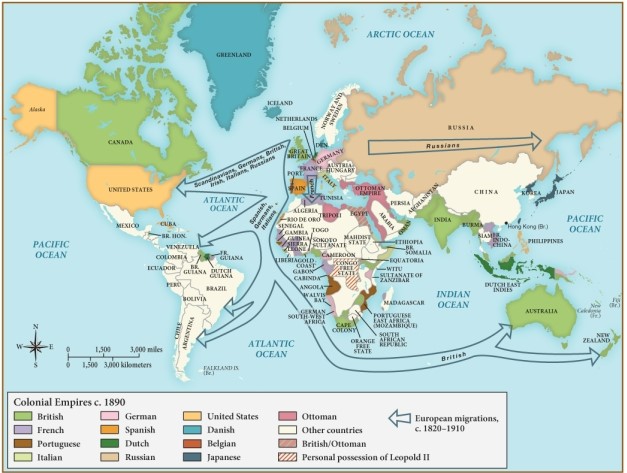
(71) By 1890, which European nation claimed territory on each of the continents shown on this map?
(Multiple Choice)
4.9/5 (64)
(64) Describe the inroads that Russia made into Asia between the 1860s and the 1890s.
(Essay)
4.9/5 (80)
(80) The demand for raw materials along with business that was brought on by industrialism led to a rise in
(Multiple Choice)
4.8/5 (79)
(79) What features characterized the 1880s movement known as new unionism?
(Multiple Choice)
4.9/5 (69)
(69) Briefly describe the significance of Pan-Slavism in shaping the Balkan peninsula.
(Essay)
4.8/5 (70)
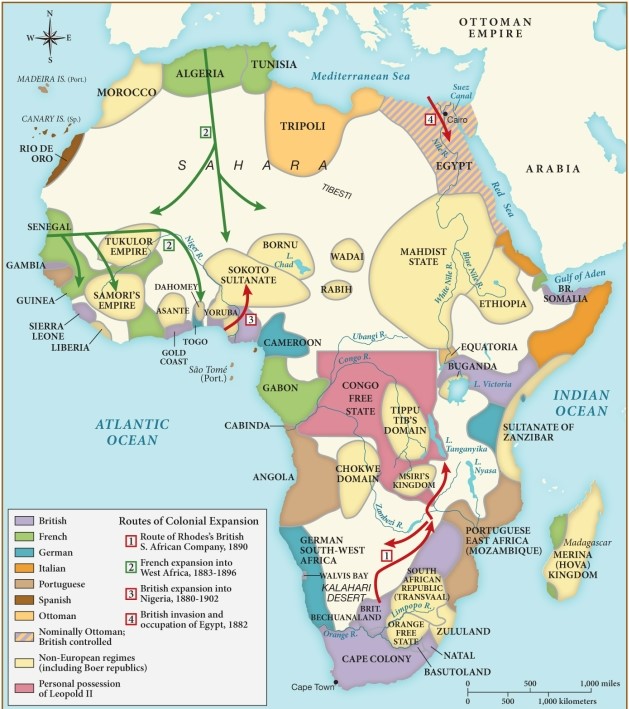
(70) Which of the following statements is supported by this map?
(Multiple Choice)
4.7/5 (80)
(80) As part of its program for modernization, the Meiji government in Japan
(Multiple Choice)
4.7/5 (90)
(90) Discuss the ways in which industrialization promoted the growth of mass politics. How did industrialization promote the formation of working-class organizations? How did industrialization change the means by which people formed their opinions about issues and politicians, and how did it in turn change the way citizens made their concerns known to the government?
(Essay)
4.7/5 (85)
(85) Which of the following two countries came to rival Britain in industrial strength?
(Multiple Choice)
4.9/5 (84)
(84) What factors led to the development of the "new imperialism" in the late nineteenth century? In your answer, be sure to take into consideration the economic, political, and social aspects of the European quest for empire.
(Essay)
4.8/5 (61)
(61) Why was Egypt an early and attractive target for European takeover in the age of imperialism?
(Multiple Choice)
4.9/5 (76)
(76) What was one of the main purposes of the Dual Alliance forged by Germany and Austria-Hungary in 1879?
(Multiple Choice)
5.0/5 (76)
(76) 
Filters
- Essay(0)
- Multiple Choice(0)
- Short Answer(0)
- True False(0)
- Matching(0)