



 Chat with AI
Exam 23: Empire, Industry, and Everyday Life, 1870-1890

Exam 1: Early Western Civilization, 400,000-1000 B.C.E65 Questions
Exam 2: Near East Empires and the Reemergence of Civilization in Greece, 1000-500 B.C.E64 Questions
Exam 3: The Greek Golden Age, C 500-C 400 B.C.E65 Questions
Exam 4: From the Classical to the Hellenistic World, 400-30 B.C.E65 Questions
Exam 5: The Rise of Rome and Its Republic, 753-44 B.C.E64 Questions
Exam 6: The Creation of the Roman Empire, 44 B.C.E-284 C.E65 Questions
Exam 7: The Transformation of the Roman Empire, 284-600 C.E64 Questions
Exam 8: The Heirs of Rome: Islam, Byzantium, and Europe, 600-75065 Questions
Exam 9: From Centralization to Fragmentation, 750-105065 Questions
Exam 10: Commercial Quickening and Religious Reform, 1050-115065 Questions
Exam 11: The Flowering of the Middle Ages, 1150-121565 Questions
Exam 12: The Medieval Synthesis and Its Cracks, 1215-134065 Questions
Exam 13: Crisis and Renaissance, 1340-149265 Questions
Exam 14: Global Encounters and the Shock of the Reformation, 1492-156065 Questions
Exam 15: Wars of Religion and the Clash of Worldviews, 1560-164865 Questions
Exam 16: Absolutism, Constitutionalism, and the Search for Order, 1640-170065 Questions
Exam 17: The Atlantic System and Its Consequences, 1700-175065 Questions
Exam 18: The Promise of Enlightenment, 1750-178965 Questions
Exam 19: The Cataclysm of Revolution, 1789-179965 Questions
Exam 20: Napoleon and the Revolutionary Legacy, 1800-183065 Questions
Exam 21: Industrialization and Social Ferment, 1830-185064 Questions
Exam 22: Politics and Culture of the Nation-State, 1850-187065 Questions
Exam 23: Empire, Industry, and Everyday Life, 1870-189065 Questions
Exam 24: Modernity and the Road to War, 1890-191465 Questions
Exam 25: World War I and Its Aftermath, 1914-192965 Questions
Exam 26: The Great Depression and World War II, 1929-194565 Questions
Exam 27: The Cold War and the Remaking of Europe, 1945-1960s64 Questions
Exam 28: Postindustrial Society and the End of the Cold War Order, 1960s-198965 Questions
Exam 29: A New Globalism, 1989 to the Present65 Questions
Select questions type


Which of the following was manifested in the development of team sports and leisure activities like mountain climbing and bicycle touring in Europe?
(Multiple Choice)
4.9/5  (70)
(70) Which of the following did the most to stimulate the new consumer culture in the late nineteenth century?
(Multiple Choice)
4.7/5 (86)
(86) Which major new artistic movement emerged from France in the 1800s and is best represented in the work of Claude Monet?
(Multiple Choice)
4.8/5 (86)
(86) 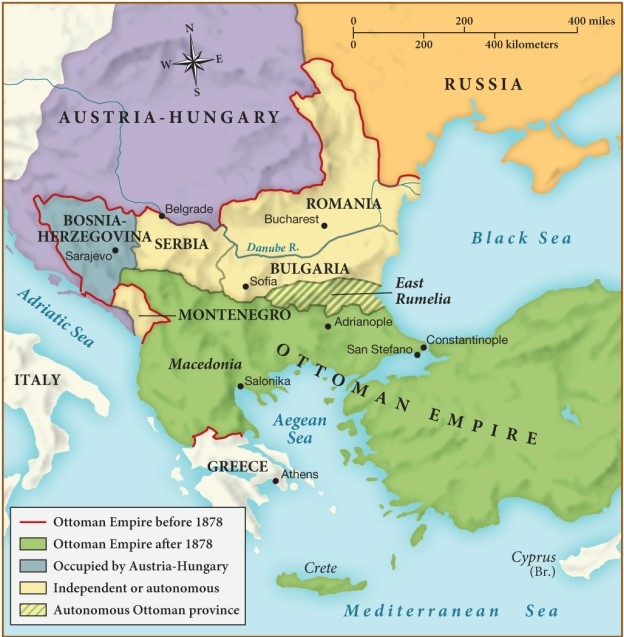
How did the political and economic developments of the late nineteenth century affect women's roles in society? What new opportunities were women afforded and why? In what areas were they held back? In your answer, consider factors like the impact of imperialism, the revolution in business practices, the shift in consumption patterns, and the influence of mass politics.
(Essay)
4.8/5 (82)
(82) In the early 1880s, what touched off a scramble among European countries for colonies in Africa?
(Multiple Choice)
4.9/5 (76)
(76) Which of the following European countries was the slowest to industrialize?
(Multiple Choice)
4.8/5 (92)
(92) The Second International (1889) was an organization that sought
(Multiple Choice)
4.9/5 (85)
(85) What new organizations were established by educated reformers in the nineteenth century in an effort to understand and alleviate working-class poverty?
(Multiple Choice)
4.7/5 (78)
(78) In the late nineteenth century, industrialization tended to be capital intensive, which meant that
(Multiple Choice)
4.9/5 (71)
(71) According to this map, what is the likely relationship between the establishment of railways and canals and the territory of the city of Berlin?
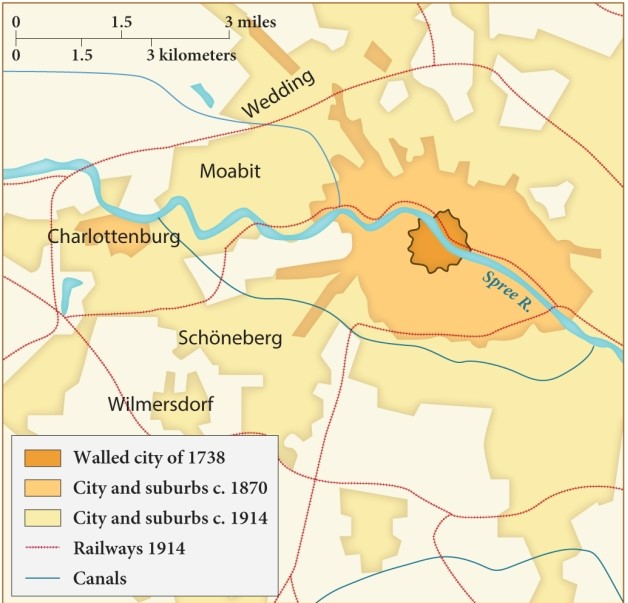
(Multiple Choice)
4.7/5 (85)
(85) How did scientific ideas influence new social reforms and organizations for social improvement?
(Essay)
5.0/5 (75)
(75) The growth of revolutionary movements in Russia in the late nineteenth century resulted in which of the following events?
(Multiple Choice)
4.9/5 (94)
(94) Why did many European countries abandon free-trade policies in the late nineteenth century?
(Multiple Choice)
4.9/5 (75)
(75) Which of the following was a major industrial innovation of the late nineteenth century?
(Multiple Choice)
4.8/5 (69)
(69) What German institution did German chancellor Otto von Bismarck (1815-1898) attack in 1878, after the failure of his Kulturkampf?
(Multiple Choice)
4.7/5 (75)
(75) Briefly explain why late-nineteenth-century imperialism was not as beneficial to European politics and Europeans as it was generally supposed to be.
(Essay)
4.9/5 (83)
(83) Spain and Belgium abruptly awarded suffrage to all men in 1890 and 1893, respectively,
(Multiple Choice)
4.8/5 (78)
(78) The new mass journalism of this period was characterized by
(Multiple Choice)
4.8/5 (88)
(88) Which of the following is an example of the opening of the political process to wider participation in Europe?
(Multiple Choice)
4.8/5 (61)
(61) 
Filters
- Essay(0)
- Multiple Choice(0)
- Short Answer(0)
- True False(0)
- Matching(0)