



 Chat with AI
Exam 7: The Transformation of the Roman Empire, 284-600 C.E

Exam 1: Early Western Civilization, 400,000-1000 B.C.E65 Questions
Exam 2: Near East Empires and the Reemergence of Civilization in Greece, 1000-500 B.C.E64 Questions
Exam 3: The Greek Golden Age, C 500-C 400 B.C.E65 Questions
Exam 4: From the Classical to the Hellenistic World, 400-30 B.C.E65 Questions
Exam 5: The Rise of Rome and Its Republic, 753-44 B.C.E64 Questions
Exam 6: The Creation of the Roman Empire, 44 B.C.E-284 C.E65 Questions
Exam 7: The Transformation of the Roman Empire, 284-600 C.E64 Questions
Exam 8: The Heirs of Rome: Islam, Byzantium, and Europe, 600-75065 Questions
Exam 9: From Centralization to Fragmentation, 750-105065 Questions
Exam 10: Commercial Quickening and Religious Reform, 1050-115065 Questions
Exam 11: The Flowering of the Middle Ages, 1150-121565 Questions
Exam 12: The Medieval Synthesis and Its Cracks, 1215-134065 Questions
Exam 13: Crisis and Renaissance, 1340-149265 Questions
Exam 14: Global Encounters and the Shock of the Reformation, 1492-156065 Questions
Exam 15: Wars of Religion and the Clash of Worldviews, 1560-164865 Questions
Exam 16: Absolutism, Constitutionalism, and the Search for Order, 1640-170065 Questions
Exam 17: The Atlantic System and Its Consequences, 1700-175065 Questions
Exam 18: The Promise of Enlightenment, 1750-178965 Questions
Exam 19: The Cataclysm of Revolution, 1789-179965 Questions
Exam 20: Napoleon and the Revolutionary Legacy, 1800-183065 Questions
Exam 21: Industrialization and Social Ferment, 1830-185064 Questions
Exam 22: Politics and Culture of the Nation-State, 1850-187065 Questions
Exam 23: Empire, Industry, and Everyday Life, 1870-189065 Questions
Exam 24: Modernity and the Road to War, 1890-191465 Questions
Exam 25: World War I and Its Aftermath, 1914-192965 Questions
Exam 26: The Great Depression and World War II, 1929-194565 Questions
Exam 27: The Cold War and the Remaking of Europe, 1945-1960s64 Questions
Exam 28: Postindustrial Society and the End of the Cold War Order, 1960s-198965 Questions
Exam 29: A New Globalism, 1989 to the Present65 Questions
Select questions type


Based on this map, which of the following districts would have been the most vulnerable to invasion by Germanic peoples?
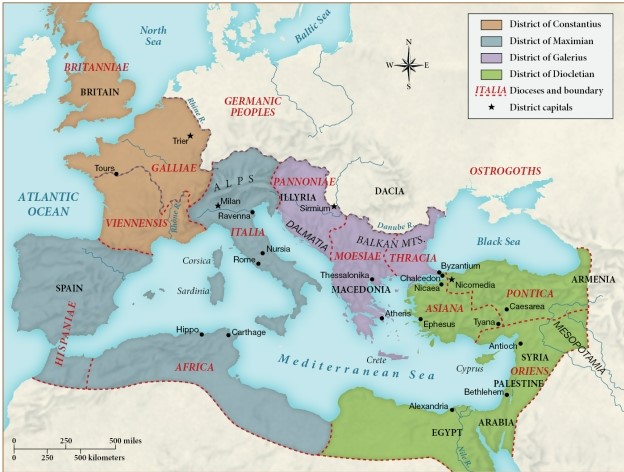

Free
(Multiple Choice)
4.9/5  (72)
(72) Correct Answer: Verified
D
How did the dominate's emperors take cues for their style of ruling from the Sasanid Empire in Persia?
Free
(Multiple Choice)
4.8/5 (73)
(73) Correct Answer:Verified
VerifiedA
Which group did Diocletian and his co-rulers persecute in response to the crisis at the close of the third century?
Free
(Multiple Choice)
4.8/5 (94)
(94) Correct Answer:Verified
VerifiedB
The Visigoths and the Franks were the first of the Frankish tribes to have written codes of law. What language were their laws written in?
(Multiple Choice)
4.8/5 (81)
(81) How did the development of Christian literature, specifically of the codex, tend to preserve classical literature?
(Essay)
4.8/5 (82)
(82) Where did the most important attempt to end doctrinal disputes and clarify Christian orthodoxy take place in the mid-fifth century?
(Multiple Choice)
4.8/5 (89)
(89) What factor allowed Christianity to become the dominant religion in the course of the fourth century, however gradual the process?
(Multiple Choice)
4.9/5 (80)
(80) The standard code of monastic conduct in the west that took shape around 540 was known as the rule of Saint
(Multiple Choice)
4.9/5 (82)
(82) In tribal societies of the fourth and fifth centuries, women
(Multiple Choice)
4.9/5 (83)
(83) During the transformation of the Roman Empire, becoming a monk and living a life of self-denial was seen as
(Multiple Choice)
4.9/5 (85)
(85) Monophysitism, Nestorianism, and Arianism were all part of the debate about the
(Multiple Choice)
4.8/5 (76)
(76) Why did the deposition of the last Roman emperor in 476 by Ostrogothic troops under the command of Odoacer have more of a symbolic than an actual political impact?
(Essay)
4.9/5 (87)
(87) Why were many unmarried women throughout the Roman Empire attracted to Christianity in the fourth and fifth centuries?
(Multiple Choice)
4.9/5 (77)
(77) The various barbarian tribes that moved into the Roman Empire during the fourth and fifth centuries shared both a terror of the Asiatic Huns, who had invaded eastern Europe in the fourth century, and
(Multiple Choice)
4.8/5 (86)
(86) Scholars under the direction of Justinian I produced the Codex (529), the Digest (533), and the Institutes (533), all of which had an enormous impact on European
(Multiple Choice)
4.7/5 (87)
(87) How did Diocletian respond to the hyperinflation brought on by the civil wars of the third century?
(Multiple Choice)
4.8/5 (76)
(76) The Angles and the Saxons migrated to which of the following regions?
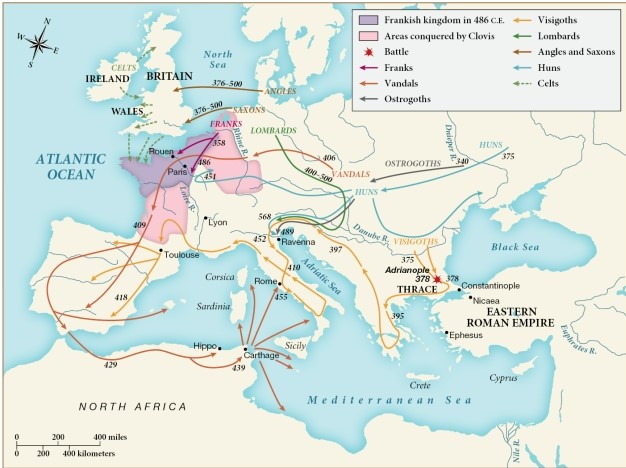
(Multiple Choice)
4.8/5 (70)
(70) What was Arianism, and how did the Council of Nicaea, called in 325, attempt to resolve the issue?
(Essay)
4.8/5 (83)
(83) What political and economic reforms did Diocletian initiate to save the Roman Empire, and what were the consequences, both intended and unintended, of these attempts at reform?
(Essay)
4.8/5 (80)
(80) 
Filters
- Essay(0)
- Multiple Choice(0)
- Short Answer(0)
- True False(0)
- Matching(0)