



 Chat with AI
Exam 29: A New Globalism, 1989 to the Present


The global response to the atrocities of the Balkan wars, particularly massacres such as the one at Srebrenica, was generally thought to be

 (82)
 Verified
C
Describe the arguments made for and against Turkey's admission to the European Union.
(82) VerifiedAnswer would ideally include the following. Greece, a member of the EU and a traditional enemy of Turkey, pushed for the admission of Turkey in 2002 and 2003. Greece argued that Turkey had been a great European power for centuries. It was hoped that the rivalry between Greece and Turkey, which had often been violent, would dissolve once both countries were part of the EU. Greece and Turkey would both gain by this because they would be able to spend less on national defense. A former president of France argued, however, that a predominantly Muslim country could never fit in with the Christian tradition of the EU members. More recently, concerns have been expressed about Turkish president Recep Erdogan's antidemocratic crackdowns on free speech and political opponents.
Which of the following is an example of the measures that European governments undertook in the late twentieth century to address environmental problems?
(73) VerifiedD
What barriers did nations in Africa encounter as they attempted economic development?
(74) Which of the following concepts, which can be defined as an intense stylistic mixing in the arts without following an elite set of standards, is often applied to the global culture of the late twentieth and early twenty-first centuries?
(71) Although Iraq's president Saddam Hussein attacked Iran in September 1980 primarily for its oil-rich territory, he also
(80) By the end of the twentieth century, some 60 percent of the national income of Egypt, Spain, Mexico, and Pakistan
(91) In 1994, by the terms of the Maastricht Treaty, the European Community
(68) Which political party was founded in Europe in the late 1970s in response to concerns about the environment and unchecked urban growth?
(88) Based on this map, which of the following statements best explains the migration of refugees from Somalia?
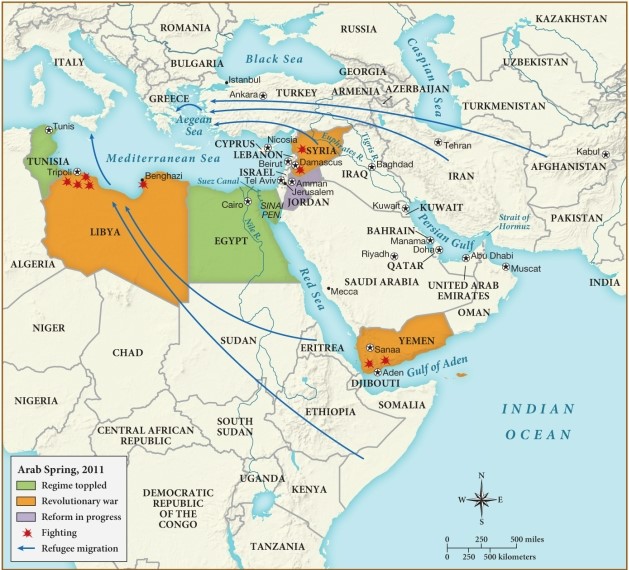
(87) In what ways did economic life in eastern Europe improve, especially after 2000?
(101) Why did the culture of the United States become dominant during the late twentieth and early twenty-first centuries?
(82) Between 2004 and 2007, many of the countries of eastern Europe
(78) What is postmodernism? How is postmodernism presented in the twenty-first century? Define postmodernism in political terms, and provide one example of political postmodernism.
(86) In the late twentieth and early twenty-first centuries, a new threat to the world economy emerged in the form of
(83) The demise of the Soviet Union in the 1990s led to both the establishment of new democratic republics in formerly Soviet-controlled territories and
(83) The 1980s and 1990s were a period in which globalization took a number of different forms. Discuss the ways in which technology and economic developments began to blur the borders of nation-states. Although many people saw these developments as decided advantages for society, in what ways did they also make businesses, governments, and individuals more vulnerable?
(74) Acquired immunodeficiency syndrome (AIDS) spread most quickly among the populations of which of the following continents?
(76) The former Yugoslavia became a flash point for tension, war, and genocide. Why did this happen, and how successful were attempts to stop it?
(93) 
Filters
- Essay(0)
- Multiple Choice(0)
- Short Answer(0)
- True False(0)
- Matching(0)