



 Chat with AI
Exam 8: The Heirs of Rome: Islam, Byzantium, and Europe, 600-750

Exam 1: Early Western Civilization, 400,000-1000 B.C.E65 Questions
Exam 2: Near East Empires and the Reemergence of Civilization in Greece, 1000-500 B.C.E64 Questions
Exam 3: The Greek Golden Age, C 500-C 400 B.C.E65 Questions
Exam 4: From the Classical to the Hellenistic World, 400-30 B.C.E65 Questions
Exam 5: The Rise of Rome and Its Republic, 753-44 B.C.E64 Questions
Exam 6: The Creation of the Roman Empire, 44 B.C.E-284 C.E65 Questions
Exam 7: The Transformation of the Roman Empire, 284-600 C.E64 Questions
Exam 8: The Heirs of Rome: Islam, Byzantium, and Europe, 600-75065 Questions
Exam 9: From Centralization to Fragmentation, 750-105065 Questions
Exam 10: Commercial Quickening and Religious Reform, 1050-115065 Questions
Exam 11: The Flowering of the Middle Ages, 1150-121565 Questions
Exam 12: The Medieval Synthesis and Its Cracks, 1215-134065 Questions
Exam 13: Crisis and Renaissance, 1340-149265 Questions
Exam 14: Global Encounters and the Shock of the Reformation, 1492-156065 Questions
Exam 15: Wars of Religion and the Clash of Worldviews, 1560-164865 Questions
Exam 16: Absolutism, Constitutionalism, and the Search for Order, 1640-170065 Questions
Exam 17: The Atlantic System and Its Consequences, 1700-175065 Questions
Exam 18: The Promise of Enlightenment, 1750-178965 Questions
Exam 19: The Cataclysm of Revolution, 1789-179965 Questions
Exam 20: Napoleon and the Revolutionary Legacy, 1800-183065 Questions
Exam 21: Industrialization and Social Ferment, 1830-185064 Questions
Exam 22: Politics and Culture of the Nation-State, 1850-187065 Questions
Exam 23: Empire, Industry, and Everyday Life, 1870-189065 Questions
Exam 24: Modernity and the Road to War, 1890-191465 Questions
Exam 25: World War I and Its Aftermath, 1914-192965 Questions
Exam 26: The Great Depression and World War II, 1929-194565 Questions
Exam 27: The Cold War and the Remaking of Europe, 1945-1960s64 Questions
Exam 28: Postindustrial Society and the End of the Cold War Order, 1960s-198965 Questions
Exam 29: A New Globalism, 1989 to the Present65 Questions
Select questions type


What was the main function of aristocratic Merovingian marriage? What marriage customs did the Merovingian elite employ?

Free
(Essay)
4.9/5  (88)
(88) Correct Answer: Verified
Answer would ideally include the following. The main function of aristocratic Merovingian marriage was to produce heirs who could continue the family line and inherit its power and property. The economic and reproductive elements of marriage were emphasized by the fact that the groom paid a considerable dowry for his bride, and she also received a morning gift after consummation. Men could have more than one wife; less formal types of marriage did not require a dowry. Marriages were not performed in churches but were matters of family and property.
According to this map, which of the following can be said about Islam by about 750?
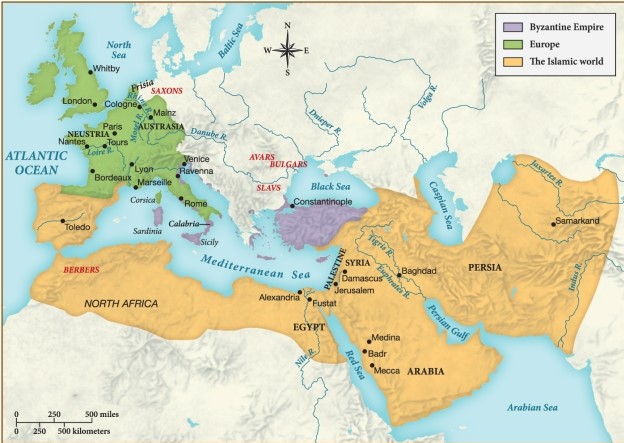
Free
(Multiple Choice)
4.9/5 (90)
(90) Correct Answer:Verified
VerifiedC
What caused the split between Shi'ite and Sunni Muslims?
Free
(Multiple Choice)
4.9/5 (72)
(72) Correct Answer:Verified
VerifiedA
Who ordered the destruction of all icons after the eighth-century defeat of the Arabs besieging Constantinople?
(Multiple Choice)
4.9/5 (72)
(72) A major conflict between Irish and Roman Christianity was how to calculate the date of
(Multiple Choice)
4.7/5 (71)
(71) Which kingdom in Spain was defeated in 711 by invading Arab armies?
(Multiple Choice)
4.9/5 (77)
(77) Why did sentiment grow against the use of icons in the Byzantine Empire in the eighth century?
(Multiple Choice)
4.9/5 (69)
(69) What changes did Muhammad make after he realized that the Jews were not accepting Islam?
(Essay)
4.9/5 (86)
(86) Roman Christianity's organization was based on bishops' and archbishops' control of territorial units called
(Multiple Choice)
4.9/5 (81)
(81) Which of the following statements is justified by the map shown here?
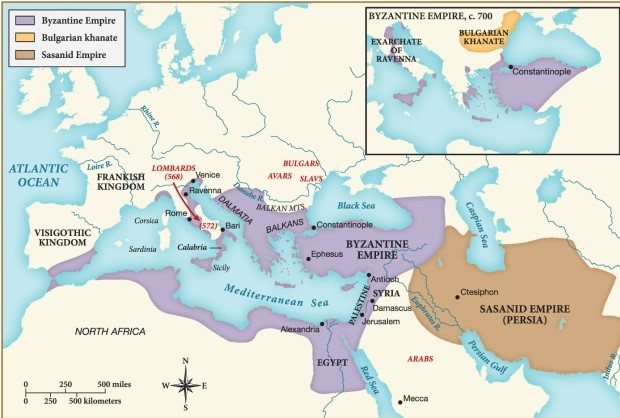
(Multiple Choice)
4.8/5 (87)
(87) What impact did war between the Sasanid Empire of Persia and the Byzantine Empire have on those empires' later experiences with Arab Muslims?
(Essay)
4.9/5 (85)
(85) In what way did Muhammad's position in Medina become a model for Islamic governance?
(Multiple Choice)
4.8/5 (91)
(91) Between the sixth and tenth centuries, Jews in western Europe were
(Multiple Choice)
4.8/5 (74)
(74) What does this map of the Merovingian city of Tours c. 600 tell us about religious life of the region?
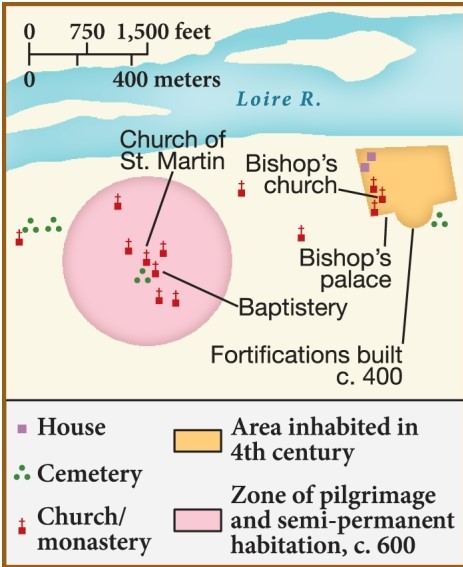
(Multiple Choice)
4.8/5 (64)
(64) 
Filters
- Essay(0)
- Multiple Choice(0)
- Short Answer(0)
- True False(0)
- Matching(0)