



 Chat with AI
Exam 16: Absolutism, Constitutionalism, and the Search for Order, 1640-1700


Seventeenth-century painters, sculptors, and architects developed what style of art that came to be preferred by French artists as well as their patron Louis XIV?

 (82)
 Verified
C
While European rulers were embracing absolutism in the late seventeenth century, how did people in their American colonies react to the attendant economic, racial, political, and social changes?
(86) VerifiedAnswer would ideally include the following. Colonial subjects in the Americas, especially those subject to French and English rule, increasingly came under the control of mercantilist economies in the late sixteenth century. In France, Jean-Baptiste Colbert's reforms created high tariffs and forbade colonial businesses from manufacturing goods produced in France, retarding economic growth. In 1663, he also took over the French trading company that had established New France. The same held true with the English after the 1651 Navigation Act. To allow for cultivation of lucrative sugarcane, slaves were imported in increasing numbers first to the Caribbean, then elsewhere where expensive products could be grown. As a result, European governments codified slavery largely based on race in this period. For instance, Barbados in 1661 instituted a slave code that stripped all Africans of rights under English law. Louis XIV promulgated a "black code" in 1685 to regulate the legal status of slaves in the French colonies and to prevent non-Catholics from owning slaves. Especially in British North America, even as Black people were increasingly being subjugated, white people increased their political authority. Left largely to their own political devices by London authorities provided they nominally paid heed to mercantilist codes, white British Americans developed localized representative governments through their colonial legislatures. African slavery led to increasingly consolidated landholdings in some areas, though the plentiful availability of land for ordinary immigrants mitigated social tensions.
How did European peasants and colonized subjects resist attempts to reform popular religious rituals?
(79) VerifiedB
The work of Maria Sibylla Merian (1646-1717) is characteristic of what development in seventeenth-century art?
(83) By agreeing to Parliament's demand for a Petition of Right in 1628, Charles I
(99) Which territory did the Austrian Habsburgs take from the Turks between 1683 and 1699?
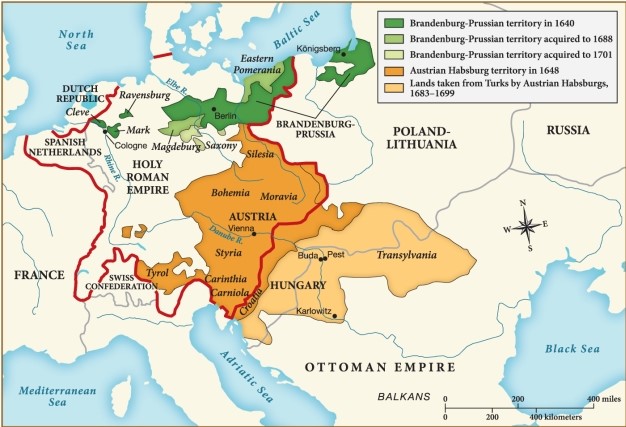
(70) Why was the code of 1649 critical to Russia's political and social development?
(84) When Louis XIV's wars with much of western and central Europe finally ended with the Treaty of Rijswijk in 1697, Louis
(89) Why did Louis XIV revoke the Edict of Nantes in 1685, and what impact did this have on international politics?
(76) How did the breakdown of constitutionalism, the violence of the Cossack revolts, and a Russo-Polish war affect religious toleration in Poland-Lithuania?
(73) Why can the English Bill of Rights be seen as the culmination of fifty years of parliamentary struggle for increased constitutionalism?
(95) The English civil war of the 1640s led to the emergence of which new religious sects in England?
(77) Which of the following statements is supported by this map?
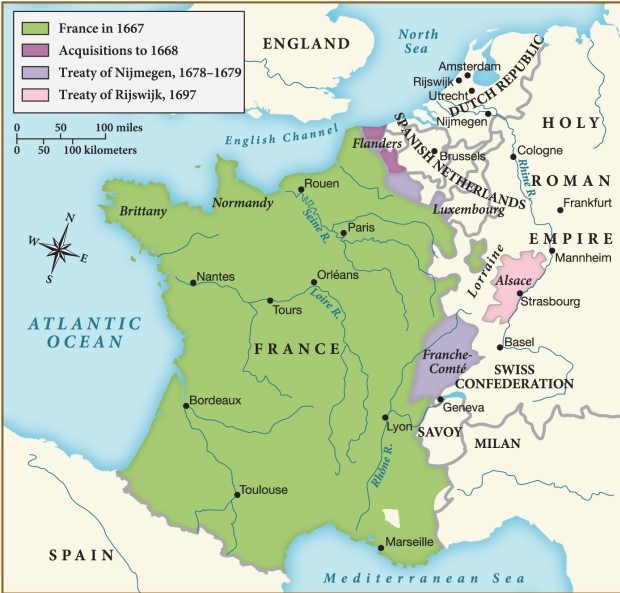
(84) For more than 150 years, the Austrian Habsburgs and the Ottoman Turks fought over what territory?
(79) Which of the following characterizes the French government's implementation of the new economic doctrine of mercantilism in the mid-seventeenth century?
(69) How did the prosperity of the Dutch Republic affect women and their position in society?
(79) Although John Milton's Paradise Lost explores the fall of Adam and Eve, it can also be seen as
(68) Why did the philosophy of the Jewish scholar Benedict Spinoza (1633-1677) alarm so many people?
(81) What factors contributed to the spread of the "new science" in the West?
(94) What role did women of the upper classes play in society during the seventeenth century? Were women granted more or fewer freedoms during this time? How was this received by others in society?
(84) 
Filters
- Essay(0)
- Multiple Choice(0)
- Short Answer(0)
- True False(0)
- Matching(0)