



 Chat with AI
Exam 16: Absolutism, Constitutionalism, and the Search for Order, 1640-1700

Exam 1: Early Western Civilization, 400,000-1000 B.C.E65 Questions
Exam 2: Near East Empires and the Reemergence of Civilization in Greece, 1000-500 B.C.E64 Questions
Exam 3: The Greek Golden Age, C 500-C 400 B.C.E65 Questions
Exam 4: From the Classical to the Hellenistic World, 400-30 B.C.E65 Questions
Exam 5: The Rise of Rome and Its Republic, 753-44 B.C.E64 Questions
Exam 6: The Creation of the Roman Empire, 44 B.C.E-284 C.E65 Questions
Exam 7: The Transformation of the Roman Empire, 284-600 C.E64 Questions
Exam 8: The Heirs of Rome: Islam, Byzantium, and Europe, 600-75065 Questions
Exam 9: From Centralization to Fragmentation, 750-105065 Questions
Exam 10: Commercial Quickening and Religious Reform, 1050-115065 Questions
Exam 11: The Flowering of the Middle Ages, 1150-121565 Questions
Exam 12: The Medieval Synthesis and Its Cracks, 1215-134065 Questions
Exam 13: Crisis and Renaissance, 1340-149265 Questions
Exam 14: Global Encounters and the Shock of the Reformation, 1492-156065 Questions
Exam 15: Wars of Religion and the Clash of Worldviews, 1560-164865 Questions
Exam 16: Absolutism, Constitutionalism, and the Search for Order, 1640-170065 Questions
Exam 17: The Atlantic System and Its Consequences, 1700-175065 Questions
Exam 18: The Promise of Enlightenment, 1750-178965 Questions
Exam 19: The Cataclysm of Revolution, 1789-179965 Questions
Exam 20: Napoleon and the Revolutionary Legacy, 1800-183065 Questions
Exam 21: Industrialization and Social Ferment, 1830-185064 Questions
Exam 22: Politics and Culture of the Nation-State, 1850-187065 Questions
Exam 23: Empire, Industry, and Everyday Life, 1870-189065 Questions
Exam 24: Modernity and the Road to War, 1890-191465 Questions
Exam 25: World War I and Its Aftermath, 1914-192965 Questions
Exam 26: The Great Depression and World War II, 1929-194565 Questions
Exam 27: The Cold War and the Remaking of Europe, 1945-1960s64 Questions
Exam 28: Postindustrial Society and the End of the Cold War Order, 1960s-198965 Questions
Exam 29: A New Globalism, 1989 to the Present65 Questions
Select questions type


What did Louis XIV's palace at Versailles symbolize both to his subjects and to foreigners during his reign?
(Multiple Choice)
4.9/5  (76)
(76) In 1667, Stenka Razin led a legendary rebellion in Russia against what social and political practice?
(Multiple Choice)
4.9/5 (86)
(86) During the upheavals of the civil war in England in the mid-seventeenth century, the fledgling English colonies in North America
(Multiple Choice)
4.8/5 (90)
(90) Historians have advanced several different ideas about the increase in the slave trade during the seventeenth century. Which of the following factors might explain this increase?
(Multiple Choice)
4.8/5 (83)
(83) How and why were women significant in the cultivation of manners and the promotion of the arts?
(Essay)
4.8/5 (76)
(76) In what ways did governments become involved in the sciences during the seventeenth century?
(Multiple Choice)
4.9/5 (63)
(63) What was the name given to runaway serfs and poor nobles who formed outlaw bands in the no-man's-land of southern Russia and Ukraine?
(Multiple Choice)
4.9/5 (84)
(84) How did Austria's "liberation" of Hungary hasten the decline of Ottoman influence in Europe?
(Essay)
4.8/5 (75)
(75) In what ways was the government of Oliver Cromwell even more absolutist than that of Charles I?
(Essay)
4.8/5 (90)
(90) Seventeenth-century absolutism was a political response to which of the following French developments?
(Multiple Choice)
4.9/5 (88)
(88) In opposition to Hobbes, John Locke in his Two Treatises of Government (1690) used the concept of a "social contract" to
(Multiple Choice)
4.7/5 (76)
(76) Which of the following statements about Europe at the end of the seventeenth century is supported by this map?
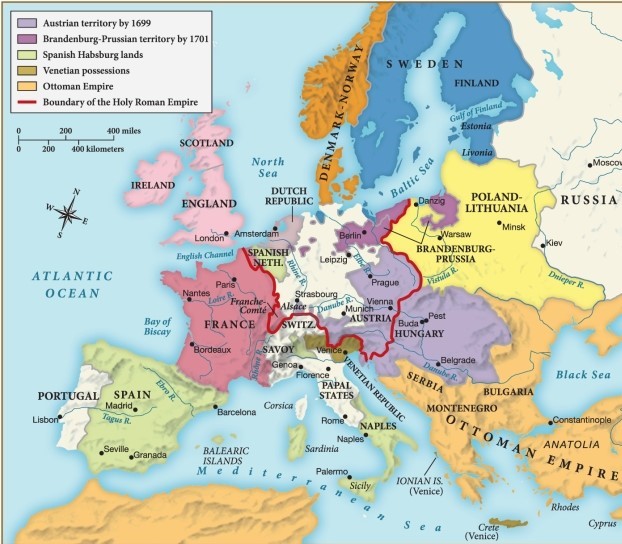
(Multiple Choice)
4.8/5 (72)
(72) Outline the basic political theories of Thomas Hobbes and John Locke. To what degree did they agree about the basis of political authority? How did their visions of the best form of political authority differ?
(Essay)
4.7/5 (77)
(77) How did the Rump Parliament respond to the execution of Charles I on January 30, 1649?
(Multiple Choice)
4.9/5 (79)
(79) Parliament offered the throne jointly to William (r. 1689-1702) and Mary (r. 1689-1694) on the condition that they accept which of the following?
(Multiple Choice)
4.9/5 (78)
(78) What was the purpose of Louis XIV's expansion and professionalization of the French military?
(Multiple Choice)
4.9/5 (78)
(78) What compelled Charles I to call a session of Parliament in 1640 after refusing to do so for eleven years?
(Multiple Choice)
4.8/5 (83)
(83) Why did Louis XIV persecute the Jansenists and drive them underground?
(Multiple Choice)
4.8/5 (88)
(88) The series of revolts in France known as the Fronde (1648-1653) broke out when Cardinal Mazarin
(Multiple Choice)
4.9/5 (95)
(95) 
Filters
- Essay(0)
- Multiple Choice(0)
- Short Answer(0)
- True False(0)
- Matching(0)