



 Chat with AI
Exam 16: Absolutism, Constitutionalism, and the Search for Order, 1640-1700

Exam 1: Early Western Civilization, 400,000-1000 B.C.E65 Questions
Exam 2: Near East Empires and the Reemergence of Civilization in Greece, 1000-500 B.C.E64 Questions
Exam 3: The Greek Golden Age, C 500-C 400 B.C.E65 Questions
Exam 4: From the Classical to the Hellenistic World, 400-30 B.C.E65 Questions
Exam 5: The Rise of Rome and Its Republic, 753-44 B.C.E64 Questions
Exam 6: The Creation of the Roman Empire, 44 B.C.E-284 C.E65 Questions
Exam 7: The Transformation of the Roman Empire, 284-600 C.E64 Questions
Exam 8: The Heirs of Rome: Islam, Byzantium, and Europe, 600-75065 Questions
Exam 9: From Centralization to Fragmentation, 750-105065 Questions
Exam 10: Commercial Quickening and Religious Reform, 1050-115065 Questions
Exam 11: The Flowering of the Middle Ages, 1150-121565 Questions
Exam 12: The Medieval Synthesis and Its Cracks, 1215-134065 Questions
Exam 13: Crisis and Renaissance, 1340-149265 Questions
Exam 14: Global Encounters and the Shock of the Reformation, 1492-156065 Questions
Exam 15: Wars of Religion and the Clash of Worldviews, 1560-164865 Questions
Exam 16: Absolutism, Constitutionalism, and the Search for Order, 1640-170065 Questions
Exam 17: The Atlantic System and Its Consequences, 1700-175065 Questions
Exam 18: The Promise of Enlightenment, 1750-178965 Questions
Exam 19: The Cataclysm of Revolution, 1789-179965 Questions
Exam 20: Napoleon and the Revolutionary Legacy, 1800-183065 Questions
Exam 21: Industrialization and Social Ferment, 1830-185064 Questions
Exam 22: Politics and Culture of the Nation-State, 1850-187065 Questions
Exam 23: Empire, Industry, and Everyday Life, 1870-189065 Questions
Exam 24: Modernity and the Road to War, 1890-191465 Questions
Exam 25: World War I and Its Aftermath, 1914-192965 Questions
Exam 26: The Great Depression and World War II, 1929-194565 Questions
Exam 27: The Cold War and the Remaking of Europe, 1945-1960s64 Questions
Exam 28: Postindustrial Society and the End of the Cold War Order, 1960s-198965 Questions
Exam 29: A New Globalism, 1989 to the Present65 Questions
Select questions type


The 1699 Treaty of Karlowitz marked the beginning of the decline of what empire?
(Multiple Choice)
4.8/5  (87)
(87) What was the Fronde, what were its goals, why was it unsuccessful, and what were its consequences?
(Essay)
4.9/5 (75)
(75) What did Frederick William of Hohenzollern give his nobles in Brandenburg-Prussia in exchange for allowing him to collect taxes in their provinces?
(Multiple Choice)
4.9/5 (78)
(78) What institution did Frederick William of Hohenzollern expand dramatically in Brandenburg-Prussia?
(Multiple Choice)
4.8/5 (67)
(67) What was the doctrine of divine right as expressed by Bishop Jacques-Bénigne Bossuet, and how did it fit in with Louis XIV's political goals?
(Essay)
4.9/5 (78)
(78) What was one of Louis XIV's first goals when he assumed direct control as king of France?
(Multiple Choice)
4.8/5 (91)
(91) Which of the following did Louis XIV employ as a counter to the parlements, provincial estates, aristocratic governors, and hereditary officials, many of whom had purchased their offices?
(Multiple Choice)
4.8/5 (80)
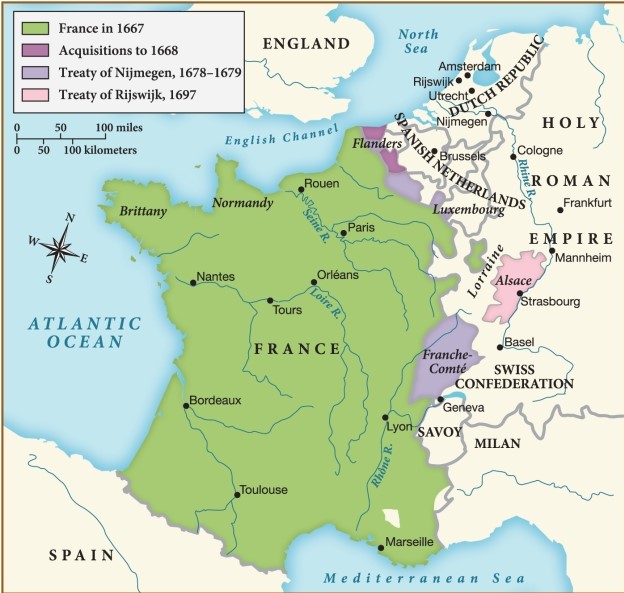
(80) Which region did Louis XIV acquire following the Treaty of Rijswijk in 1697?
(Multiple Choice)
5.0/5 (90)
(90) Why did Thomas Hobbes's Leviathan (1651) enrage both royalists and supporters of Parliament?
(Multiple Choice)
4.8/5 (79)
(79) In the sixteenth and seventeenth centuries, the poor were no longer perceived as deserving of charity but as
(Multiple Choice)
4.8/5 (86)
(86) What were the consequences of Louis XIV's revocation of the Edict of Nantes in 1685?
(Multiple Choice)
4.8/5 (69)
(69) The Tories and the Whigs invited the Dutch ruler William of Orange and his wife, James II's daughter Mary, to invade England in 1688 after
(Multiple Choice)
4.8/5 (72)
(72) Why did Louis XIV place such immense importance on court ritual at the palace of Versailles?
(Multiple Choice)
4.8/5 (68)
(68) Compare the English civil war and its aftermath to Louis XIV's persecution of the Jansenists and his revocation of the Edict of Nantes. To what extent were these conflicts actually about religious belief? Explain how religious questions could also become debates about the nature of sovereign power, obedience, and loyalty; draw examples from both England and France.
(Essay)
4.7/5 (66)
(66) Using the examples of Louis XIV of France, Frederick William of Brandenburg-Prussia, and Holy Roman Emperor Leopold I, discuss the principles of European absolutism. How were these monarchies similar, and in what ways did they differ?
(Essay)
4.8/5 (59)
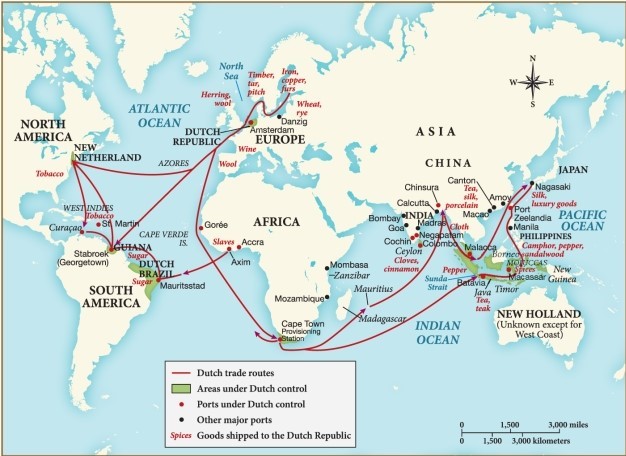
(59) According to this map, South American territories primarily exported which good to the Dutch Republic during the seventeenth century?
(Multiple Choice)
5.0/5 (85)
(85) How did the absolutist monarchy of Frederick William of Hohenzollern differ from that of Louis XIV?
(Multiple Choice)
4.9/5 (94)
(94) What does Molière's play The Middle-Class Gentleman (1670) reveal about seventeenth-century manners?
(Multiple Choice)
4.8/5 (77)
(77) 
Filters
- Essay(0)
- Multiple Choice(0)
- Short Answer(0)
- True False(0)
- Matching(0)