



 Chat with AI
Exam 8: The Heirs of Rome: Islam, Byzantium, and Europe, 600-750

Exam 1: Early Western Civilization, 400,000-1000 B.C.E65 Questions
Exam 2: Near East Empires and the Reemergence of Civilization in Greece, 1000-500 B.C.E64 Questions
Exam 3: The Greek Golden Age, C 500-C 400 B.C.E65 Questions
Exam 4: From the Classical to the Hellenistic World, 400-30 B.C.E65 Questions
Exam 5: The Rise of Rome and Its Republic, 753-44 B.C.E64 Questions
Exam 6: The Creation of the Roman Empire, 44 B.C.E-284 C.E65 Questions
Exam 7: The Transformation of the Roman Empire, 284-600 C.E64 Questions
Exam 8: The Heirs of Rome: Islam, Byzantium, and Europe, 600-75065 Questions
Exam 9: From Centralization to Fragmentation, 750-105065 Questions
Exam 10: Commercial Quickening and Religious Reform, 1050-115065 Questions
Exam 11: The Flowering of the Middle Ages, 1150-121565 Questions
Exam 12: The Medieval Synthesis and Its Cracks, 1215-134065 Questions
Exam 13: Crisis and Renaissance, 1340-149265 Questions
Exam 14: Global Encounters and the Shock of the Reformation, 1492-156065 Questions
Exam 15: Wars of Religion and the Clash of Worldviews, 1560-164865 Questions
Exam 16: Absolutism, Constitutionalism, and the Search for Order, 1640-170065 Questions
Exam 17: The Atlantic System and Its Consequences, 1700-175065 Questions
Exam 18: The Promise of Enlightenment, 1750-178965 Questions
Exam 19: The Cataclysm of Revolution, 1789-179965 Questions
Exam 20: Napoleon and the Revolutionary Legacy, 1800-183065 Questions
Exam 21: Industrialization and Social Ferment, 1830-185064 Questions
Exam 22: Politics and Culture of the Nation-State, 1850-187065 Questions
Exam 23: Empire, Industry, and Everyday Life, 1870-189065 Questions
Exam 24: Modernity and the Road to War, 1890-191465 Questions
Exam 25: World War I and Its Aftermath, 1914-192965 Questions
Exam 26: The Great Depression and World War II, 1929-194565 Questions
Exam 27: The Cold War and the Remaking of Europe, 1945-1960s64 Questions
Exam 28: Postindustrial Society and the End of the Cold War Order, 1960s-198965 Questions
Exam 29: A New Globalism, 1989 to the Present65 Questions
Select questions type


Who was St. Martin? How does he typify the unofficial origins and roles of saints?
(Essay)
4.8/5  (72)
(72) What was one major departure from Roman life in Merovingian lands during the sixth and seventh centuries?
(Multiple Choice)
4.8/5 (68)
(68) As social life shifted away from decaying urban centers to small rural communities in the seventh and eighth centuries, emperors began to place greater emphasis on
(Multiple Choice)
4.7/5 (79)
(79) Which of the following accurately describes Spain and Italy with regard to ecclesiastical authority?
(Multiple Choice)
5.0/5 (74)
(74) Why did many Christians in the Middle East welcome the new Islamic overlords?
(Multiple Choice)
5.0/5 (80)
(80) How did Boniface (680-754), who established churches in Germany and Gaul, demonstrate his loyalty to the church in Rome?
(Multiple Choice)
4.9/5 (91)
(91) What is the Qur'an and what is its significance? According to the Qur'an, what is the fundamental unit of Muslim society? Who was responsible for establishing the Five Pillars of Islam? Explain the broader purpose of those pillars, and list four of the five pillars discussed in the text.
(Essay)
4.8/5 (88)
(88) Why did the Byzantine Empire, an empire based in the east, see itself as the continuation of the old Roman Empire?
(Multiple Choice)
4.9/5 (80)
(80) Why did Mecca have religious importance even before the rise of Islam?
(Multiple Choice)
4.8/5 (80)
(80) What was the Byzantine emperor's role in the church? How did this contribute to Leo III's decision to adopt iconoclasm in the ninth century?
(Essay)
4.8/5 (76)
(76) During the medieval period, Christians showed special religious devotion to
(Multiple Choice)
4.7/5 (74)
(74) How did the reforms of Pope Gregory the Great in the late sixth century lay the foundations for the papacy's later spiritual and temporal ascendancy?
(Essay)
4.8/5 (73)
(73) In the seventh and eighth centuries, war was a constant concern for Byzantine emperors, and it transformed their society. Explain what Byzantine rulers did to strengthen and reorganize society for war and defense. Assess the effect these measures had on Byzantine culture and society and the empire's relationship with western Europe.
(Essay)
4.7/5 (91)
(91) Why had cities declined so much in size and importance by the seventh century in western Europe?
(Essay)
4.8/5 (78)
(78) Why did relations between Rome and the Byzantine Empire deteriorate so markedly in the late seventh and early eighth centuries?
(Multiple Choice)
4.8/5 (82)
(82) Which of the following factors allowed Merovingian kings to increase their power?
(Multiple Choice)
4.8/5 (66)
(66) Which of the following statements about Islam's expansion is justified by this map?
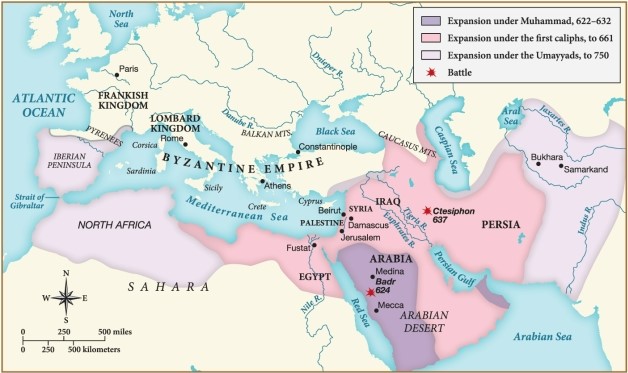
(Multiple Choice)
4.9/5 (84)
(84) 
Filters
- Essay(0)
- Multiple Choice(0)
- Short Answer(0)
- True False(0)
- Matching(0)