



 Chat with AI
Exam 7: The Transformation of the Roman Empire, 284-600 C.E

Exam 1: Early Western Civilization, 400,000-1000 B.C.E65 Questions
Exam 2: Near East Empires and the Reemergence of Civilization in Greece, 1000-500 B.C.E64 Questions
Exam 3: The Greek Golden Age, C 500-C 400 B.C.E65 Questions
Exam 4: From the Classical to the Hellenistic World, 400-30 B.C.E65 Questions
Exam 5: The Rise of Rome and Its Republic, 753-44 B.C.E64 Questions
Exam 6: The Creation of the Roman Empire, 44 B.C.E-284 C.E65 Questions
Exam 7: The Transformation of the Roman Empire, 284-600 C.E64 Questions
Exam 8: The Heirs of Rome: Islam, Byzantium, and Europe, 600-75065 Questions
Exam 9: From Centralization to Fragmentation, 750-105065 Questions
Exam 10: Commercial Quickening and Religious Reform, 1050-115065 Questions
Exam 11: The Flowering of the Middle Ages, 1150-121565 Questions
Exam 12: The Medieval Synthesis and Its Cracks, 1215-134065 Questions
Exam 13: Crisis and Renaissance, 1340-149265 Questions
Exam 14: Global Encounters and the Shock of the Reformation, 1492-156065 Questions
Exam 15: Wars of Religion and the Clash of Worldviews, 1560-164865 Questions
Exam 16: Absolutism, Constitutionalism, and the Search for Order, 1640-170065 Questions
Exam 17: The Atlantic System and Its Consequences, 1700-175065 Questions
Exam 18: The Promise of Enlightenment, 1750-178965 Questions
Exam 19: The Cataclysm of Revolution, 1789-179965 Questions
Exam 20: Napoleon and the Revolutionary Legacy, 1800-183065 Questions
Exam 21: Industrialization and Social Ferment, 1830-185064 Questions
Exam 22: Politics and Culture of the Nation-State, 1850-187065 Questions
Exam 23: Empire, Industry, and Everyday Life, 1870-189065 Questions
Exam 24: Modernity and the Road to War, 1890-191465 Questions
Exam 25: World War I and Its Aftermath, 1914-192965 Questions
Exam 26: The Great Depression and World War II, 1929-194565 Questions
Exam 27: The Cold War and the Remaking of Europe, 1945-1960s64 Questions
Exam 28: Postindustrial Society and the End of the Cold War Order, 1960s-198965 Questions
Exam 29: A New Globalism, 1989 to the Present65 Questions
Select questions type


Why did the Huns ultimately direct their energies westward and not toward the eastern half of the empire?
(Multiple Choice)
4.7/5  (92)
(92) Why did Rome lose its status as the Roman Empire's most important city as a result of Diocletian's reforms?
(Multiple Choice)
4.8/5 (86)
(86) Who were the Huns? How did their invasions start a "ripple effect" across Europe?
(Essay)
4.9/5 (94)
(94) Explain how Justinian's military campaigns, which successfully regained large parts of the old Roman Empire, actually weakened the empire.
(Essay)
4.9/5 (83)
(83) How did Diocletian use titles and court ceremony to reinforce and legitimize his demand for absolute obedience to his rule?
(Essay)
4.9/5 (85)
(85) How did Diocletian indicate his autocratic intentions when he came to power in 284?
(Multiple Choice)
4.9/5 (70)
(70) In his mammoth work The City of God, Augustine put forward the notion of original sin and argued that human beings had a duty to
(Multiple Choice)
4.7/5 (69)
(69) The Edict of Milan, promulgated by Constantine and Licinius in 313, decreed
(Multiple Choice)
4.9/5 (74)
(74) Why is the label "Germanic peoples" misleading when used to describe the non-Roman peoples who flooded into the empire?
(Multiple Choice)
4.8/5 (93)
(93) It is common to attribute the expansion of Christianity in the Roman Empire to the conversion of Constantine in 312. But in fact, this process was gradual rather than sudden. Why was this the case? Discuss the gradual Christianization of the Roman Empire from the reign of Constantine through the early sixth century.
(Essay)
4.8/5 (87)
(87) Why was Diocletian (r. 284-305) an unlikely candidate for emperor?
(Multiple Choice)
4.9/5 (92)
(92) By the time of Justinian's death in 565 C.E., which of the following regions had come under the control of the eastern Roman Empire?
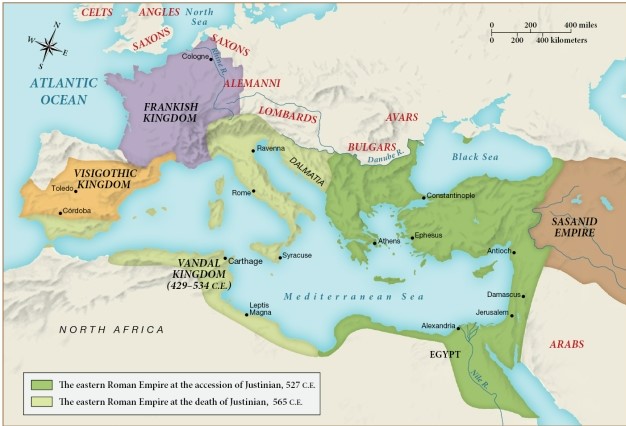
(Multiple Choice)
4.8/5 (86)
(86) Following the emperors' conversion to Christianity, the plight of the Jews
(Multiple Choice)
4.9/5 (81)
(81) Who exerted a strong influence on Justinian's rule despite a humble upbringing as the child of a bear trainer?
(Multiple Choice)
4.9/5 (72)
(72) What new obligations did the emperors impose on the curials, the social elite in the towns, in response to Rome's economic problems?
(Multiple Choice)
4.8/5 (76)
(76) Why did classical polytheist texts in Latin and Greek survive in the Byzantine Empire, even though its leaders had become ardent Christians?
(Multiple Choice)
4.9/5 (71)
(71) Discuss the ways in which the eastern empire preserved or attempted to preserve Greek and Roman culture.
(Essay)
4.8/5 (85)
(85) What was wergild? What was the principle behind it, and how does this explain why the murder of a woman of childbearing age required a higher wergild than that of an older woman?
(Essay)
4.7/5 (81)
(81) What was one of the primary attractions of monasticism for early Christians?
(Multiple Choice)
4.9/5 (90)
(90) 
Filters
- Essay(0)
- Multiple Choice(0)
- Short Answer(0)
- True False(0)
- Matching(0)