



 Chat with AI
Exam 21: Industrialization and Social Ferment, 1830-1850

Exam 1: Early Western Civilization, 400,000-1000 B.C.E65 Questions
Exam 2: Near East Empires and the Reemergence of Civilization in Greece, 1000-500 B.C.E64 Questions
Exam 3: The Greek Golden Age, C 500-C 400 B.C.E65 Questions
Exam 4: From the Classical to the Hellenistic World, 400-30 B.C.E65 Questions
Exam 5: The Rise of Rome and Its Republic, 753-44 B.C.E64 Questions
Exam 6: The Creation of the Roman Empire, 44 B.C.E-284 C.E65 Questions
Exam 7: The Transformation of the Roman Empire, 284-600 C.E64 Questions
Exam 8: The Heirs of Rome: Islam, Byzantium, and Europe, 600-75065 Questions
Exam 9: From Centralization to Fragmentation, 750-105065 Questions
Exam 10: Commercial Quickening and Religious Reform, 1050-115065 Questions
Exam 11: The Flowering of the Middle Ages, 1150-121565 Questions
Exam 12: The Medieval Synthesis and Its Cracks, 1215-134065 Questions
Exam 13: Crisis and Renaissance, 1340-149265 Questions
Exam 14: Global Encounters and the Shock of the Reformation, 1492-156065 Questions
Exam 15: Wars of Religion and the Clash of Worldviews, 1560-164865 Questions
Exam 16: Absolutism, Constitutionalism, and the Search for Order, 1640-170065 Questions
Exam 17: The Atlantic System and Its Consequences, 1700-175065 Questions
Exam 18: The Promise of Enlightenment, 1750-178965 Questions
Exam 19: The Cataclysm of Revolution, 1789-179965 Questions
Exam 20: Napoleon and the Revolutionary Legacy, 1800-183065 Questions
Exam 21: Industrialization and Social Ferment, 1830-185064 Questions
Exam 22: Politics and Culture of the Nation-State, 1850-187065 Questions
Exam 23: Empire, Industry, and Everyday Life, 1870-189065 Questions
Exam 24: Modernity and the Road to War, 1890-191465 Questions
Exam 25: World War I and Its Aftermath, 1914-192965 Questions
Exam 26: The Great Depression and World War II, 1929-194565 Questions
Exam 27: The Cold War and the Remaking of Europe, 1945-1960s64 Questions
Exam 28: Postindustrial Society and the End of the Cold War Order, 1960s-198965 Questions
Exam 29: A New Globalism, 1989 to the Present65 Questions
Select questions type


What was the aim of the Chartist movement, which organized in Britain in the 1830s?
(Multiple Choice)
5.0/5  (82)
(82) What issue took precedence over social reform and constitutional changes in the German states in 1848?
(Multiple Choice)
4.8/5 (84)
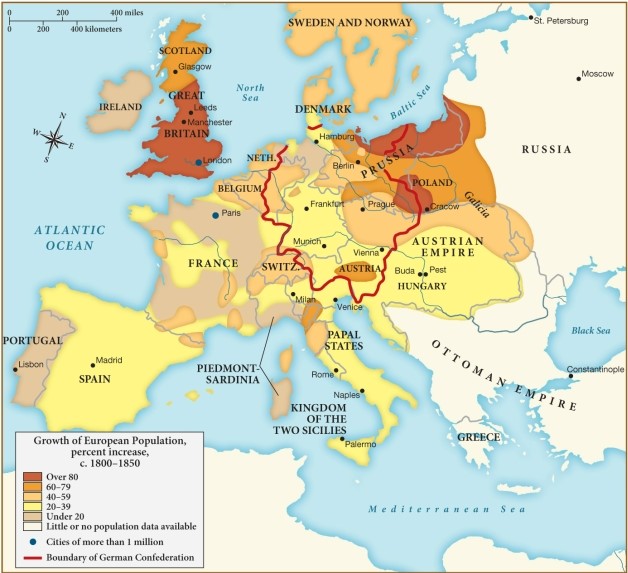
(84) During the nineteenth century, industrialization often led to a significant increase in population in the region that had industrialized. Based on this map, which of the following European nations likely had very little, or very slow, industrial development during this time?
(Multiple Choice)
5.0/5 (83)
(83) Middle-class reformers became concerned about what they perceived to be the urban working classes' increasing
(Multiple Choice)
4.8/5 (88)
(88) The crop failures of the mid-1840s not only drove up the price of food but also
(Multiple Choice)
5.0/5 (77)
(77) In 1848, the Chartists staged the largest demonstrations in their ten-year history, yet they failed to win their point because
(Multiple Choice)
4.7/5 (94)
(94) Why did the 1848 revolution in Hungary ultimately fail to achieve political autonomy?
(Multiple Choice)
4.8/5 (78)
(78) According to the ideology that historians call domesticity, what role were women expected to play in society?
(Multiple Choice)
4.9/5 (70)
(70) What was the reasoning behind the 1834 passage of a new poor law in Great Britain, dubbed by its critics the "Starvation Act"?
(Multiple Choice)
4.9/5 (73)
(73) Why was nationalism a particularly complex and explosive issue in the Austrian Empire? What role did nationalism play in the attempted revolutions of 1848, and what was the government's response?
(Essay)
4.8/5 (81)
(81) How did peasants in Europe generally respond to the spread of industrialization in the 1840s?
(Multiple Choice)
4.9/5 (71)
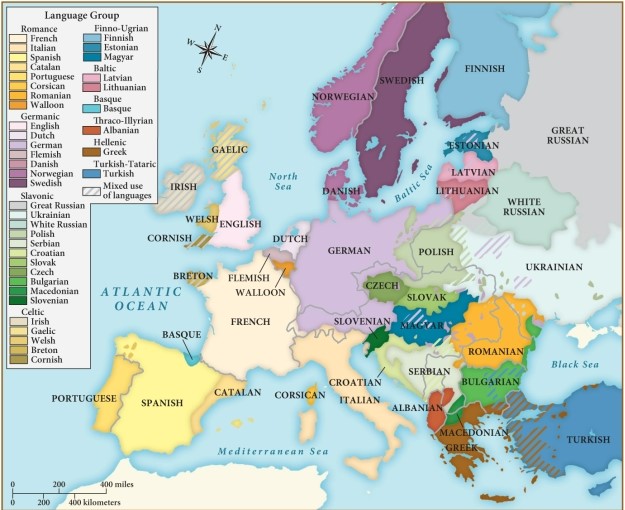
(71) The subject of the map reproduced here directly relates to the rise of what nineteenth-century phenomenon?
(Multiple Choice)
4.9/5 (79)
(79) What was the significance of the Factory Act of 1833 in Great Britain?
(Multiple Choice)
4.9/5 (69)
(69) What major issues were at the root of the revolutions of 1848? Describe the similarities and differences between the causes and outcomes of the revolutions in France, Italy, Prussia, and Austria.
(Essay)
4.8/5 (82)
(82) How did the reassertion of conservative rule after 1848 harden gender definitions?
(Essay)
5.0/5 (89)
(89) Which nation became the first site of the Industrial Revolution? List at least three factors that fostered industrialization in that country. How did developments in technology contribute to the Industrial Revolution?
(Essay)
4.9/5 (73)
(73) The failure of the 1848 uprisings in Italy, Germany, and the Austrian Empire had their individual causes, but they shared which major problem?
(Multiple Choice)
4.8/5 (86)
(86) Why did slavery and the slave trade continue for several decades after Britain and France abolished its practice in their empires in the 1830s and 1840s?
(Multiple Choice)
4.9/5 (79)
(79) Who were Louis Blanc and Pierre-Joseph Proudhon, and how did they contribute to the development of a workers' movement in France?
(Essay)
4.8/5 (75)
(75) Young Italy, an Italian nationalist group, was founded in 1831 by what exiled nationalist?
(Multiple Choice)
4.9/5 (75)
(75) 
Filters
- Essay(0)
- Multiple Choice(0)
- Short Answer(0)
- True False(0)
- Matching(0)