



 Chat with AI
Exam 21: Industrialization and Social Ferment, 1830-1850

Exam 1: Early Western Civilization, 400,000-1000 B.C.E65 Questions
Exam 2: Near East Empires and the Reemergence of Civilization in Greece, 1000-500 B.C.E64 Questions
Exam 3: The Greek Golden Age, C 500-C 400 B.C.E65 Questions
Exam 4: From the Classical to the Hellenistic World, 400-30 B.C.E65 Questions
Exam 5: The Rise of Rome and Its Republic, 753-44 B.C.E64 Questions
Exam 6: The Creation of the Roman Empire, 44 B.C.E-284 C.E65 Questions
Exam 7: The Transformation of the Roman Empire, 284-600 C.E64 Questions
Exam 8: The Heirs of Rome: Islam, Byzantium, and Europe, 600-75065 Questions
Exam 9: From Centralization to Fragmentation, 750-105065 Questions
Exam 10: Commercial Quickening and Religious Reform, 1050-115065 Questions
Exam 11: The Flowering of the Middle Ages, 1150-121565 Questions
Exam 12: The Medieval Synthesis and Its Cracks, 1215-134065 Questions
Exam 13: Crisis and Renaissance, 1340-149265 Questions
Exam 14: Global Encounters and the Shock of the Reformation, 1492-156065 Questions
Exam 15: Wars of Religion and the Clash of Worldviews, 1560-164865 Questions
Exam 16: Absolutism, Constitutionalism, and the Search for Order, 1640-170065 Questions
Exam 17: The Atlantic System and Its Consequences, 1700-175065 Questions
Exam 18: The Promise of Enlightenment, 1750-178965 Questions
Exam 19: The Cataclysm of Revolution, 1789-179965 Questions
Exam 20: Napoleon and the Revolutionary Legacy, 1800-183065 Questions
Exam 21: Industrialization and Social Ferment, 1830-185064 Questions
Exam 22: Politics and Culture of the Nation-State, 1850-187065 Questions
Exam 23: Empire, Industry, and Everyday Life, 1870-189065 Questions
Exam 24: Modernity and the Road to War, 1890-191465 Questions
Exam 25: World War I and Its Aftermath, 1914-192965 Questions
Exam 26: The Great Depression and World War II, 1929-194565 Questions
Exam 27: The Cold War and the Remaking of Europe, 1945-1960s64 Questions
Exam 28: Postindustrial Society and the End of the Cold War Order, 1960s-198965 Questions
Exam 29: A New Globalism, 1989 to the Present65 Questions
Select questions type


What does the "putting-out" system of the nineteenth century refer to?
(Multiple Choice)
4.9/5  (74)
(74) According to this map, which of the following countries dominated in the mining of coal around 1850?
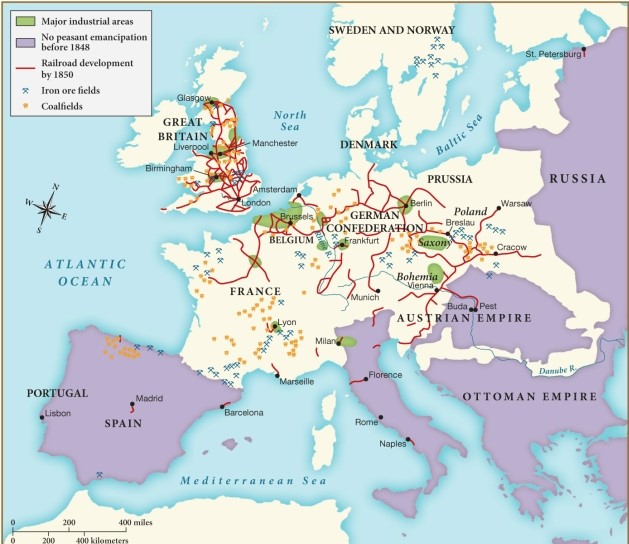
(Multiple Choice)
4.8/5 (70)
(70) What were the "hungry forties," and how did they contribute to political change?
(Essay)
4.8/5 (92)
(92) Where was the most significant nationalist movement in western Europe?
(Multiple Choice)
4.8/5 (78)
(78) What was the main difference between colonialism and imperialism?
(Multiple Choice)
4.8/5 (88)
(88) Beginning in the 1840s, what factory-produced good became increasingly important to industrial economies?
(Multiple Choice)
4.8/5 (67)
(67) What were the "June Days," and what do they reveal about divisions among those involved?
(Essay)
4.8/5 (79)
(79) The Economist was established in 1843 to promote the free-trade goals of what organization?
(Multiple Choice)
4.9/5 (86)
(86) According to this map, which region experienced cholera only during its second wave, from 1840 through 1855?
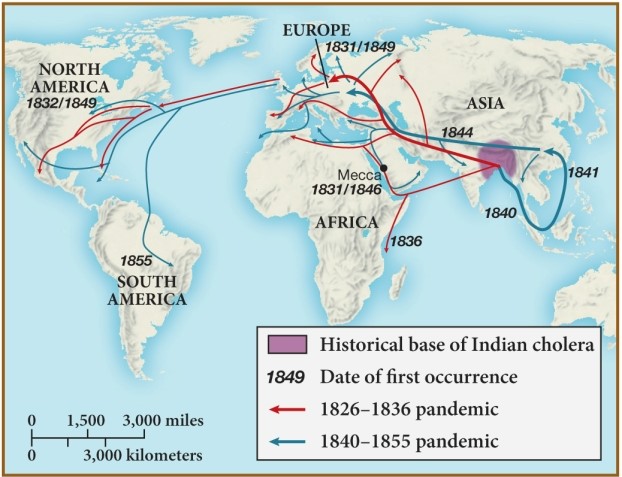
(Multiple Choice)
4.9/5 (79)
(79) Charles Dickens (1812-1870) wrote with passion and insight about working-class men and women because he
(Multiple Choice)
4.9/5 (87)
(87) Why did the 1846 Polish insurrection, in which Polish exiles tried to stir the province of Galicia to rise up against Austria, end in failure?
(Multiple Choice)
4.8/5 (84)
(84) Who was Adam Mickiewicz, and how did he shape Polish nationalism in the early nineteenth century?
(Essay)
4.8/5 (82)
(82) The Welsh-born manufacturer Robert Owen was known for founding what political movement?
(Multiple Choice)
4.9/5 (77)
(77) What was "revolutionary" about the Industrial Revolution? In what ways did it alter the lives of Europeans and transform the social and political landscape of Europe? In your answer, be sure to consider factors like the shift in labor patterns, the impact of urbanization, and political responses to industrialization.
(Essay)
4.8/5 (69)
(69) The rapid urbanization that developed as a result of industrialization caused European cities to
(Multiple Choice)
4.8/5 (79)
(79) Italian nationalists expelled the pope and declared Rome a republic until the pope was reinstalled by
(Multiple Choice)
4.9/5 (87)
(87) Which of the following diseases had the most devastating impact on cities in the first half of the nineteenth century?
(Multiple Choice)
4.9/5 (85)
(85) In terms of their impact, what set Marx and Engels apart from other socialist and communist intellectuals?
(Multiple Choice)
4.9/5 (80)
(80) The advent of what new artistic medium in 1839 created enormous potential for portraying the social realities of the industrial age?
(Multiple Choice)
4.8/5 (91)
(91) Key inventions in which industry drove the development of the Industrial Revolution?
(Multiple Choice)
4.9/5 (76)
(76) 
Filters
- Essay(0)
- Multiple Choice(0)
- Short Answer(0)
- True False(0)
- Matching(0)