



 Chat with AI
Exam 25: World War I and Its Aftermath, 1914-1929

Exam 1: Early Western Civilization, 400,000-1000 B.C.E65 Questions
Exam 2: Near East Empires and the Reemergence of Civilization in Greece, 1000-500 B.C.E64 Questions
Exam 3: The Greek Golden Age, C 500-C 400 B.C.E65 Questions
Exam 4: From the Classical to the Hellenistic World, 400-30 B.C.E65 Questions
Exam 5: The Rise of Rome and Its Republic, 753-44 B.C.E64 Questions
Exam 6: The Creation of the Roman Empire, 44 B.C.E-284 C.E65 Questions
Exam 7: The Transformation of the Roman Empire, 284-600 C.E64 Questions
Exam 8: The Heirs of Rome: Islam, Byzantium, and Europe, 600-75065 Questions
Exam 9: From Centralization to Fragmentation, 750-105065 Questions
Exam 10: Commercial Quickening and Religious Reform, 1050-115065 Questions
Exam 11: The Flowering of the Middle Ages, 1150-121565 Questions
Exam 12: The Medieval Synthesis and Its Cracks, 1215-134065 Questions
Exam 13: Crisis and Renaissance, 1340-149265 Questions
Exam 14: Global Encounters and the Shock of the Reformation, 1492-156065 Questions
Exam 15: Wars of Religion and the Clash of Worldviews, 1560-164865 Questions
Exam 16: Absolutism, Constitutionalism, and the Search for Order, 1640-170065 Questions
Exam 17: The Atlantic System and Its Consequences, 1700-175065 Questions
Exam 18: The Promise of Enlightenment, 1750-178965 Questions
Exam 19: The Cataclysm of Revolution, 1789-179965 Questions
Exam 20: Napoleon and the Revolutionary Legacy, 1800-183065 Questions
Exam 21: Industrialization and Social Ferment, 1830-185064 Questions
Exam 22: Politics and Culture of the Nation-State, 1850-187065 Questions
Exam 23: Empire, Industry, and Everyday Life, 1870-189065 Questions
Exam 24: Modernity and the Road to War, 1890-191465 Questions
Exam 25: World War I and Its Aftermath, 1914-192965 Questions
Exam 26: The Great Depression and World War II, 1929-194565 Questions
Exam 27: The Cold War and the Remaking of Europe, 1945-1960s64 Questions
Exam 28: Postindustrial Society and the End of the Cold War Order, 1960s-198965 Questions
Exam 29: A New Globalism, 1989 to the Present65 Questions
Select questions type


The Russian civil war pitted which two groups against each other?
(Multiple Choice)
4.7/5  (77)
(77) How did women's participation in the war effort on the home front affect debates over gender roles?
(Multiple Choice)
4.9/5 (74)
(74) The Peace of Paris, which was composed of a cluster of individual treaties negotiated between 1919 and 1920, redrew the map of Europe in which of the following ways?
(Multiple Choice)
4.7/5 (76)
(76) How did Benito Mussolini consolidate his power and protect himself from political attack after becoming prime minister?
(Essay)
4.7/5 (68)
(68) What was the single most significant aspect of German military policy in terms of its provocative effect on the United States and subsequent U.S. involvement in the war?
(Multiple Choice)
4.8/5 (82)
(82) Throughout Europe, the efforts of governments to support veterans who returned home after World War I were
(Multiple Choice)
4.9/5 (87)
(87) Among all the combatants the world over, which country suffered the greatest number of casualties, with some 7.5 million dead during World War I?
(Multiple Choice)
4.9/5 (61)
(61) How did postwar popular culture reflect the political and social tumult of the 1920s?
(Essay)
4.8/5 (76)
(76) One of the main tasks of the League of Nations was the administration of the mandate system, which entailed
(Multiple Choice)
4.9/5 (77)
(77) What allowed Benito Mussolini, the leader of the Fascists in Italy, to become prime minister in 1922?
(Multiple Choice)
4.8/5 (75)
(75) The "cult of the offensive," a strategy that officers on both sides in World War I wholeheartedly adopted, was uniquely unsuited to
(Multiple Choice)
4.8/5 (84)
(84) Despite the intention of the Peace of Paris, which was to prevent future conflict in Europe, its resulting treaties actually made future conflicts more likely. Explain why this was the case and what factors played a role in the negotiation and implementation of the postwar settlement.
(Essay)
4.8/5 (81)
(81) Adolf Hitler's rise to power in Germany was slowed in the 1920s by
(Multiple Choice)
4.7/5 (75)
(75) What did the German high command do in October 1918 to deflect blame for Germany's total defeat away from the military?
(Multiple Choice)
5.0/5 (85)
(85) According to this map, which of the following territories did Russia lose after the Treaty of Brest-Litovsk?
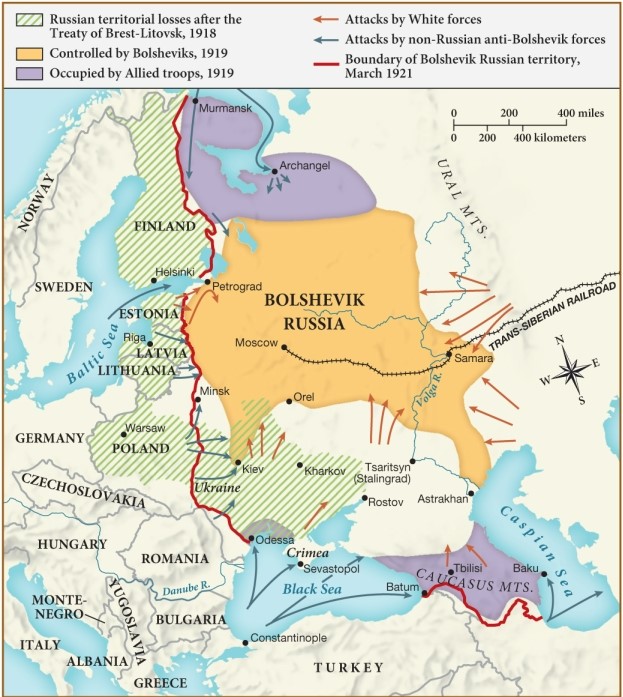
(Multiple Choice)
4.8/5 (88)
(88) What was the Bauhaus movement, and how was it a reaction to the carnage of the Great War?
(Essay)
4.8/5 (83)
(83) Of all the penalties imposed by the Treaty of Versailles, the one that generated the most outrage in Germany was the
(Multiple Choice)
5.0/5 (81)
(81) Which development of the 1920s made it easier for ordinary people to obtain new consumer goods such as refrigerators, washing machines, and stoves?
(Multiple Choice)
4.9/5 (73)
(73) 
Filters
- Essay(0)
- Multiple Choice(0)
- Short Answer(0)
- True False(0)
- Matching(0)