



 Chat with AI
Exam 5: Transport of Solutes and Water

Exam 1: Animals and Environments: Function on the Ecological Stage66 Questions
Exam 2: Molecules and Cells in Animal Physiology65 Questions
Exam 3: Genomics, Proteomics, and Related Approaches to Physiology64 Questions
Exam 4: Physiological Development and Epigenetics59 Questions
Exam 5: Transport of Solutes and Water67 Questions
Exam 6: Nutrition, Feeding, and Digestion77 Questions
Exam 7: Energy Metabolism68 Questions
Exam 8: Aerobic and Anaerobic Forms of Metabolism75 Questions
Exam 9: The Energetics of Aerobic Activity72 Questions
Exam 10: Thermal Relations84 Questions
Exam 11: Food, Energy, and Temperature at Work: The Lives of Mammals in Frigid Places76 Questions
Exam 12: Neurons59 Questions
Exam 13: Synapses58 Questions
Exam 14: Sensory Processes67 Questions
Exam 15: Nervous System Organization and Biological Clocks59 Questions
Exam 16: Endocrine and Neuroendocrine Physiology69 Questions
Exam 17: Reproduction68 Questions
Exam 18: Integrating Systems at Work: Animal Navigation61 Questions
Exam 19: Control of Movement71 Questions
Exam 20: Muscle78 Questions
Exam 21: Movement and Muscle at Work: Plasticity in Response to Use and Disuse67 Questions
Exam 22: Introduction to Oxygen and Carbon Dioxide in Physiology65 Questions
Exam 23: External Respiration: the Physiology of Breathing70 Questions
Exam 24: Transport of Oxygen and Carbon Dioxide in Body Fluids With an Introduction to Acid- Base Physiology68 Questions
Exam 25: Circulation72 Questions
Exam 26: Oxygen, Carbon Dioxide, and Internal Transport at Work: Diving by Marine Mammals63 Questions
Exam 27: Water and Salt Physiology: Introduction and Mechanisms72 Questions
Exam 29: Kidneys and Excretion With Notes on Nitrogen Excretion89 Questions
Exam 30: Water, Salts, and Excretion at Work: Mammals of Deserts and Dry Savannas64 Questions
Exam 28: Water and Salt Physiology of Animals in Their Environments87 Questions
Select questions type


Refer to the figure shown.
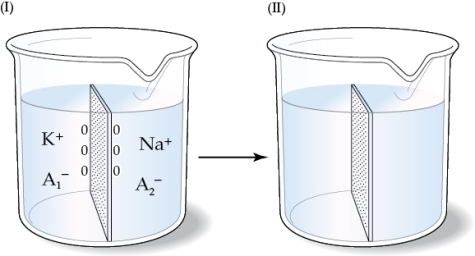 If the figure on the left represents the initial state and the membrane shown in the beakers is permeable only to Na+, which manipulation would cause a net negative charge on the left side of the membrane once the system comes to equilibrium?
 (Multiple Choice)
4.9/5  (75)
(75) Refer to the figure shown. Assume that the two pistons have the same mass and move without friction, the center membrane in the diagram is permeable only to water, and solutes are shaded according to concentration (the darker the shading, the higher the concentration).
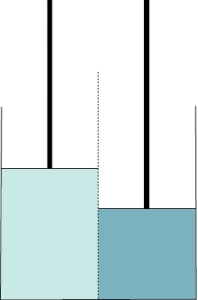 If the diagram represents the starting condition, what will occur as the solutions achieve equilibrium?
 (Multiple Choice)
4.7/5 (74)
(74) Outward diffusion of a substance from an animal cell increases the concentration of that substance around the outer surface of the cell. If this process continues,
(Multiple Choice)
4.9/5 (77)
(77) Refer to the figure shown. Assume that the two pistons have the same mass and move without friction, the center membrane in the diagram is permeable only to water, and solutes are shaded according to concentration (the darker the shading, the higher the concentration).
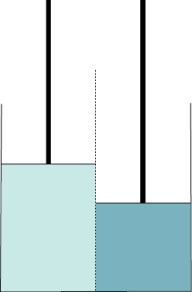 If a piston moved up because of water movement, could it be physically pushed back down to force water through the membrane?
 (Multiple Choice)
4.7/5 (86)
(86) Which statement regarding channels and transporters is false?
(Multiple Choice)
4.8/5 (87)
(87) Transporter proteins on freshwater fish gills transport sodium and chloride
(Multiple Choice)
4.9/5 (81)
(81) Refer to the figure shown. Assume that the two pistons have the same mass and move without friction, the center membrane in the diagram is permeable only to water, and solutes are shaded according to concentration (the darker the shading, the higher the concentration).
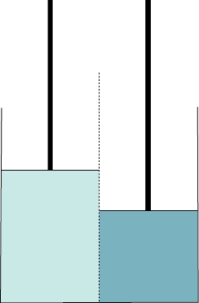 The piston on the left would move upward if the membrane were permeable to only _______ and the solution on the left was _______ and the solution on the right was _______.
 (Multiple Choice)
4.9/5 (68)
(68) Refer to the figure shown.
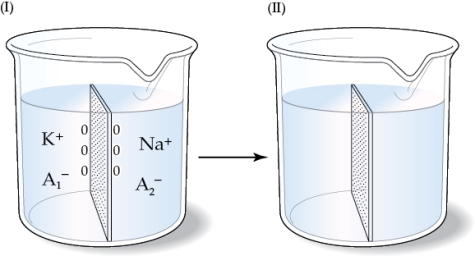 If the beaker on the left represents the initial state and the membrane shown in the beakers is permeable to K+ and Na+,
 (Multiple Choice)
4.8/5 (67)
(67) Refer to the figure shown.
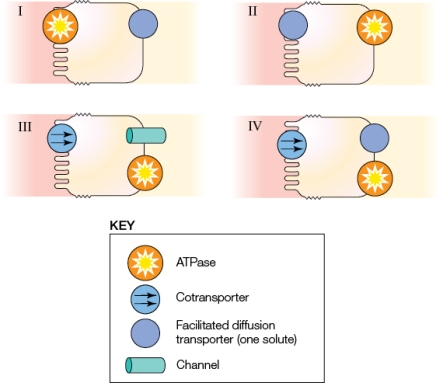 Which of the panels in the figure represents passive diffusion?
 (Multiple Choice)
4.9/5 (84)
(84) Discuss the electrochemical equilibrium of Cl‒ across a typical animal cell.
(Essay)
4.8/5 (91)
(91) In the animal cell, the overall electrical effects on Cl‒ diffusion cause Cl‒ to _______ the cell.
(Multiple Choice)
4.7/5 (85)
(85) In what way does facilitated diffusion resemble simple diffusion as well as active transport?
(Essay)
4.7/5 (92)
(92) Outward diffusion of a substance from an animal cell increases the concentration of that substance around the outer surface of the cell. This surface is called the
(Multiple Choice)
4.9/5 (76)
(76) Discuss how a boundary layer forms outside of a cell and how it can impede further diffusion.
(Essay)
4.9/5 (88)
(88) Choose the situation that would generate the greatest amount of hydrostatic pressure.
(Multiple Choice)
4.9/5 (84)
(84) Most terrestrial vertebrates typically have internal fluids of approximately
(Multiple Choice)
4.8/5 (90)
(90) Refer to the figure shown.
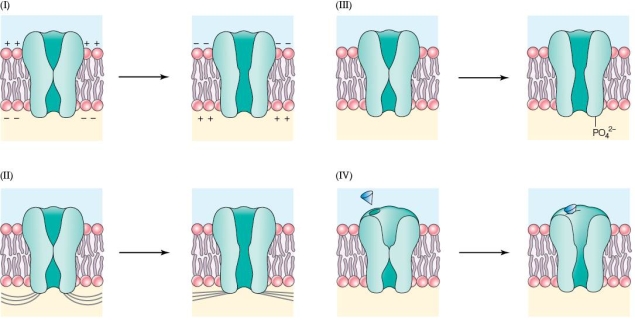 In which panel do the channels open and close based on chemical bonding?
 (Multiple Choice)
4.9/5 (79)
(79) 
Filters
- Essay(0)
- Multiple Choice(0)
- Short Answer(0)
- True False(0)
- Matching(0)