



 Chat with AI
Exam 5: Transport of Solutes and Water

Exam 1: Animals and Environments: Function on the Ecological Stage66 Questions
Exam 2: Molecules and Cells in Animal Physiology65 Questions
Exam 3: Genomics, Proteomics, and Related Approaches to Physiology64 Questions
Exam 4: Physiological Development and Epigenetics59 Questions
Exam 5: Transport of Solutes and Water67 Questions
Exam 6: Nutrition, Feeding, and Digestion77 Questions
Exam 7: Energy Metabolism68 Questions
Exam 8: Aerobic and Anaerobic Forms of Metabolism75 Questions
Exam 9: The Energetics of Aerobic Activity72 Questions
Exam 10: Thermal Relations84 Questions
Exam 11: Food, Energy, and Temperature at Work: The Lives of Mammals in Frigid Places76 Questions
Exam 12: Neurons59 Questions
Exam 13: Synapses58 Questions
Exam 14: Sensory Processes67 Questions
Exam 15: Nervous System Organization and Biological Clocks59 Questions
Exam 16: Endocrine and Neuroendocrine Physiology69 Questions
Exam 17: Reproduction68 Questions
Exam 18: Integrating Systems at Work: Animal Navigation61 Questions
Exam 19: Control of Movement71 Questions
Exam 20: Muscle78 Questions
Exam 21: Movement and Muscle at Work: Plasticity in Response to Use and Disuse67 Questions
Exam 22: Introduction to Oxygen and Carbon Dioxide in Physiology65 Questions
Exam 23: External Respiration: the Physiology of Breathing70 Questions
Exam 24: Transport of Oxygen and Carbon Dioxide in Body Fluids With an Introduction to Acid- Base Physiology68 Questions
Exam 25: Circulation72 Questions
Exam 26: Oxygen, Carbon Dioxide, and Internal Transport at Work: Diving by Marine Mammals63 Questions
Exam 27: Water and Salt Physiology: Introduction and Mechanisms72 Questions
Exam 29: Kidneys and Excretion With Notes on Nitrogen Excretion89 Questions
Exam 30: Water, Salts, and Excretion at Work: Mammals of Deserts and Dry Savannas64 Questions
Exam 28: Water and Salt Physiology of Animals in Their Environments87 Questions
Select questions type


When two solutions exchange water by osmosis, water always moves
(Multiple Choice)
4.8/5  (69)
(69) Which of the following statements about ion transport in the typical freshwater fish gill is true?
(Multiple Choice)
4.8/5 (81)
(81) Refer to the figure shown.
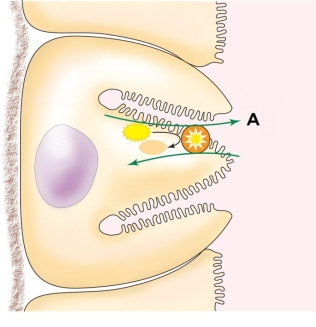 What type of process is shown in the figure?
 (Multiple Choice)
4.9/5 (94)
(94) The number of dissolved entities per unit of volume defines
(Multiple Choice)
4.7/5 (83)
(83) A solution that has a concentration effect on diffusion that is equal but opposite to the electrical effect is said to be
(Multiple Choice)
4.8/5 (80)
(80) A 1-M solution of serum albumin (66,000 daltons) has _______ a 1-M solution of urea (66 daltons).
(Multiple Choice)
4.9/5 (83)
(83) If you were to drop a mammalian red blood cell into a 10 mOsm solution, the red cell would _______ in this _______ solution.
(Multiple Choice)
4.8/5 (78)
(78) Refer to the figure shown.
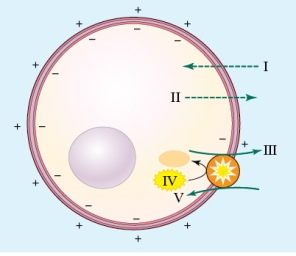 At which location(s) in the figure is K+ moving into or out of the cell?
 (Multiple Choice)
4.7/5 (92)
(92) Refer to the figure shown.
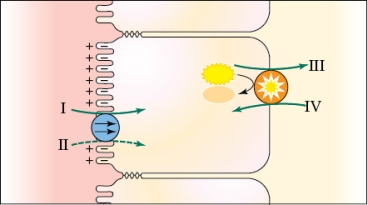 Which letter in the figure represents glucose?
 (Multiple Choice)
4.9/5 (80)
(80) Refer to the figure shown.
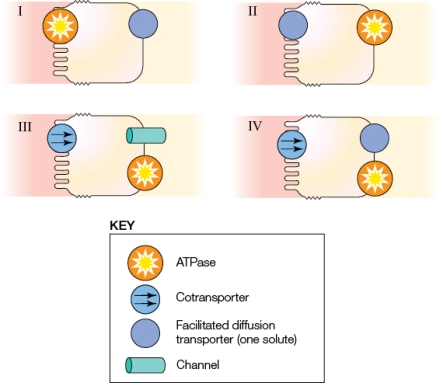 Which of the panels most accurately represents the mechanism for glucose transport at the epithelium?
 (Multiple Choice)
4.8/5 (70)
(70) Refer to the figure shown.
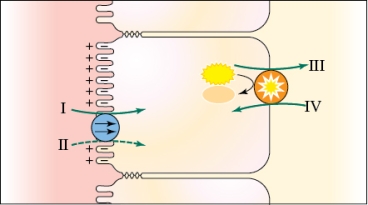 In the study of glucose transport, which pair of numerals in the figure represents the same ion?
 (Multiple Choice)
4.9/5 (86)
(86) Refer to the figure shown.
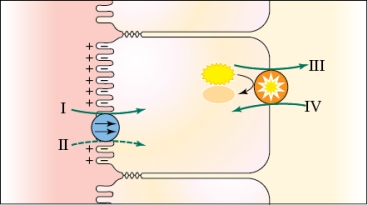 How does glucose cross the basolateral membrane?
 (Multiple Choice)
4.9/5 (78)
(78) Support or refute the following statement and provide evidence for your
(Short Answer)
4.9/5 (85)
(85) Refer to the figure shown.
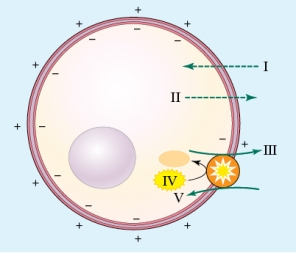 At what point in the figure is energy being used?
 (Multiple Choice)
4.7/5 (70)
(70) On the cell membrane, the Na+‒ K+ pump transports _______ in for every _______ that it transports out.
(Multiple Choice)
4.9/5 (82)
(82) The inside of a typical animal cell is negatively charged. Therefore, it makes sense that Na+ diffuses into the cell if there are channels that allow it to do so. Considering K+ has the same charge as Na+, why will it diffuse out of the cell if there are channels that allow it to do so?
(Essay)
4.8/5 (76)
(76) 
Filters
- Essay(0)
- Multiple Choice(0)
- Short Answer(0)
- True False(0)
- Matching(0)