



 Chat with AI
Exam 7: Energy Metabolism

Exam 1: Animals and Environments: Function on the Ecological Stage66 Questions
Exam 2: Molecules and Cells in Animal Physiology65 Questions
Exam 3: Genomics, Proteomics, and Related Approaches to Physiology64 Questions
Exam 4: Physiological Development and Epigenetics59 Questions
Exam 5: Transport of Solutes and Water67 Questions
Exam 6: Nutrition, Feeding, and Digestion77 Questions
Exam 7: Energy Metabolism68 Questions
Exam 8: Aerobic and Anaerobic Forms of Metabolism75 Questions
Exam 9: The Energetics of Aerobic Activity72 Questions
Exam 10: Thermal Relations84 Questions
Exam 11: Food, Energy, and Temperature at Work: The Lives of Mammals in Frigid Places76 Questions
Exam 12: Neurons59 Questions
Exam 13: Synapses58 Questions
Exam 14: Sensory Processes67 Questions
Exam 15: Nervous System Organization and Biological Clocks59 Questions
Exam 16: Endocrine and Neuroendocrine Physiology69 Questions
Exam 17: Reproduction68 Questions
Exam 18: Integrating Systems at Work: Animal Navigation61 Questions
Exam 19: Control of Movement71 Questions
Exam 20: Muscle78 Questions
Exam 21: Movement and Muscle at Work: Plasticity in Response to Use and Disuse67 Questions
Exam 22: Introduction to Oxygen and Carbon Dioxide in Physiology65 Questions
Exam 23: External Respiration: the Physiology of Breathing70 Questions
Exam 24: Transport of Oxygen and Carbon Dioxide in Body Fluids With an Introduction to Acid- Base Physiology68 Questions
Exam 25: Circulation72 Questions
Exam 26: Oxygen, Carbon Dioxide, and Internal Transport at Work: Diving by Marine Mammals63 Questions
Exam 27: Water and Salt Physiology: Introduction and Mechanisms72 Questions
Exam 29: Kidneys and Excretion With Notes on Nitrogen Excretion89 Questions
Exam 30: Water, Salts, and Excretion at Work: Mammals of Deserts and Dry Savannas64 Questions
Exam 28: Water and Salt Physiology of Animals in Their Environments87 Questions
Select questions type


Assume that the standard allometric equation (M = aWb) applies to a given species. Weight-specific metabolic rate will not depend on weight when
(Multiple Choice)
4.9/5  (92)
(92) Refer to the figure.
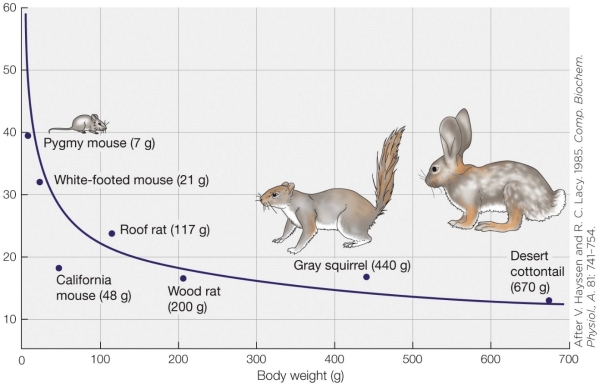 Based on the graph, change the scale of both axes and change the y axis units to be non-mass-specific. What is the best description of the line that fits the replotted data?
 (Multiple Choice)
4.8/5 (78)
(78) As part of an exercise program, a person holds a heavy weight above the ground for 10 minutes without moving the weight. Is the person doing work?
(Essay)
4.8/5 (79)
(79) If an animal's metabolic rate is measured in a respirometer that has a continuous stream of air flowing through it, the type of calorimetry is called _______ and the type of respirometry is called _______.
(Multiple Choice)
4.8/5 (81)
(81) For which macromolecule is the conversion factor for heat to amount of oxygen consumed furthest from the conversion factor for heat to amount of carbon dioxide produced?
(Multiple Choice)
4.8/5 (73)
(73) Sprinting is an activity that relies heavily on anaerobic metabolism over short periods of time. From a conceptual perspective, what would be the most accurate way to measure metabolic rate during sprinting?
(Multiple Choice)
4.7/5 (66)
(66) Suppose you use indirect calorimetry to estimate an animal's metabolic rate and you do not know what foodstuff the animal is oxidizing. Is it better to estimate energy use from O2 or CO2? Why?
(Essay)
4.9/5 (76)
(76) You measure the metabolic rate of a group of poikilotherms that has never been studied before. Compared to the relationship between metabolic rate and weight for birds, the value of a for the new group is likely to be _______ and the value of b is likely to be _______.
(Multiple Choice)
4.9/5 (73)
(73) Rubner's surface "law" cannot be applied to fish and crabs because
(Multiple Choice)
4.9/5 (79)
(79) Refer to the figure.
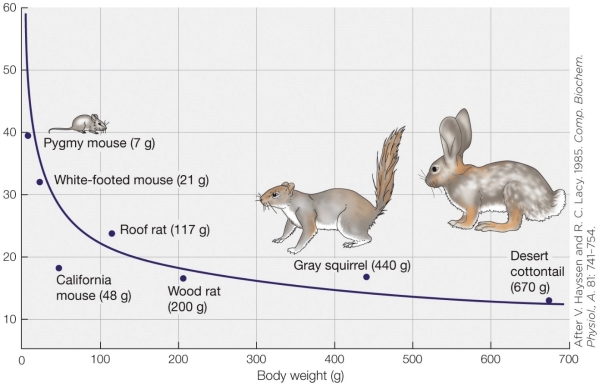 Where on the graph would you plot a wood frog?
 (Multiple Choice)
4.8/5 (82)
(82) Suppose that W (weight) for groups of big and little eaters has been measured in grams. Daily food consumption of big eaters is described by the allometric equation: food (g/day) = 5 W0.67. Daily food consumption of little eaters is described by the allometric equation: food (g/day) = 0.75 W0.67. Each day, a 1-g big eater will need _______ more food than a 1-g little eater.
(Multiple Choice)
4.7/5 (76)
(76) Suppose the value of b for the allometric equation for maximal metabolic rate (MMR) and body weight is 0.87. The exponent for the equation relating the mass-specific MMR to body weight would be
(Multiple Choice)
4.8/5 (81)
(81) The increase in the metabolic rate of an animal that results from eating food is called
(Multiple Choice)
5.0/5 (78)
(78) Attempts to explain the mechanistic basis for the allometric scaling of metabolic rate with size have focused mostly on the
(Multiple Choice)
4.8/5 (89)
(89) Specific conditions must apply when either basal or standard metabolic rate is being measured. The animals must be
(Multiple Choice)
4.9/5 (84)
(84) A person's resting heat production is approximately equivalent to that of a _______ incandescent light bulb.
(Multiple Choice)
4.7/5 (78)
(78) Suppose you use direct calorimetry to measure heat production by a person picking s out of a box on the floor and stacking them onto a bookshelf. Is the measure of heat production an accurate indicator of the person's metabolic rate? Why or why not?
(Essay)
4.8/5 (85)
(85) Animals need _______ to create and maintain internal organization.
(Multiple Choice)
4.8/5 (83)
(83) In the equation M =aWb, a and b are constants. Why, then, do the values of a and b vary across different groups of animals or even with different samples from a related group of animals?
(Essay)
4.9/5 (68)
(68) The exponent for the relationship between metabolic rate and weight
(Multiple Choice)
4.8/5 (74)
(74) 
Filters
- Essay(0)
- Multiple Choice(0)
- Short Answer(0)
- True False(0)
- Matching(0)