



 Chat with AI
Exam 14: Sensory Processes

Exam 1: Animals and Environments: Function on the Ecological Stage66 Questions
Exam 2: Molecules and Cells in Animal Physiology65 Questions
Exam 3: Genomics, Proteomics, and Related Approaches to Physiology64 Questions
Exam 4: Physiological Development and Epigenetics59 Questions
Exam 5: Transport of Solutes and Water67 Questions
Exam 6: Nutrition, Feeding, and Digestion77 Questions
Exam 7: Energy Metabolism68 Questions
Exam 8: Aerobic and Anaerobic Forms of Metabolism75 Questions
Exam 9: The Energetics of Aerobic Activity72 Questions
Exam 10: Thermal Relations84 Questions
Exam 11: Food, Energy, and Temperature at Work: The Lives of Mammals in Frigid Places76 Questions
Exam 12: Neurons59 Questions
Exam 13: Synapses58 Questions
Exam 14: Sensory Processes67 Questions
Exam 15: Nervous System Organization and Biological Clocks59 Questions
Exam 16: Endocrine and Neuroendocrine Physiology69 Questions
Exam 17: Reproduction68 Questions
Exam 18: Integrating Systems at Work: Animal Navigation61 Questions
Exam 19: Control of Movement71 Questions
Exam 20: Muscle78 Questions
Exam 21: Movement and Muscle at Work: Plasticity in Response to Use and Disuse67 Questions
Exam 22: Introduction to Oxygen and Carbon Dioxide in Physiology65 Questions
Exam 23: External Respiration: the Physiology of Breathing70 Questions
Exam 24: Transport of Oxygen and Carbon Dioxide in Body Fluids With an Introduction to Acid- Base Physiology68 Questions
Exam 25: Circulation72 Questions
Exam 26: Oxygen, Carbon Dioxide, and Internal Transport at Work: Diving by Marine Mammals63 Questions
Exam 27: Water and Salt Physiology: Introduction and Mechanisms72 Questions
Exam 29: Kidneys and Excretion With Notes on Nitrogen Excretion89 Questions
Exam 30: Water, Salts, and Excretion at Work: Mammals of Deserts and Dry Savannas64 Questions
Exam 28: Water and Salt Physiology of Animals in Their Environments87 Questions
Select questions type


Refer to the figure shown.
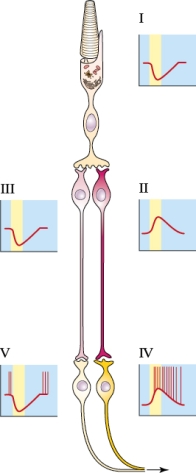 According to the letters in the figure, light inducing (activating) an on-center response would proceed through which of the following sequences?
 (Multiple Choice)
4.8/5  (73)
(73) Refer to the figure shown.
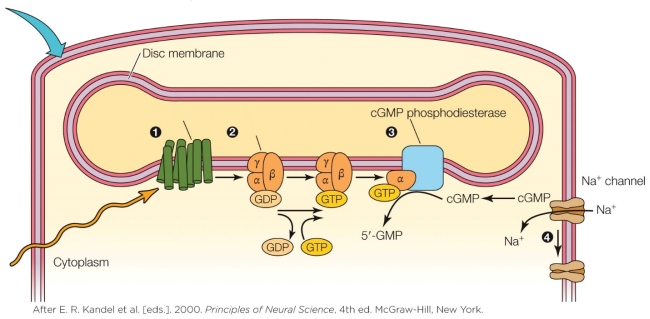 Which statement regarding the regeneration of rhodopsin in vertebrates is false?
 (Multiple Choice)
5.0/5 (84)
(84) Explain how hyperpolarization of a vertebrate cone will eventually be transduced into a train of action potentials sent to the brain via the optic nerve.
(Essay)
4.9/5 (70)
(70) Compare and contrast vertebrate and invertebrate transduction in photoreception.
(Essay)
5.0/5 (68)
(68) Refer to the figure shown.
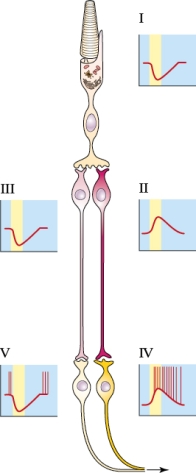 Which letter in the figure best represents only a depolarizing graded potential in the presence of light.
 (Multiple Choice)
4.8/5 (89)
(89) What happens in the vertebrate rod in the absence of light?
(Multiple Choice)
4.8/5 (87)
(87) Which sense perception depends on a metabotropic mechanism for initial signal transduction?
(Multiple Choice)
5.0/5 (59)
(59) What would occur at location number 4 in the figure in the absence of light?
(Multiple Choice)
4.8/5 (71)
(71) Refer to the figure shown.
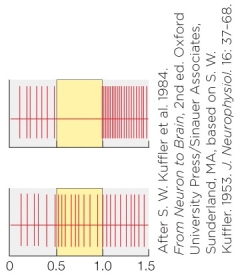 If the top panel (activity trace) of the figure is the result of light shining in the center of the receptive field, which of the following is true?
 (Multiple Choice)
5.0/5 (72)
(72) Describe the process of adaptation as it relates to mechanoreceptors in mammalian skin.
(Essay)
4.9/5 (65)
(65) Refer to the figure shown.
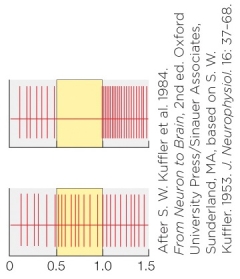 The figure shows the activity of _______ cells.
 (Multiple Choice)
4.8/5 (83)
(83) Refer to the figure shown.
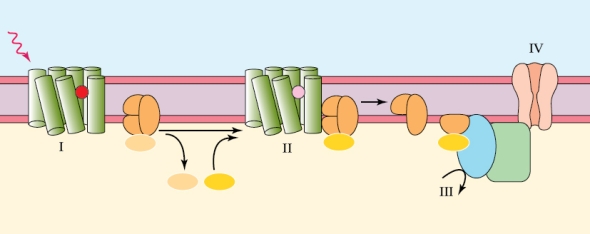 The animals that make use of the sensory mechanism shown in this figure are all
 (Multiple Choice)
4.8/5 (68)
(68) Refer to the figure shown.
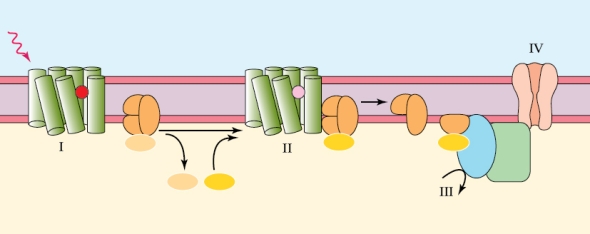 Which letter in the figure corresponds to activated opsin?
 (Multiple Choice)
4.9/5 (93)
(93) Refer to the figure shown.
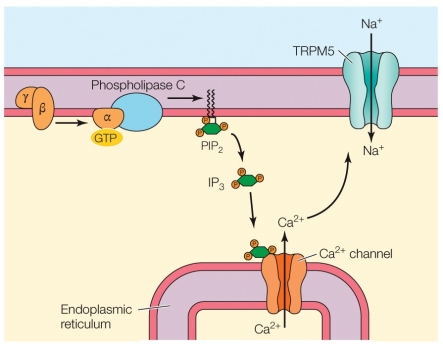 How many different (taste) qualities depend on the mechanism shown in the figure?
 (Multiple Choice)
5.0/5 (73)
(73) Which receptor uses a metabotropic mechanism of signal transduction?
(Multiple Choice)
4.8/5 (69)
(69) Which of the following is the most common evolved feature of eyes?
(Multiple Choice)
5.0/5 (88)
(88) 
Filters
- Essay(0)
- Multiple Choice(0)
- Short Answer(0)
- True False(0)
- Matching(0)