



 Chat with AI
Exam 14: Sensory Processes

Exam 1: Animals and Environments: Function on the Ecological Stage66 Questions
Exam 2: Molecules and Cells in Animal Physiology65 Questions
Exam 3: Genomics, Proteomics, and Related Approaches to Physiology64 Questions
Exam 4: Physiological Development and Epigenetics59 Questions
Exam 5: Transport of Solutes and Water67 Questions
Exam 6: Nutrition, Feeding, and Digestion77 Questions
Exam 7: Energy Metabolism68 Questions
Exam 8: Aerobic and Anaerobic Forms of Metabolism75 Questions
Exam 9: The Energetics of Aerobic Activity72 Questions
Exam 10: Thermal Relations84 Questions
Exam 11: Food, Energy, and Temperature at Work: The Lives of Mammals in Frigid Places76 Questions
Exam 12: Neurons59 Questions
Exam 13: Synapses58 Questions
Exam 14: Sensory Processes67 Questions
Exam 15: Nervous System Organization and Biological Clocks59 Questions
Exam 16: Endocrine and Neuroendocrine Physiology69 Questions
Exam 17: Reproduction68 Questions
Exam 18: Integrating Systems at Work: Animal Navigation61 Questions
Exam 19: Control of Movement71 Questions
Exam 20: Muscle78 Questions
Exam 21: Movement and Muscle at Work: Plasticity in Response to Use and Disuse67 Questions
Exam 22: Introduction to Oxygen and Carbon Dioxide in Physiology65 Questions
Exam 23: External Respiration: the Physiology of Breathing70 Questions
Exam 24: Transport of Oxygen and Carbon Dioxide in Body Fluids With an Introduction to Acid- Base Physiology68 Questions
Exam 25: Circulation72 Questions
Exam 26: Oxygen, Carbon Dioxide, and Internal Transport at Work: Diving by Marine Mammals63 Questions
Exam 27: Water and Salt Physiology: Introduction and Mechanisms72 Questions
Exam 29: Kidneys and Excretion With Notes on Nitrogen Excretion89 Questions
Exam 30: Water, Salts, and Excretion at Work: Mammals of Deserts and Dry Savannas64 Questions
Exam 28: Water and Salt Physiology of Animals in Their Environments87 Questions
Select questions type


Which statement regarding the vertebrate hair cell is false?
(Multiple Choice)
4.7/5  (82)
(82) In the mechanism of vertebrate olfaction, a G protein activates the enzyme
(Multiple Choice)
4.9/5 (70)
(70) Which statement regarding the transduction mechanism in vision is true of both vertebrates and invertebrates?
(Multiple Choice)
4.8/5 (80)
(80) Which statement best describes the vertebrate vestibular system?
(Multiple Choice)
4.9/5 (82)
(82) Refer to the figure shown.
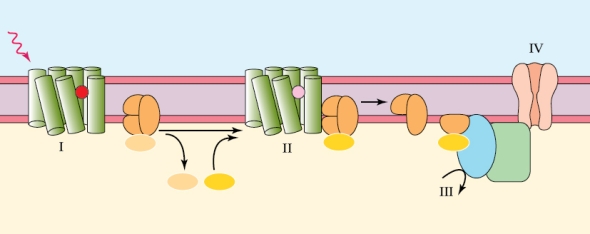 What the mechanism is occurring at IV in the figure?
 (Multiple Choice)
4.8/5 (73)
(73) Refer to the figure shown.
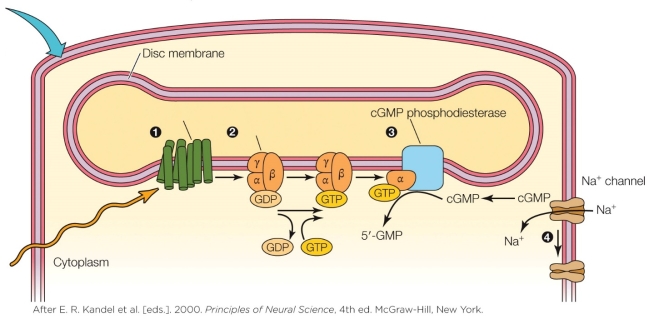 Which number in the figure corresponds to the location where an aldehyde is isomerized?
 (Multiple Choice)
4.8/5 (74)
(74) Refer to the figure shown.
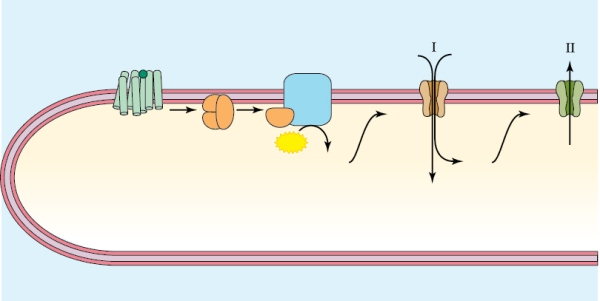 What is the resulting electrical event on the membrane as shown in the figure?
 (Multiple Choice)
4.8/5 (94)
(94) How does the transduction mechanism work in a stretch (mechano-) receptor?
(Essay)
4.9/5 (81)
(81) "The sensory modality or quality of sensation associated with a stimulus depends solely on which receptor cells are stimulated, rather than on how they are stimulated." This generalization is known as the
(Multiple Choice)
4.8/5 (70)
(70) Refer to the figure shown.
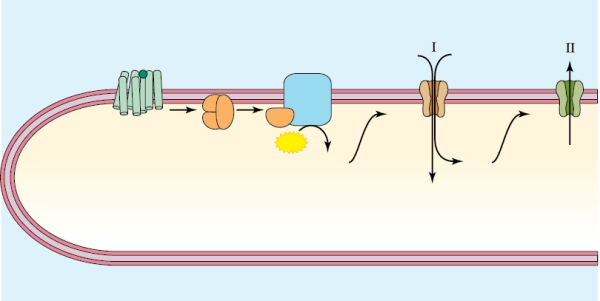 Which key best represents the ion movement shown in the figure?
 (Multiple Choice)
4.8/5 (81)
(81) A bat is just a few centimeters away from a moth that it is locating and attempting to eat. What is the most likely response from the moth?
(Multiple Choice)
4.7/5 (65)
(65) The area of the retina within which the membrane potential of a particular neuron can be influenced by light is called the
(Multiple Choice)
4.9/5 (86)
(86) The conversion of stimulus energy into an electrical signal is known as
(Multiple Choice)
4.9/5 (85)
(85) For terrestrial vertebrates, the greatest amount of refraction occurs
(Multiple Choice)
4.9/5 (86)
(86) 
Filters
- Essay(0)
- Multiple Choice(0)
- Short Answer(0)
- True False(0)
- Matching(0)