



 Chat with AI
Exam 17: Reproduction

Exam 1: Animals and Environments: Function on the Ecological Stage66 Questions
Exam 2: Molecules and Cells in Animal Physiology65 Questions
Exam 3: Genomics, Proteomics, and Related Approaches to Physiology64 Questions
Exam 4: Physiological Development and Epigenetics59 Questions
Exam 5: Transport of Solutes and Water67 Questions
Exam 6: Nutrition, Feeding, and Digestion77 Questions
Exam 7: Energy Metabolism68 Questions
Exam 8: Aerobic and Anaerobic Forms of Metabolism75 Questions
Exam 9: The Energetics of Aerobic Activity72 Questions
Exam 10: Thermal Relations84 Questions
Exam 11: Food, Energy, and Temperature at Work: The Lives of Mammals in Frigid Places76 Questions
Exam 12: Neurons59 Questions
Exam 13: Synapses58 Questions
Exam 14: Sensory Processes67 Questions
Exam 15: Nervous System Organization and Biological Clocks59 Questions
Exam 16: Endocrine and Neuroendocrine Physiology69 Questions
Exam 17: Reproduction68 Questions
Exam 18: Integrating Systems at Work: Animal Navigation61 Questions
Exam 19: Control of Movement71 Questions
Exam 20: Muscle78 Questions
Exam 21: Movement and Muscle at Work: Plasticity in Response to Use and Disuse67 Questions
Exam 22: Introduction to Oxygen and Carbon Dioxide in Physiology65 Questions
Exam 23: External Respiration: the Physiology of Breathing70 Questions
Exam 24: Transport of Oxygen and Carbon Dioxide in Body Fluids With an Introduction to Acid- Base Physiology68 Questions
Exam 25: Circulation72 Questions
Exam 26: Oxygen, Carbon Dioxide, and Internal Transport at Work: Diving by Marine Mammals63 Questions
Exam 27: Water and Salt Physiology: Introduction and Mechanisms72 Questions
Exam 29: Kidneys and Excretion With Notes on Nitrogen Excretion89 Questions
Exam 30: Water, Salts, and Excretion at Work: Mammals of Deserts and Dry Savannas64 Questions
Exam 28: Water and Salt Physiology of Animals in Their Environments87 Questions
Select questions type


Refer to the figure shown.
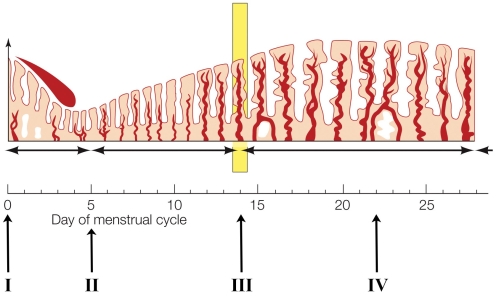 Which of the following hormones would not be surging at the time of arrow III in the figure?
 (Multiple Choice)
4.9/5  (82)
(82) In an adult, there is a strong correlation between the _______ and both testis size and the rate of sperm production.
(Multiple Choice)
4.9/5 (88)
(88) An important advantage of internal fertilization over external fertilization is
(Multiple Choice)
4.9/5 (89)
(89) During the birthing process, oxytocin stimulates the myometrial muscle to produce
(Multiple Choice)
4.9/5 (70)
(70) Briefly compare and contrast the production of female and male gametes in humans.
(Essay)
4.8/5 (89)
(89) Refer to the figure shown.
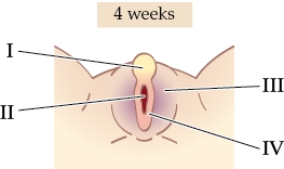 In a sexually indifferent embryo whose gonads will develop into ovaries, which external structure will become the labia majora?
 (Multiple Choice)
4.7/5 (76)
(76) Refer to the figure shown. 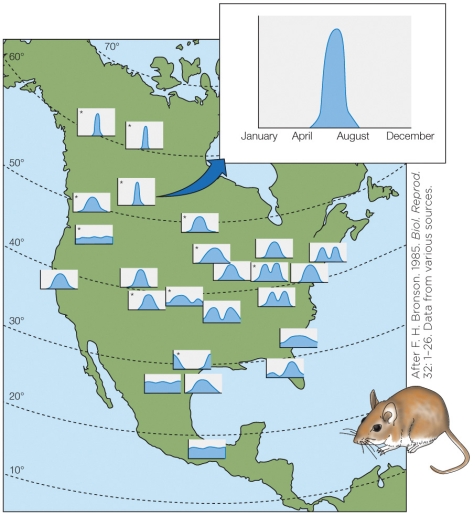 The graphs in the figure represent the
 (Multiple Choice)
4.7/5 (76)
(76) When studying the control of the annual cycle of reproduction in an aquatic mammal, which of the following questions would be considered mechanistic?
(Multiple Choice)
4.8/5 (76)
(76) The oocyte and its layer of somatic cells together are called a
(Multiple Choice)
4.8/5 (76)
(76) Some species of female crabs, queen honey bees, certain bats, sharks, turtles, snakes, and birds all share a common adaptation that permits flexible timing between copulation and fertilization. This is called
(Multiple Choice)
4.8/5 (76)
(76) Species that provision large amounts of yolk per egg typically _______ compared to species that provision small amounts of yolk per egg.
(Multiple Choice)
4.8/5 (84)
(84) The entry of the early embryo into the cellular matrix of the endometrium is called
(Multiple Choice)
4.8/5 (79)
(79) Refer to the figure shown.
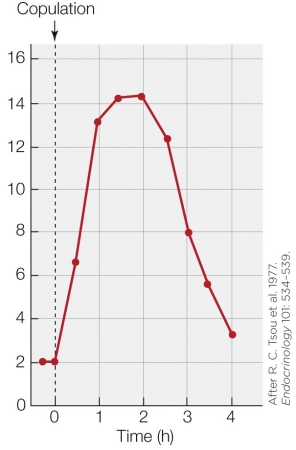 According to the figure, copulation triggers an increase in
 (Multiple Choice)
4.8/5 (90)
(90) 
Filters
- Essay(0)
- Multiple Choice(0)
- Short Answer(0)
- True False(0)
- Matching(0)