



 Chat with AI
Exam 20: Muscle

Exam 1: Animals and Environments: Function on the Ecological Stage66 Questions
Exam 2: Molecules and Cells in Animal Physiology65 Questions
Exam 3: Genomics, Proteomics, and Related Approaches to Physiology64 Questions
Exam 4: Physiological Development and Epigenetics59 Questions
Exam 5: Transport of Solutes and Water67 Questions
Exam 6: Nutrition, Feeding, and Digestion77 Questions
Exam 7: Energy Metabolism68 Questions
Exam 8: Aerobic and Anaerobic Forms of Metabolism75 Questions
Exam 9: The Energetics of Aerobic Activity72 Questions
Exam 10: Thermal Relations84 Questions
Exam 11: Food, Energy, and Temperature at Work: The Lives of Mammals in Frigid Places76 Questions
Exam 12: Neurons59 Questions
Exam 13: Synapses58 Questions
Exam 14: Sensory Processes67 Questions
Exam 15: Nervous System Organization and Biological Clocks59 Questions
Exam 16: Endocrine and Neuroendocrine Physiology69 Questions
Exam 17: Reproduction68 Questions
Exam 18: Integrating Systems at Work: Animal Navigation61 Questions
Exam 19: Control of Movement71 Questions
Exam 20: Muscle78 Questions
Exam 21: Movement and Muscle at Work: Plasticity in Response to Use and Disuse67 Questions
Exam 22: Introduction to Oxygen and Carbon Dioxide in Physiology65 Questions
Exam 23: External Respiration: the Physiology of Breathing70 Questions
Exam 24: Transport of Oxygen and Carbon Dioxide in Body Fluids With an Introduction to Acid- Base Physiology68 Questions
Exam 25: Circulation72 Questions
Exam 26: Oxygen, Carbon Dioxide, and Internal Transport at Work: Diving by Marine Mammals63 Questions
Exam 27: Water and Salt Physiology: Introduction and Mechanisms72 Questions
Exam 29: Kidneys and Excretion With Notes on Nitrogen Excretion89 Questions
Exam 30: Water, Salts, and Excretion at Work: Mammals of Deserts and Dry Savannas64 Questions
Exam 28: Water and Salt Physiology of Animals in Their Environments87 Questions
Select questions type


Identify the two major uses of ATP in skeletal muscle cells that are involved in contraction and relaxation and explain why each process uses ATP more rapidly in fast-twitch muscles than in slow-twitch muscles.
(Essay)
4.8/5  (90)
(90) Describe two mechanisms by which the human nervous system can voluntarily alter the force and velocity of a contraction of the biceps muscle of the arm.
(Essay)
4.9/5 (74)
(74) Mammalian cardiac muscle cells are stimulated to contract by
(Multiple Choice)
5.0/5 (74)
(74) The diffusion rate of which factor best explains why vertebrates evolved to have slow oxidative muscle fibers that are smaller in diameter than fast glycolytic fibers?
(Multiple Choice)
4.9/5 (73)
(73) According to the sliding filament theory of muscle contraction, myosin heads pull on _______ filaments and _______.
(Multiple Choice)
4.9/5 (78)
(78) How can summation of skeletal muscle twitches occur if the motor neuron's refractory period prevents multiple action potentials from being transmitted to the neuromuscular junction at the same time?
(Multiple Choice)
4.8/5 (76)
(76) Refer to the figure shown.
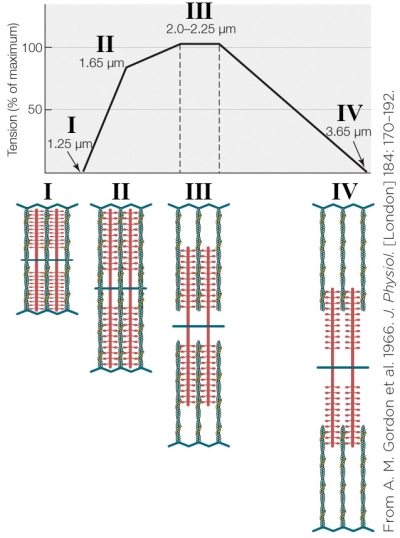 Which number on the diagram represents the most optimal positioning of actin and myosin before contraction?
 (Multiple Choice)
4.8/5 (81)
(81) In striated muscle, _______ before the sarcomere can generate force.
(Multiple Choice)
4.8/5 (78)
(78) In resting skeletal muscle, contraction does not occur because
(Multiple Choice)
4.9/5 (77)
(77) Refer to the figure shown.
 In the figure, which numeral represents the A band?
 (Multiple Choice)
4.8/5 (69)
(69) Refer to the figure shown.
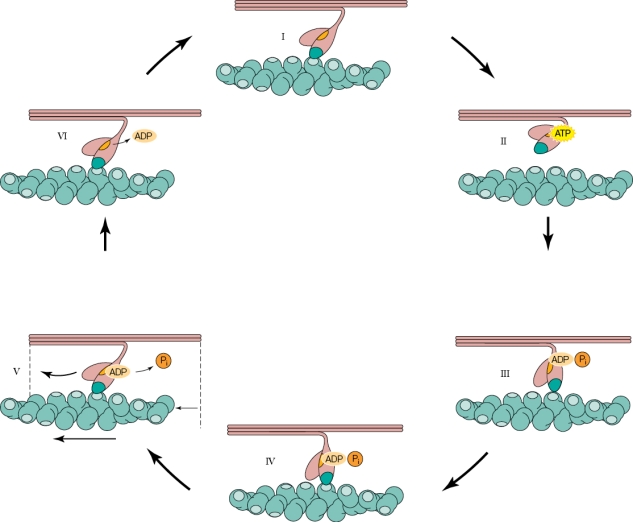 In the figure, which panel, taken out of context, represents a state where muscle relaxation could be occurring?
 (Multiple Choice)
4.9/5 (83)
(83) Which statement is true of most arthropod and vertebrate skeletal muscle?
(Multiple Choice)
4.8/5 (73)
(73) Refer to the figure shown.
 Which area(s) shorten(s) during muscle contraction?
 (Multiple Choice)
4.9/5 (75)
(75) A muscle produces less force during a twitch than during a tetanic contraction because during a twitch
(Multiple Choice)
4.8/5 (75)
(75) The small diameter of slow oxidative muscle fibers is particularly advantageous for minimizing the distance over which
(Multiple Choice)
4.8/5 (73)
(73) Why does a skeletal muscle twitch last longer than a skeletal muscle action potential?
(Essay)
5.0/5 (83)
(83) One reason that fast glycolytic muscle fibers fatigue more rapidly than slow oxidative muscle fibers is that fast glycolytic fibers
(Multiple Choice)
4.9/5 (69)
(69) 
Filters
- Essay(0)
- Multiple Choice(0)
- Short Answer(0)
- True False(0)
- Matching(0)