



 Chat with AI
Exam 20: Muscle

Exam 1: Animals and Environments: Function on the Ecological Stage66 Questions
Exam 2: Molecules and Cells in Animal Physiology65 Questions
Exam 3: Genomics, Proteomics, and Related Approaches to Physiology64 Questions
Exam 4: Physiological Development and Epigenetics59 Questions
Exam 5: Transport of Solutes and Water67 Questions
Exam 6: Nutrition, Feeding, and Digestion77 Questions
Exam 7: Energy Metabolism68 Questions
Exam 8: Aerobic and Anaerobic Forms of Metabolism75 Questions
Exam 9: The Energetics of Aerobic Activity72 Questions
Exam 10: Thermal Relations84 Questions
Exam 11: Food, Energy, and Temperature at Work: The Lives of Mammals in Frigid Places76 Questions
Exam 12: Neurons59 Questions
Exam 13: Synapses58 Questions
Exam 14: Sensory Processes67 Questions
Exam 15: Nervous System Organization and Biological Clocks59 Questions
Exam 16: Endocrine and Neuroendocrine Physiology69 Questions
Exam 17: Reproduction68 Questions
Exam 18: Integrating Systems at Work: Animal Navigation61 Questions
Exam 19: Control of Movement71 Questions
Exam 20: Muscle78 Questions
Exam 21: Movement and Muscle at Work: Plasticity in Response to Use and Disuse67 Questions
Exam 22: Introduction to Oxygen and Carbon Dioxide in Physiology65 Questions
Exam 23: External Respiration: the Physiology of Breathing70 Questions
Exam 24: Transport of Oxygen and Carbon Dioxide in Body Fluids With an Introduction to Acid- Base Physiology68 Questions
Exam 25: Circulation72 Questions
Exam 26: Oxygen, Carbon Dioxide, and Internal Transport at Work: Diving by Marine Mammals63 Questions
Exam 27: Water and Salt Physiology: Introduction and Mechanisms72 Questions
Exam 29: Kidneys and Excretion With Notes on Nitrogen Excretion89 Questions
Exam 30: Water, Salts, and Excretion at Work: Mammals of Deserts and Dry Savannas64 Questions
Exam 28: Water and Salt Physiology of Animals in Their Environments87 Questions
Select questions type


In skeletal muscle, an incomplete tetanus would result from
(Multiple Choice)
5.0/5  (86)
(86) Which type of muscle does not use troponin as part of the excitation-contraction coupling mechanism?
(Multiple Choice)
4.7/5 (84)
(84) The extraocular muscles that move the mammalian eyeball can contract and relax at much higher frequencies than the muscles of the limbs, but they produce relatively low force as they rotate the eye. These characteristics tell us that extraocular muscles have
(Multiple Choice)
4.9/5 (71)
(71) For muscle, the work produced during any given contractile event is equal to
(Multiple Choice)
4.9/5 (66)
(66) ATP use is lower in smooth muscle than in skeletal muscle in part because
(Multiple Choice)
4.9/5 (82)
(82) Which muscle can generate the most power per cubic centimeter of muscle?
(Multiple Choice)
4.8/5 (83)
(83) The smallest unit of a skeletal muscle that shortens during a muscle contraction is the
(Multiple Choice)
4.7/5 (76)
(76) A skeletal muscle fiber with high myosin ATPase activity, a high rate of Ca2+ reuptake by the sarcoplasmic reticulum, and large number of mitochondria would be classified as a
(Multiple Choice)
4.8/5 (71)
(71) Single-unit smooth muscle differs from multiunit smooth muscle in that multiunit smooth muscle
(Multiple Choice)
4.9/5 (83)
(83) Suppose that each cross-bridge cycle moves the thin filament 10 nanometers relative to the thick filament. If myosin in a particular muscle can go through the cross-bridge cycle at 250 cycles per second, what is the rate at which a muscle that is 30 cm long can shorten?
(Multiple Choice)
4.8/5 (93)
(93) Refer to the figure shown.
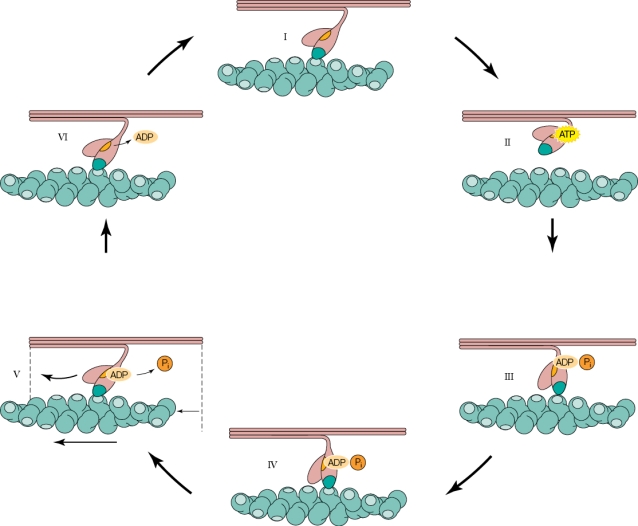 In the figure, which panel represents the transient rigor state?
 (Multiple Choice)
4.7/5 (74)
(74) Which statement provides the most likely explanation for the differing patterns of innervation in arthropod skeletal muscle (polyneuronal) and vertebrate skeletal muscle (single innervation)?
(Multiple Choice)
4.9/5 (82)
(82) Explain why a muscle always works by shortening and cannot actively increase its length unless an external force pulls on it.
(Essay)
4.9/5 (72)
(72) Running mice are capable of moving their legs back and forth much more quickly than elephants. Thus, compared to an elephant muscle cell, a mouse muscle cell likely contains more
(Multiple Choice)
4.9/5 (81)
(81) Which of the following is not a function of ATP in skeletal muscle?
(Multiple Choice)
4.8/5 (78)
(78) Some crabs have giant skeletal muscle fibers that are much larger in diameter than muscle fibers found in most other animals. What fiber type are these fibers likely to be and why?
(Essay)
4.8/5 (70)
(70) 
Filters
- Essay(0)
- Multiple Choice(0)
- Short Answer(0)
- True False(0)
- Matching(0)