



 Chat with AI
Exam 23: External Respiration: the Physiology of Breathing

Exam 1: Animals and Environments: Function on the Ecological Stage66 Questions
Exam 2: Molecules and Cells in Animal Physiology65 Questions
Exam 3: Genomics, Proteomics, and Related Approaches to Physiology64 Questions
Exam 4: Physiological Development and Epigenetics59 Questions
Exam 5: Transport of Solutes and Water67 Questions
Exam 6: Nutrition, Feeding, and Digestion77 Questions
Exam 7: Energy Metabolism68 Questions
Exam 8: Aerobic and Anaerobic Forms of Metabolism75 Questions
Exam 9: The Energetics of Aerobic Activity72 Questions
Exam 10: Thermal Relations84 Questions
Exam 11: Food, Energy, and Temperature at Work: The Lives of Mammals in Frigid Places76 Questions
Exam 12: Neurons59 Questions
Exam 13: Synapses58 Questions
Exam 14: Sensory Processes67 Questions
Exam 15: Nervous System Organization and Biological Clocks59 Questions
Exam 16: Endocrine and Neuroendocrine Physiology69 Questions
Exam 17: Reproduction68 Questions
Exam 18: Integrating Systems at Work: Animal Navigation61 Questions
Exam 19: Control of Movement71 Questions
Exam 20: Muscle78 Questions
Exam 21: Movement and Muscle at Work: Plasticity in Response to Use and Disuse67 Questions
Exam 22: Introduction to Oxygen and Carbon Dioxide in Physiology65 Questions
Exam 23: External Respiration: the Physiology of Breathing70 Questions
Exam 24: Transport of Oxygen and Carbon Dioxide in Body Fluids With an Introduction to Acid- Base Physiology68 Questions
Exam 25: Circulation72 Questions
Exam 26: Oxygen, Carbon Dioxide, and Internal Transport at Work: Diving by Marine Mammals63 Questions
Exam 27: Water and Salt Physiology: Introduction and Mechanisms72 Questions
Exam 29: Kidneys and Excretion With Notes on Nitrogen Excretion89 Questions
Exam 30: Water, Salts, and Excretion at Work: Mammals of Deserts and Dry Savannas64 Questions
Exam 28: Water and Salt Physiology of Animals in Their Environments87 Questions
Select questions type


Although tracheoles run between cells, they also very commonly penetrate _______ cells.
(Multiple Choice)
4.8/5  (73)
(73) Which animal group(s) ventilate(s) with the use of negative pressure?
(Multiple Choice)
5.0/5 (72)
(72) Aquatic insects sometimes have evaginations of the body surface called _______ that are densely supplied with trachea and covered with a thin cuticle.
(Multiple Choice)
4.8/5 (69)
(69) Which animal is likely to have the highest O2 and CO2 exchange percentage via the skin?
(Multiple Choice)
4.7/5 (86)
(86) In mammals, ventilation is modulated by the chemosensation of
(Multiple Choice)
5.0/5 (88)
(88) The evolution of sheetlike gills occurred in which major animal group?
(Multiple Choice)
4.9/5 (71)
(71) Describe the quality of the gas within the alveoli of the mammalian lung and explain how it differs from atmospheric air.
(Essay)
4.8/5 (70)
(70) What is the main vulnerability of the insect respiratory system?
(Multiple Choice)
4.9/5 (91)
(91) The volume of air in the lungs following a complete exhalation of the expiratory reserve volume is
(Multiple Choice)
4.8/5 (79)
(79) Refer to the figure shown.
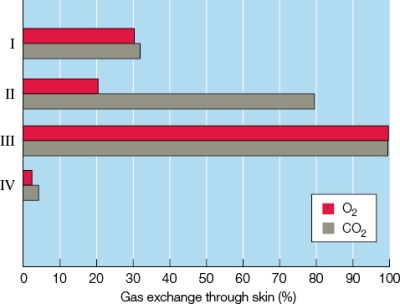 Of the animals in the figure, which one represents a primarily aquatic animal using lungs as the primary source for O2 uptake?
 (Multiple Choice)
4.8/5 (92)
(92) Refer to the figure shown.
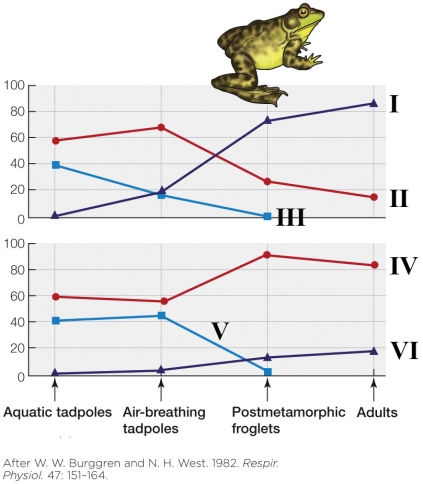 Which line best represents the excretion of CO2 via the skin?
 (Multiple Choice)
4.9/5 (92)
(92) 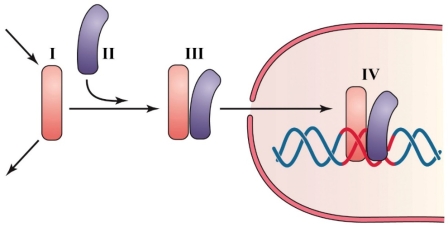 When O2 in a cell drops
Several morphological features of the bird respiratory system allow for more efficient gas exchange. Describe these features.
(Essay)
4.9/5 (78)
(78) The evolution of the mantle cavity into a lung occurred in which major animal group?
(Multiple Choice)
4.8/5 (81)
(81) As mammals get smaller, lung volume _______ and breathing frequency _______.
(Multiple Choice)
4.9/5 (74)
(74) A key mechanism of gas transport through the tracheal system is
(Multiple Choice)
4.9/5 (88)
(88) In which structure does diffusion of oxygen to capillaries not play a major role?
(Multiple Choice)
4.9/5 (87)
(87) 
Filters
- Essay(0)
- Multiple Choice(0)
- Short Answer(0)
- True False(0)
- Matching(0)