



 Chat with AI
Exam 30: Water, Salts, and Excretion at Work: Mammals of Deserts and Dry Savannas

Exam 1: Animals and Environments: Function on the Ecological Stage66 Questions
Exam 2: Molecules and Cells in Animal Physiology65 Questions
Exam 3: Genomics, Proteomics, and Related Approaches to Physiology64 Questions
Exam 4: Physiological Development and Epigenetics59 Questions
Exam 5: Transport of Solutes and Water67 Questions
Exam 6: Nutrition, Feeding, and Digestion77 Questions
Exam 7: Energy Metabolism68 Questions
Exam 8: Aerobic and Anaerobic Forms of Metabolism75 Questions
Exam 9: The Energetics of Aerobic Activity72 Questions
Exam 10: Thermal Relations84 Questions
Exam 11: Food, Energy, and Temperature at Work: The Lives of Mammals in Frigid Places76 Questions
Exam 12: Neurons59 Questions
Exam 13: Synapses58 Questions
Exam 14: Sensory Processes67 Questions
Exam 15: Nervous System Organization and Biological Clocks59 Questions
Exam 16: Endocrine and Neuroendocrine Physiology69 Questions
Exam 17: Reproduction68 Questions
Exam 18: Integrating Systems at Work: Animal Navigation61 Questions
Exam 19: Control of Movement71 Questions
Exam 20: Muscle78 Questions
Exam 21: Movement and Muscle at Work: Plasticity in Response to Use and Disuse67 Questions
Exam 22: Introduction to Oxygen and Carbon Dioxide in Physiology65 Questions
Exam 23: External Respiration: the Physiology of Breathing70 Questions
Exam 24: Transport of Oxygen and Carbon Dioxide in Body Fluids With an Introduction to Acid- Base Physiology68 Questions
Exam 25: Circulation72 Questions
Exam 26: Oxygen, Carbon Dioxide, and Internal Transport at Work: Diving by Marine Mammals63 Questions
Exam 27: Water and Salt Physiology: Introduction and Mechanisms72 Questions
Exam 29: Kidneys and Excretion With Notes on Nitrogen Excretion89 Questions
Exam 30: Water, Salts, and Excretion at Work: Mammals of Deserts and Dry Savannas64 Questions
Exam 28: Water and Salt Physiology of Animals in Their Environments87 Questions
Select questions type


Deserts and savannas have extreme conditions. Explain why these conditions exist.
(Essay)
4.8/5  (79)
(79) Describe the advantages and disadvantages that large mammals have living in hot deserts and dry savannas over small mammals in the same environment.
(Essay)
4.9/5 (88)
(88) Which animal has the highest weight-specific water costs to void endogenously produced heat?
(Multiple Choice)
4.9/5 (83)
(83) Refer to the figure shown.
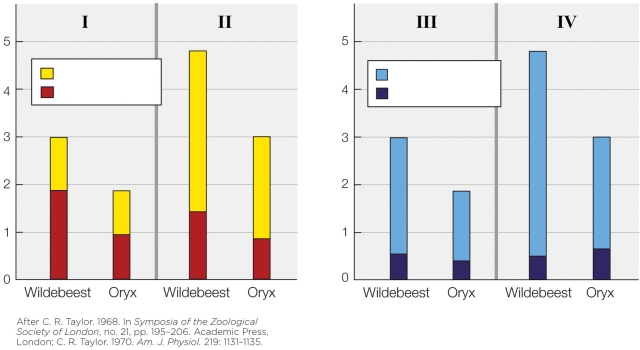 Which panel shows evaporative water loss under near-desert temperatures?
 (Multiple Choice)
4.8/5 (78)
(78) Deserts and semi-deserts cover about _______ of the land on Earth.
(Multiple Choice)
5.0/5 (64)
(64) What are the mechanisms by which oryxes achieve exceptional water conservation and low water turnover rates?
(Essay)
4.8/5 (78)
(78) The dominant controlling factor of biological processes in dry savannas is
(Multiple Choice)
4.9/5 (84)
(84) If an Arabian oryx's urine osmolarity is 240 mOsm and the U/P ratio is 8, its plasma osmolarity would be _______ mOsm.
(Multiple Choice)
4.7/5 (80)
(80) Refer to the figure shown.
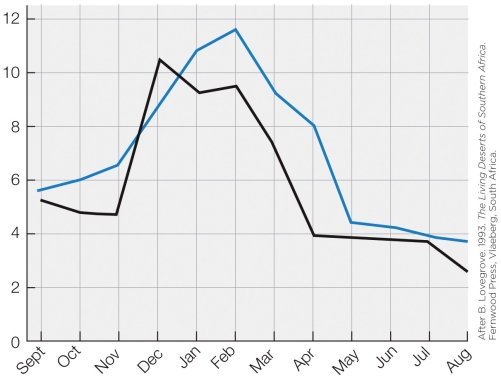 What do the two lines in this figure represent?
 (Multiple Choice)
4.8/5 (87)
(87) In dry savannas and deserts, animals that weigh _______ have the most behavioral advantages.
(Multiple Choice)
4.9/5 (77)
(77) In an oryx living in a dry savanna, the amount of water saved per day as a result of a cycling body temperature as opposed to a constant one is
(Multiple Choice)
4.8/5 (76)
(76) D. B. Dill was a pioneer in the study of exercise and heat. Describe his experiments and explain the results.
(Essay)
4.8/5 (78)
(78) An organism meets 30% of its water needs from metabolic water; the rest of its water needs are met
(Multiple Choice)
4.7/5 (91)
(91) Which of the following does not occur in the Serengeti plains of East Africa?
(Multiple Choice)
4.9/5 (69)
(69) Which animal has the lowest weight-specific metabolic rate?
(Multiple Choice)
4.9/5 (78)
(78) 
Filters
- Essay(0)
- Multiple Choice(0)
- Short Answer(0)
- True False(0)
- Matching(0)