



 Chat with AI
Exam 8: Immunology

Exam 1: Anatomy265 Questions
Exam 2: Behavioral Sciences178 Questions
Exam 3: Biochemistry102 Questions
Exam 4: Embryology59 Questions
Exam 5: Epidemiology, Biostatistics, and Medical Informatics94 Questions
Exam 6: Genetics88 Questions
Exam 7: Histology46 Questions
Exam 8: Immunology147 Questions
Exam 9: Microbiology and Virology330 Questions
Exam 10: Pathology817 Questions
Exam 11: Pharmacology and Toxicology509 Questions
Exam 12: Physiology339 Questions
Exam 13: Psychiatry and Psychotherapy23 Questions
Select questions type


A 10-month-old boy is brought to the office due to recurrent sinopulmonary infections for the last several months. The infections were caused by encapsulated bacteria, and the patient was also recently hospitalized due to Pneumocystis jiroveci pneumonia. He was born at full term after an uneventful pregnancy. Family history is significant for a maternal uncle's early childhood death due to severe infection. Genetic testing of the patient reveals missense mutation of the CD40 ligand gene. Interaction between which of the following immune components is most likely impaired in this patient?
(Multiple Choice)
4.8/5  (77)
(77) An 18-month-old, partially vaccinated boy is brought to the office for a routine well-child examination. His parents have elected a delayed schedule for vaccine administration based on personal preferences. Today, the patient is scheduled to receive the Haemophilus influenzae serotype b (Hib) conjugate vaccine. The parents are given detailed information about the vaccine, but the mother asks, "Why is 'tetanus toxoid conjugate' listed on the package insert?" She adds that her son already received the diphtheria-tetanus-acellular pertussis (DTaP) vaccine. The parents request an explanation for the reason the Hib vaccine contains both the capsular polysaccharide of Hib as well as the conjugated tetanus toxoid. Which of the following best describes the purpose of Hib vaccine conjugation?
(Multiple Choice)
4.7/5 (69)
(69) A 7-year-old boy is evaluated for a foot wound. He sustained a splinter injury to his left foot while playing in the yard several days ago and has continued to have purulent drainage from the wound. The patient has no significant medical history and is up to date with all recommended vaccinations. Wound examination reveals a small retained foreign body with surrounding necrotic tissue and pus. Anaerobic culture of the wound swab grows thin, gram-positive rods with terminal spore, which is biochemically identified as Clostridium tetani. Which of the following most likely protected this patient from developing neurological symptoms of the infection?
(Multiple Choice)
4.8/5 (68)
(68) A 42-year-old woman comes to the emergency department due to worsening jaw pain over the past week. She is unable to chew solid foods on the left side because of severe throbbing pain. The patient has had several "tooth infections" over the last year despite meticulous oral hygiene. Physical examination shows facial edema over the left mandible. Multiple teeth have decay and gingival recession, and gentle tapping of the left second molar elicits pain. This patient's current disease process is most likely to develop secondary to which of the following underlying conditions?
(Multiple Choice)
4.9/5 (91)
(91) A 23-year-old man comes to the physician with dysuria and increased urinary frequency. He is an active duty member of the US military and recently returned from sub-Saharan Africa, where he had been stationed for the last year. The patient's symptoms have persisted for several months and have failed to resolve following antibiotic treatment. His blood eosinophil count is elevated. Urine microscopy shows schistosome eggs. He is started on praziquantel and experiences improvement in his symptoms. The elevated eosinophils in this patient contribute to the host defense against schistosomiasis through which of the following mechanisms?
(Multiple Choice)
4.9/5 (96)
(96) A 3-year-old boy is being evaluated for persistent diarrhea. Although the patient seemed healthy at his 12-month well child visit, since then he has experienced 4 episodes of otitis media and 3 episodes of pneumococcal pneumonia. He was at the 50th percentile for weight and height at 12 months but is now at the 25th percentile for height and 10th percentile for weight. The patient is referred for upper gastrointestinal endoscopy, and Giardia lamblia is isolated from duodenal aspirates. Further workup shows very low serum levels of all immunoglobulin types. Flow cytometry of this patient's peripheral blood is most likely to show a near absence of cells bearing which of the following markers?
(Multiple Choice)
5.0/5 (90)
(90) Pharmacology researchers are developing a new antivenom to treat coral snakebites. They immunize horses with snake venom, extract IgG-containing plasma, and then administer the plasma to humans who have been bitten by a coral snake. This therapy neutralizes the venom and improves the patient's symptoms. In order to produce venom-selective antibodies, the researchers select a single venom-specific plasma cell from the immunized horse and induce it to proliferate and produce large amounts of venom-specific IgG. However, they find that the antibody produced by the single plasma cell is less effective at neutralizing the venom than the IgG-containing plasma. A decrease in which of the following best explains the reduced efficacy of the immunoglobulin produced by the single plasma cell?
(Multiple Choice)
5.0/5 (85)
(85) A 24-year-old nurse comes to the office for his annual wellness visit that includes tuberculosis screening. The patient has no chronic medical conditions and does not have recent fever, cough, or other health changes. He receives an intradermal injection of tuberculin on the inner surface of his forearm. Two days later, he has a distinct area of induration 20 mm across at the injection site. Which of the following interactions is essential to the development of this patient's skin reaction?
(Multiple Choice)
4.9/5 (84)
(84) A 64-year-old man visits the clinic after experiencing many weeks of continuous coughing, fever, and weight loss. He smokes a pack of cigarettes every day and consumes 10 to 12 beers on weekends. An infiltration in the left upper lobe is shown by a chest x-ray. Despite receiving broad-spectrum antibiotic therapy for both aspiration and community-acquired pneumonia, the patient's symptoms deteriorate. The Gram stain on sputum does not indicate any microbes. The following picture depicts the results of a lung biopsy: 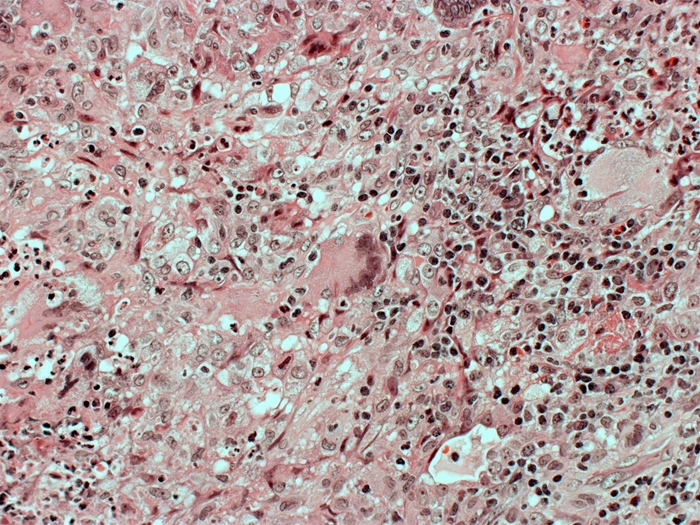 Which of the following substances is most important for driving the development of this patient's observed microscopic lesion?
 (Multiple Choice)
4.9/5 (86)
(86) A 23-year-old man is referred to the gastroenterology clinic due to a 3-year history of recurring abdominal pain accompanied by cramps and diarrhea. The patient has noticed an increased frequency of episodes lately with worsening pain. He also says that his urine occasionally appears dark brown and his urine stream sometimes sputters. Imaging studies reveal a colovesical fistula. Biopsy obtained during colonoscopy shows chronic ileocolitis with discontinuous transmural inflammation and noncaseating granulomas. When given the diagnosis of Crohn disease, the patient becomes skeptical and says, "There's no way I'm getting a colostomy bag." He then refuses treatment and pursues a second opinion once his symptoms subside. A second biopsy demonstrates reduced inflammation in regions of previously active ileocolitis. An increase in which of the following cytokines is most likely responsible for this patient's clinical regression?
(Multiple Choice)
4.8/5 (84)
(84) A 3-year-old boy is brought to the physician for the evaluation of recurrent skin lesions. The lesions first appeared at the age of 2 months and multiple treatment options have been attempted without success. He has also had several episodes of respiratory tract infections, enlarged lymph nodes, and recurrent fevers since birth. The patient's immunizations are up-to-date. He is at the 5th percentile for length and 10th percentile for weight. He appears ill. His temperature is 38°C (100.4°F), pulse is 100/min, and blood pressure is 100/60 mm Hg. Examination shows several raised, erythematous lesions of different sizes over the face, neck, groin, and extremities; some secrete pus. Cervical and axillary lymph nodes are enlarged bilaterally. This patient most likely has an increased risk of infection with which of the following organisms?
(Multiple Choice)
4.8/5 (79)
(79) A 7-year-old boy is brought to the clinic by his parents after developing red urine earlier in the day. The patient has asthma, allergic rhinitis, and atopic dermatitis. He was recently treated for a skin infection. Blood pressure is 140/90 mm Hg. On physical examination, there is periorbital edema as well as pitting edema on both feet. Laboratory results are as follows: 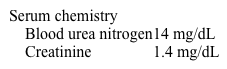 Which of the following is most likely responsible for this patient's renal injury?
 (Multiple Choice)
4.8/5 (75)
(75) A 34-year-old man is brought to the hospital by ambulance after being involved in a motor vehicle collision. He was an unrestrained passenger and sustained considerable trauma. On arrival to the emergency department, he is hypotensive and bleeding from several sites. The patient receives an emergency blood transfusion as part of the resuscitation efforts. Abdominal ultrasound reveals splenic laceration and blood in the peritoneal cavity. En route to the operating room, the patient develops difficulty breathing, chills, and pain in the chest and back. Urine drainage from the Foley catheter was initially clear but now appears brown in color. Which of the following is the most likely cause of this patient's new findings?
(Multiple Choice)
4.8/5 (82)
(82) A 5-year-old girl is brought to the office for evaluation of a persistent cough. The patient has had a productive cough daily for the past month. History includes recurrent episodes of otitis media despite bilateral ear tube placement, numerous lower respiratory tract infections, and occasional ulcerative skin lesions. Laboratory evaluation shows normal levels of total B and T cells and serum immunoglobulin. Genetic testing reveals a mutation in the TAP1 gene, which encodes a protein involved in the transport of cytosolic molecules into the endoplasmic reticulum. Which of the following processes is most likely to be impaired by this mutation?
(Multiple Choice)
5.0/5 (60)
(60) A 2-year-old boy is brought to the office due to recurrent infections. He was born at term after an uncomplicated pregnancy. His mother states, "My boy is always sick with something and is constantly on antibiotics." The patient has had multiple episodes of otitis media, skin infections, and pneumonia. Incision and drainage of his skin infections revealed Staphylococcus aureus on bacterial culture but no purulence. The infections usually resolve with prolonged antibiotic courses. Laboratory testing reveals absent CD18 antigens on the surface of leukocytes. This patient's underlying condition is most likely associated with which of the following?
(Multiple Choice)
4.9/5 (87)
(87) A 37-year-old man comes to the emergency department because of increasing pain and tenderness in his right forearm. During a bar brawl 6 days earlier, he sustained a 4-cm laceration through the skin and subcutaneous tissue of his forearm. Treatment at the time of injury included cleaning and dressing the wound. Physical examination shows erythema surrounding the wound site and expression of yellow pus when pressure is applied adjacent to the wound. Which of the following molecules is most likely responsible for causing accumulation of pus over this patient's wound?
(Multiple Choice)
4.8/5 (87)
(87) Researchers develop a novel agent to treat extrinsic asthma. In a clinical trial, patients with moderate to severe asthma treated with this medication experience fewer exacerbations. They are found to have lower levels of serum IgE, even after exposure to triggering allergens. This medication helps improve asthma symptoms by binding and inhibiting the substance produced by sensitized Th2 cells in the airways that promotes immunoglobulin isotype switching in B lymphocytes. Which of the following is the most likely target of this medication?
(Multiple Choice)
4.9/5 (77)
(77) A 63-year-old man comes to the physician after noticing a reddish tinge to his urine for the last couple of days. During evaluation of his hematuria, an abdominal CT scan reveals a left-sided renal mass. Further workup also shows multiple pulmonary and bone nodules. CT-guided biopsy of a peripherally located lung nodule demonstrates renal cell carcinoma. High-dose interleukin-2 (IL-2) is started, and 4 weeks later there is a significant reduction in his tumor burden. Which of the following mechanisms was most likely responsible for regression of his malignancy?
(Multiple Choice)
4.9/5 (81)
(81) A 9-year-old girl is brought to the office due to persistent nasal drainage. Over the past 2 weeks, the patient has had increasing nasal congestion and drainage. The discharge was initially clear but has become dark and foul smelling over the past few days. The patient has a history of multiple skin abscesses that developed when she was an infant, but they typically do not cause discomfort. She has also had atopic dermatitis since infancy. Temperature is 37.1 C (98.8 F). On examination, the patient is interactive and talkative. Thick nasal discharge appears from both nares. Cardiopulmonary examination is normal. There are several diffuse areas of dry, excoriated skin along the trunk and upper extremities. Results of a complete blood count are as follows: 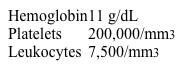 Which of the following patterns of immunoglobulin production is most likely to be seen in this patient?
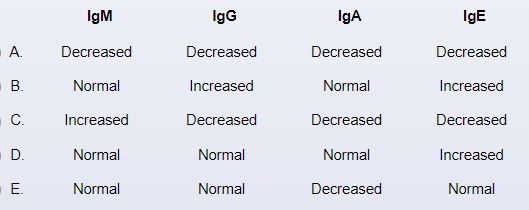
Which of the following patterns of immunoglobulin production is most likely to be seen in this patient? (Multiple Choice)
4.9/5 (76)
(76) A 4-year-old boy is brought to the emergency department for difficulty breathing and a productive cough. He has a past medical history of recurrent episodes of sinusitis and otitis media. The respiratory infections typically have a protracted course but respond to high-dose antibiotic therapy. Pulmonary auscultation shows crackles and wheezing. Cardiovascular examination shows a cardiac point of maximal impulse that is palpated at the right 5th intercostal space. Which of the following is most likely to be dysfunctional in this patient?
(Multiple Choice)
4.7/5 (71)
(71) 
Filters
- Essay(0)
- Multiple Choice(0)
- Short Answer(0)
- True False(0)
- Matching(0)