



 Chat with AI
Exam 8: Immunology

Exam 1: Anatomy265 Questions
Exam 2: Behavioral Sciences178 Questions
Exam 3: Biochemistry102 Questions
Exam 4: Embryology59 Questions
Exam 5: Epidemiology, Biostatistics, and Medical Informatics94 Questions
Exam 6: Genetics88 Questions
Exam 7: Histology46 Questions
Exam 8: Immunology147 Questions
Exam 9: Microbiology and Virology330 Questions
Exam 10: Pathology817 Questions
Exam 11: Pharmacology and Toxicology509 Questions
Exam 12: Physiology339 Questions
Exam 13: Psychiatry and Psychotherapy23 Questions
Select questions type


A 44-year-old woman comes to the physician because of a 6-month history of fatigue, intermittent fever, a 4.0-kg (9-lb) weight loss, and a progressive, nonproductive cough. She does not smoke. Physical examination shows mild wheezing over bilateral lung fields. Chest x-ray demonstrates enlarged hilar lymph nodes, and laboratory testing reveals an elevated ACE level. Purified protein derivative testing is negative. A bronchoscopy is scheduled to help determine the diagnosis. Which of the following is most likely to be the predominant cell type in this patient's bronchoalveolar lavage fluid?
(Multiple Choice)
4.9/5  (79)
(79) A 42-year-old woman comes to the emergency department due to worsening jaw pain over the past week. She is unable to chew solid foods on the left side because of severe throbbing pain. The patient has had several "tooth infections" over the last year despite meticulous oral hygiene. Physical examination shows facial edema over the left mandible. Multiple teeth have decay and gingival recession, and gentle tapping of the left second molar elicits pain. This patient's current disease process is most likely to develop secondary to which of the following underlying conditions?
(Multiple Choice)
4.8/5 (83)
(83) A 72-year-old woman is brought to the emergency department from a nursing facility due to fever, chills, and hypotension. The patient has a history of diabetes mellitus, ischemic stroke, and neurogenic bladder. She has an indwelling urinary catheter. Temperature is 38.8 C (102 F), blood pressure is 80/40 mm Hg, and pulse is 130/min. The patient is lethargic and disoriented. Her extremities are warm, and her breathing is rapid and shallow. Lungs are clear on auscultation and there are no heart murmurs. There is left costovertebral angle tenderness. The urine in her catheter appears cloudy. Her leukocyte count is elevated with left shift, and urinalysis shows pyuria and bacteruria. Which of the following chemical mediators is most responsible for this patient's current condition?
(Multiple Choice)
4.9/5 (84)
(84) A 62-year-old man arrives to the office with a severe pruritic face rash that has persisted for three days. The patient does not use any face cosmetics but has coloured his hair regularly in the last year; he recently dyed his hair 5 days ago and recalls experiencing a similar reaction the prior time he used hair dye. The patient has a history of asthma, high blood pressure, and type 2 diabetes. He does not smoke, drink, or use illegal drugs. The vital indicators are within normal ranges. The presentation depicts the results of the physical examination. 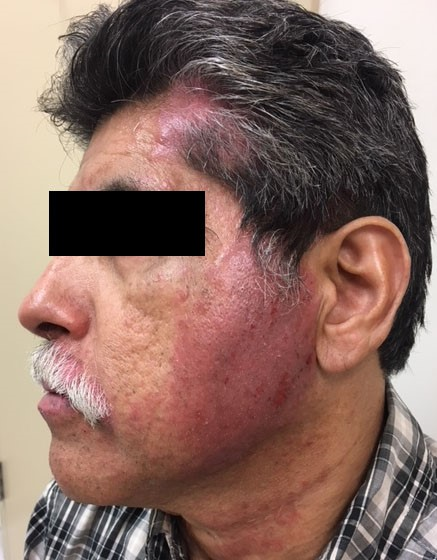 Which of the following are primarily involved in the pathogenesis of this patient's rash?
 (Multiple Choice)
4.9/5 (81)
(81) A 1-year-old boy is brought to the office for medical evaluation. The patient was recently diagnosed with type 1 diabetes mellitus. He has also had chronic diarrhea, failure to thrive, and eczematous dermatitis since early infancy. Small bowel biopsy reveals villous atrophy and extensive lymphocytic infiltration. Immunologic testing shows significantly increased serum immunoglobulins and decreased IL-10 and transforming growth factor-beta levels. Genetic testing reveals a missense mutation affecting FOXP3. Which of the following is the most likely cause of this patient's current condition?
(Multiple Choice)
4.9/5 (87)
(87) A 7-year-old boy is brought to the emergency department by his parents for arthralgias. He had a cough and runny nose last week but otherwise has been in good health. Temperature is 37 C (98.6 F), blood pressure is 95/65 mm Hg, pulse is 92/min, and respirations are 20/min. Physical examination shows raised, red-purple papules, some of which have coalesced, over the patient's buttocks and thighs. Auscultation of the lungs and heart is normal. The abdomen is soft with normal bowel sounds. The knees are tender but do not appear warm or swollen. Urinalysis results are as follows: 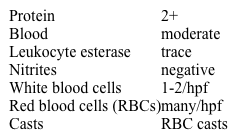 Which of the following mechanisms is the most likely underlying cause of this patient's renal findings?
 (Multiple Choice)
4.8/5 (78)
(78) A 26-year-old man returns to the emergency department after developing a fever and skin rash. The patient was discharged from the hospital 10 days ago after treatment for a copperhead snake bite to his left leg. He received multiple doses of polyvalent Fab antivenom therapy and other supportive care during hospitalization. The patient's bite site pain, swelling, and ecchymosis have resolved; however, he has developed fever, pain in multiple extremity joints, and pruritic rash over the past 2 days. He has no chronic medical conditions. Temperature is 38.5 C (101.3 F), blood pressure is 128/70 mm Hg, pulse is 98/min, and respirations are 17/min. Physical examination shows a diffuse urticarial rash. No mucous membrane lesions are present. There is tenderness to palpation of the bilateral metacarpophalangeal joints, wrists, and ankles with no redness or swelling. Blood cell counts, serum chemistry studies, and coagulation parameters are within normal limits. Which of the following is the most likely underlying mechanism of this patient's current condition?
(Multiple Choice)
4.9/5 (75)
(75) A 2-year-old boy is brought to the emergency department due to wheezing and difficulty breathing. The patient had been trick-or-treating with his parents and ate several packs of candy containing peanuts. After he receives an intramuscular epinephrine injection, his symptoms resolve. At a follow up appointment, an allergy specialist places droplets of various allergens on the patient's skin and punctures the epidermis at each site. After 15 minutes, the skin at the site with peanut extract is erythematous with a raised, itchy bump that improves by the time the family leaves the office. Four hours later, the parents notice a hard, red swelling at the puncture site. Which of the following is most likely involved in this secondary reaction?
(Multiple Choice)
4.9/5 (89)
(89) An autopsy is performed on an 8-month-old infant after his unexpected death. Prior to death, the patient had a 1-month history of poor feeding and intermittent fever, which progressed to severe lethargy and coma. The infant was adopted soon after birth, and there is limited information about his family history beyond documentation of an uncomplicated pregnancy and delivery at term gestation. Brain biopsy reveals leptomeningeal inflammation and is positive for Enterovirus by PCR. This patient would have been most likely to have which of the following laboratory findings?
(Multiple Choice)
4.8/5 (72)
(72) An 11-year-old girl is brought to the office for a health maintenance visit. She feels well and has no chronic medical conditions. As part of routine care, the patient receives a first dose of the quadrivalent meningococcal conjugate vaccine and the 9-valent human papillomavirus vaccine. Five minutes later, while being escorted to the waiting area, the patient appears pale and reports feeling dizzy. She immediately loses consciousness, but a fall is prevented by the health care provider. Blood pressure is 70/40 mm Hg and pulse is 46/min. On physical examination, the patient has normal lung and heart sounds. There is no rash. Which of the following is the most likely cause of this patient's syncope?
(Multiple Choice)
4.8/5 (84)
(84) A 44-year-old woman comes to the emergency department after waking up with facial swelling and with difficulties speaking and swallowing. She states that she does not have allergies or recently had insect bites. She has a 4-year history of hypertension and type 2 diabetes mellitus controlled with medication. Her pulse is 110/min, respirations are 20/min, and blood pressure is 140/90 mm Hg. Pulse oximetry on room air shows an oxygen saturation of 97%. On physical examination, she appears uncomfortable, with notable swelling of the lips and tongue. The remainder of the examination shows no abnormalities. Serum C4 levels are within normal limits. Which of the following is the most likely mechanism responsible for this patient's symptoms?
(Multiple Choice)
4.9/5 (78)
(78) A 24-year-old man burns his hand after grasping the handle of a hot pan while preparing a meal. Several minutes later, both the initial burn and the area around it are red without blistering. When he presses on the burn, the tissue blanches. Which of the following is most likely contributing to the reaction observed in this patient?
(Multiple Choice)
4.9/5 (83)
(83) A 36-year-old woman with fistulizing perianal Crohn disease comes to the office for a follow-up appointment. Eight weeks ago, the patient began receiving intermittent injections of infliximab, a chimeric human-mouse monoclonal antibody targeted against tumor necrosis factor-alpha. She reports improvement in fistula discharge and discomfort but has experienced fever, diffuse joint pain, and an itchy rash 5-7 days after each of the recent treatments. The symptoms spontaneously resolve after 2-3 days. The patient has no other medical conditions and has no history of drug allergies. A delayed drug reaction due to formation of antibodies against foreign drug components is suspected. Which of the following mechanisms is most likely responsible for resolution of these drug reactions?
(Multiple Choice)
4.8/5 (96)
(96) A 55-year-old man with end-stage hepatitis C virus infection undergoes orthotopic liver transplantation from a deceased donor. The patient has no perioperative complications and is discharged from the hospital on appropriate immunosuppressant medications. One week after the surgery, he develops nausea, vomiting, abdominal pain, and bloody diarrhea. Physical examination shows a painful maculopapular rash over his neck, back, and extremities that extends to the palms and soles. Endoscopic evaluation reveals multiple ulcerations of the intestinal mucosa. Which of the following is the most likely cause of this patient's current condition?
(Multiple Choice)
4.9/5 (71)
(71) A 5-year-old boy is undergoing a lymphadenoctomy to treat a poorly draining lymph node abscess. He has a history of recurrent skin abscesses. Cultures from his abscess are growing Staphylococcus aureus, which is sensitive to the current antibiotic regimen, but the abscess has failed to improve. Evaluation of the patient's neutrophils by dihydrorhodamine flow cytometry shows an absence of fluorescence. This patient's condition is most likely due to impaired activity of which of the following enzymes?
(Multiple Choice)
4.8/5 (77)
(77) A 34-year-old man is admitted to the intensive care unit due to fever, chills, shortness of breath, and altered mental status. His symptoms began 3 days ago and have progressively worsened over the last 24 hours. His past medical history is significant for a motor vehicle accident 2 years ago in which he sustained blunt abdominal trauma and required emergency laparotomy due to internal bleeding. His blood pressure is 81/44 mm Hg and pulse is 122/min. He is started on broad-spectrum antibiotics, intravenous fluids, and vasopressors. His condition continues to deteriorate and he dies in the hospital several hours later despite extensive resuscitation efforts. Blood cultures obtained on admission grow Streptococcus pneumoniae. Impairment of which of the following mechanisms most likely contributed to the severity of this patient's infection?
(Multiple Choice)
4.9/5 (78)
(78) The immune response in a healthy 12-year-old boy is observed after a recurrent bacterial infection. It is characterized by a rapid increase in pathogen-specific immunoglobulin levels. The immunoglobulins bound to the bacteria also attach to phagocytic cells (eg, macrophages, neutrophils) to enhance phagocytosis. Which of the following immunoglobulin regions is most likely involved in interacting with these phagocytic cells?
(Multiple Choice)
5.0/5 (74)
(74) A 19-year-old woman comes to the office to discuss treatment options for seasonal sneezing, rhinorrhea, and nasal congestion. She has had these symptoms for the past few springs and summers but is now willing to "try anything" to allow her to concentrate on her upcoming final exams. The patient has no significant medical history, takes no medications, and has no drug allergies. Vital signs are within normal limits and physical examination reveals mild bilateral pale and boggy nasal turbinates with copious clear mucus. Fluticasone, an intranasal glucocorticoid, is prescribed. Which of the following is the most likely mechanism of action of this drug?
(Multiple Choice)
4.7/5 (74)
(74) A 7-month-old boy is brought to the physician by his parents due to irritability and white patches in his mouth. His past medical history is significant forchronic diarrhea and failure to thrive. The child is small for his age and ill-appearing. He is found to have a low blood T-lymphocyte count and severely decreased serum immunoglobulin. After thorough evaluation, an experimental treatment is proposed to his parents. The therapy consists of infecting the patient's cells with a retroviral vector containing the gene for a protein that is deficient in this patient. Which of the following proteins is most likely coded by this gene?
(Multiple Choice)
4.9/5 (89)
(89) An 8-year-old boy is brought to the hospital due to severe headache and altered mental status. An aggressive, high-risk neuroblastoma is diagnosed. As part of his treatment, the patient will receive an autologous bone marrow transplant using stem cells obtained from his peripheral blood. His pretransplant evaluation reveals a history of Epstein-Barr virus infection. This patient is at greatest risk for which of the following after transplantation?
(Multiple Choice)
4.8/5 (78)
(78) 
Filters
- Essay(0)
- Multiple Choice(0)
- Short Answer(0)
- True False(0)
- Matching(0)