



 Chat with AI
Exam 8: Immunology

Exam 1: Anatomy265 Questions
Exam 2: Behavioral Sciences178 Questions
Exam 3: Biochemistry102 Questions
Exam 4: Embryology59 Questions
Exam 5: Epidemiology, Biostatistics, and Medical Informatics94 Questions
Exam 6: Genetics88 Questions
Exam 7: Histology46 Questions
Exam 8: Immunology147 Questions
Exam 9: Microbiology and Virology330 Questions
Exam 10: Pathology817 Questions
Exam 11: Pharmacology and Toxicology509 Questions
Exam 12: Physiology339 Questions
Exam 13: Psychiatry and Psychotherapy23 Questions
Select questions type


A 4-year-old kid is brought to the clinic for her yearly checkup. She has no chronic medical issues and has had all previously advised vaccines. Today, the patient will receive multiple immunizations, including a second measles vaccine. Which of the following IgM and IgG trends are likely to develop following initial and subsequent measles vaccinations?
(Multiple Choice)
4.7/5  (87)
(87) A 23-year-old woman comes to the physician with migratory joint pains involving her hands and knees. Physical examination shows bilateral tenderness in her wrists and proximal interphalangeal joints. There is also a malar skin rash and generalized lymphadenopathy. A urinalysis reveals proteinuria. Further evaluation shows that the patient's lymphocytes contain a mutated and functionally defective Fas gene product. Which of the following immunologic mechanisms is most likely impaired in this patient as a result of this molecular defect?
(Multiple Choice)
4.7/5 (88)
(88) A 2-year-old boy is brought to the emergency department due to 4 days of worsening cough and fevers. This evening, the patient developed increasingly rapid breathing. He has a history of 2 prior episodes of cervical lymphadenitis due to Staphylococcus aureus. Temperature is 39 C (102.2 F). Blood pressure is 100/72 mm Hg, pulse is 130/min, and respirations are 35/min. Prominent intercostal and supraclavicular retractions are present. There are diffuse crackles bilaterally, with decreased breath sounds at the lung bases. Heart sounds are normal. The patient is intubated. Laboratory results are as follows: 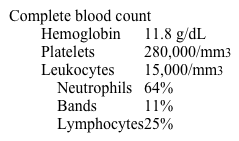 Bronchioalveolar lavage fluid tests positive for Aspergillus fumigatus. Serum immunoglobulin levels are normal. Which of the following is the most likely underlying cause of this patient's presentation?
 (Multiple Choice)
4.9/5 (68)
(68) A 33 year-old female is being followed by her neurologist for her multiple sclerosis. She was initially diagnosed with relapsing remitting subtype after an episode of visual disturbance and an episode of paralysis. In her study of autoimmune diseases she encounters the topic of lymphocyte development and comes across a question which she poses to her neurologist during a routine follow-up visit: During the process of T-lymphocyte maturation, T cell receptors of many lymphocytes demonstrate a very high-affinity interaction with MHC molecules expressed on thymic medullary epithelial and dendritic cells. What process do these lymphocytes undergo at this time?
(Multiple Choice)
4.7/5 (71)
(71) A 68-year-old man with bilateral percutaneous nephrostomy tubes is brought to the emergency department by his wife because of confusion. She adds that he complained of right flank pain yesterday. He has prostate cancer and receives leuprolide injections every 3 months. He is oriented to person but not to place or time. Temperature is 38.9 C (102 F), blood pressure is 80/50 mm Hg, pulse is 130/min, and respirations are 20/min. The right nephrostomy bag contains a small amount of cloudy urine; the left nephrostomy bag contains clear urine. Laboratory results are as follows: 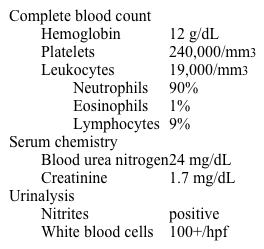 Which of the following is most likely decreased in this patient?
 (Multiple Choice)
4.8/5 (86)
(86) A 55-year-old man with end-stage hepatitis C virus infection undergoes orthotopic liver transplantation from a deceased donor. The patient has no perioperative complications and is discharged from the hospital on appropriate immunosuppressant medications. One week after the surgery, he develops nausea, vomiting, abdominal pain, and bloody diarrhea. Physical examination shows a painful maculopapular rash over his neck, back, and extremities that extends to the palms and soles. Endoscopic evaluation reveals multiple ulcerations of the intestinal mucosa. Which of the following is the most likely cause of this patient's current condition?
(Multiple Choice)
4.8/5 (79)
(79) A 75-year-old man is hospitalized due to respiratory distress. The patient developed fever, cough, and muscle aches 4 days prior to admission. He is otherwise healthy and has no chronic medical conditions. The patient has received all recommended vaccinations, including a yearly flu vaccine. Temperature is 39 C (102.2 F), blood pressure is 110/65 mm Hg, pulse is 115/min, and respirations are 29/min. Chest x-ray shows bilateral infiltrates. Reverse transcriptase PCR of a specimen from a nasopharyngeal swab reveals a strain of influenza A virus that was included in the seasonal trivalent flu vaccine. The patient lives with his 50-year-old son, who received the same vaccine but did not develop the infection. Which of the following factors most likely increased this patient's risk of vaccine failure compared with that of his son?
(Multiple Choice)
4.7/5 (78)
(78) A 45-year-old woman comes to the office due to several weeks of nonproductive cough and dyspnea. She underwent lung transplantation 7 months ago because she has a history of primary pulmonary hypertension. She takes her medications regularly. Pulmonary function testing demonstrates a forced expiratory volume in 1 second (FEV1), 67% of her best posttransplant FEV1. Her forced vital capacity remains largely unchanged. A lung biopsy shows areas of total fibrotic obstruction in the terminal bronchioles. This patient's condition is most likely caused by which of the following?
(Multiple Choice)
4.9/5 (74)
(74) A 57-year-old woman comes to the emergency department due to cough and hemoptysis. The patient also reports several months of fatigue and joint pain. Physical examination is notable for crusting of the nasal mucosa, lung crackles, and scattered palpable purpura over the lower extremities. Chest x-ray reveals bilateral, diffuse alveolar infiltrates. Laboratory studies show normocytic anemia, red blood cell casts and protein in the urine, and positive c-ANCA. After a confirmatory biopsy, treatment with rituximab infusion is planned. This medication is most likely to improve this patient's condition via which of the following mechanisms?
(Multiple Choice)
4.8/5 (79)
(79) A 28-year-old woman, gravida 2 para 2, brings her healthy 6-day-old girl to the office for her first well-baby checkup. The infant was born full-term, with a birth weight of 4.2 kg (9.3 lb) and a length of 51 cm (20 in). She was discharged from the nursery with no concerns. Physical examination is normal. The infant's blood type is A negative, whereas the mother's is B negative. High circulating levels of anti-A antibodies are found in the mother's blood. Hemolysis did not occur in the infant because these maternal antibodies are most likely of which class?
(Multiple Choice)
4.8/5 (84)
(84) Preventive disease specialists working in a developing country are investigating vaccination options to limit the spread of poliomyelitis. As part of the study, 2 patients are vaccinated against poliomyelitis. One patient receives an intramuscular inactivated vaccine and the other patient receives a live attenuated oral vaccine. One month after vaccination, the levels of which of the following poliovirus antibodies will differ the most between these 2 patients?
(Multiple Choice)
4.8/5 (86)
(86) A 5-year-old boy with severe, recurrent respiratory infections is undergoing evaluation. Sputum studies reveal intracellular bacteria. Further testing shows that the patient's T cells lack the IL-12 receptor. Supplementation with which of the following substances would most likely improve this patient's condition?
(Multiple Choice)
4.9/5 (87)
(87) A 10-month-old kid is admitted to the hospital with respiratory distress caused by Pneumocystis jiroveci pneumonia. The kid has had many bouts of otitis media and thrush, and his weight is below the fifth percentile. An examination in the laboratory indicates normal levels of circulating B and T cells as well as low levels of all immunoglobulins. A uncommon autosomal recessive mutation results in a failure in the control of human leukocyte antigen gene transcription, according to genetic testing. The figure below depicts flow cytometry of the patient's peripheral blood compared to a healthy control: 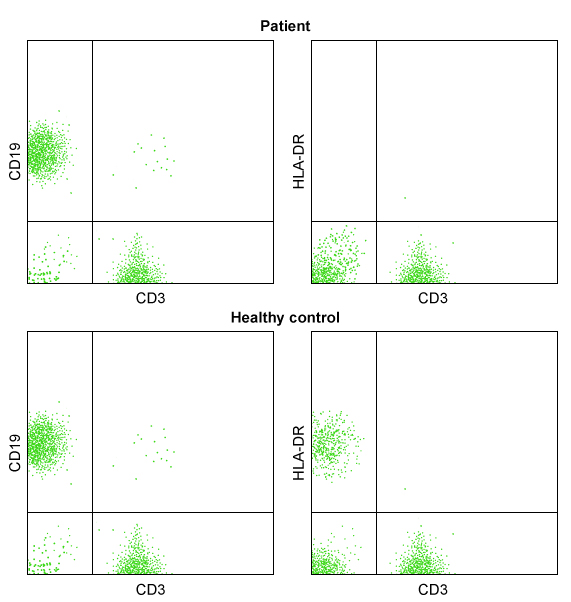 Which of the following processes is most likely to be impaired by this patient's mutation?
 (Multiple Choice)
4.7/5 (89)
(89) A 53-year-old man arrives at the emergency room after experiencing gradually worsening shortness of breath, a nonproductive cough, and low-grade fevers for the previous two weeks. He hasn't had a runny nose or a sore throat, and he hasn't had any ill contacts. He had a lung transplant four months ago for idiopathic pulmonary fibrosis. Immunosuppressants and trimethoprim-sulfamethoxazole are among his meds. The temperature is 37.8 degrees Celsius (100 F). A chest x-ray indicates bilateral diffuse interstitial infiltrates. Testing reveals a decline in pulmonary function. The image below depicts a lung biopsy specimen. 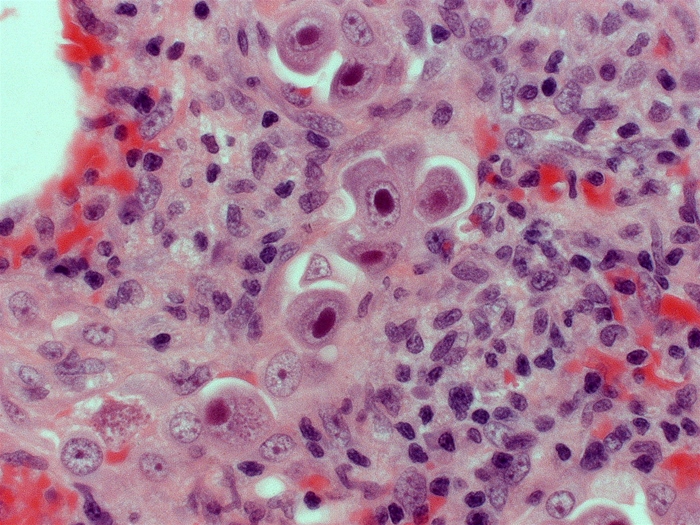 Which of the following best characterizes the organism most likely responsible for this patient's current condition?
 (Multiple Choice)
4.9/5 (89)
(89) An autopsy is performed on an 8-month-old infant after his unexpected death. Prior to death, the patient had a 1-month history of poor feeding and intermittent fever, which progressed to severe lethargy and coma. The infant was adopted soon after birth, and there is limited information about his family history beyond documentation of an uncomplicated pregnancy and delivery at term gestation. Brain biopsy reveals leptomeningeal inflammation and is positive for Enterovirus by PCR. This patient would have been most likely to have which of the following laboratory findings?
(Multiple Choice)
4.7/5 (84)
(84) A 5-month-old boy is brought to the physician because of fever and a cough for 3 days. His mother reports that he has had multiple episodes of loose stools over the past 3 months. He has been treated for otitis media 4 times and bronchiolitis 3 times during the past 3 months. He was born at 37 weeks' gestation and the neonatal period was uncomplicated. He is at the 10th percentile for height and 3rd percentile for weight. His temperature is 38.3°C (100.9°F), pulse is 126/min, and respirations are 35/min. Examination shows an erythematous scaly rash over the trunk and extremities. There are white patches on the tongue and buccal mucosa that bleed when scraped.Auscultation of the lungs shows expiratory wheezing. Cardiac examination is within normal limits. Laboratory results are as follows: 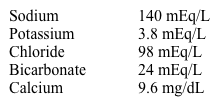 Serum protein electrophoresis shows a very low gamma globulin level. Chest x-ray reveals an absent thymic shadow. Which of the following is the most likely diagnosis?
 (Multiple Choice)
4.9/5 (87)
(87) A 14-year-old boy is brought to the emergency department by his mother after he develops a sudden rash. He was trying to retrieve a baseball that had rolled under a log when he got stung by something. By the time he told his mom, his body was covered in welts. His mother gave him diphenhydramine, but the patient's face started to swell and he was having a hard time swallowing. The patient's blood pressure is 70/50 mm Hg and heart rate is 120/min. Physical examination shows erythematous, raised plaques over the trunk, extremities, and face. Lung auscultation reveals bilateral expiratory wheezes. The mother is not aware of the child having any similar reaction in the past. Which of the following most likely triggered this patient's condition?
(Multiple Choice)
4.9/5 (78)
(78) A 43-year-old man is hospitalized with recent-onset oliguria and a high serum creatinine level. He has been seen in clinic several times for an intranasal ulcer that has failed to heal. This patient's condition is most likely associated with antibodies against which of the following?
(Multiple Choice)
4.9/5 (81)
(81) A 32-year-old woman visits an allergy clinic because she has a recurring skin problem. Over the last few months, the patient has experienced many episodes of itchy, erythematous, vesicular eruptions on her hands. She works at a hair salon, where she is frequently exposed to hair color and other beauty products. There are no additional medical issues or drugs that the patient is taking. Several allergens detected in common cosmetic items are placed on nonocclusive tape strips applied to her upper back during patch testing. The exhibit depicts skin results that occurred after two days of treatment. 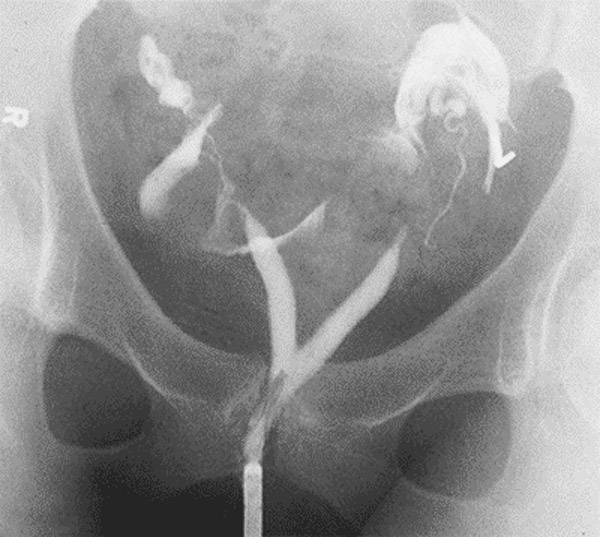 Which of the following processes most likely occurred in this patient to enable the development of the observed skin reaction?
 (Multiple Choice)
4.8/5 (80)
(80) A 13-month-old boy is brought to the clinic after repeated infections for the past 4 months, including otitis media, pneumonia, and erysipelas. Although his infections have been responsive to treatment, his father is concerned about the number of infections. The patient also has persistent diarrhea, and a recent stool antigen detection assay was positive for Giardia lamblia. An immunoglobulin panel demonstrates very low serum levels of all immunoglobulin types. Intradermal injection of Candida antigens results in a large indurated nodule within 48 hours. This patient's lymph nodes most likely lack which of the following structures?
(Multiple Choice)
4.9/5 (80)
(80) 
Filters
- Essay(0)
- Multiple Choice(0)
- Short Answer(0)
- True False(0)
- Matching(0)