



 Chat with AI
Exam 8: Immunology

Exam 1: Anatomy265 Questions
Exam 2: Behavioral Sciences178 Questions
Exam 3: Biochemistry102 Questions
Exam 4: Embryology59 Questions
Exam 5: Epidemiology, Biostatistics, and Medical Informatics94 Questions
Exam 6: Genetics88 Questions
Exam 7: Histology46 Questions
Exam 8: Immunology147 Questions
Exam 9: Microbiology and Virology330 Questions
Exam 10: Pathology817 Questions
Exam 11: Pharmacology and Toxicology509 Questions
Exam 12: Physiology339 Questions
Exam 13: Psychiatry and Psychotherapy23 Questions
Select questions type


The patient's anaphylactic reaction is determined to be mediated by antigen-specific IgE antibodies attached to high-affinity receptors on the surface of mast cells and basophils. Which of the following mechanisms is most likely to trigger vasoactive substance release by these cells?
(Multiple Choice)
4.9/5  (84)
(84) A 58-year-old asymptomatic woman comes to the office for a health checkup prior to starting volunteer work at a hospital. She has a history of hypothyroidism and takes levothyroxine. She does not use tobacco, alcohol, or illicit drugs. Her examination findings are unremarkable. During a laboratory test, her white blood cells are incubated with mycobacterial antigens. Compared to the control, a large amount of interferon-gamma is detected in her blood sample. Which of the following cell types is most directly responsible for this finding?
(Multiple Choice)
4.8/5 (81)
(81) A 67-year-old man comes to the office after he noticed several nodules in his left axilla. He has a history of malignant melanoma on his upper back, which was treated with wide surgical excision 4 years ago. The patient undergoes biopsy of an axillary lesion, and histopathology reveals melanoma recurrence. Subsequent whole-body positron emission scan shows diffuse metastatic disease involving the lungs, liver, and left axillary nodes. Checkpoint inhibitor therapy with pembrolizumab is initiated, which leads to significant reduction in the size of the axillary nodules and metastatic lesions. Which of the following best correlates with the treatment response in this patient?
(Multiple Choice)
4.9/5 (87)
(87) A 28-year-old woman is treated with high-dose prednisone for severe lupus nephritis. Several hours after therapy is initiated, she becomes very agitated and delusional. Blood pressure is 130/70 mm Hg and heart rate is 110/min. A basic metabolic profile, complete blood cell (CBC) count, and urinalysis are obtained. The CBC differential is expected to show an increase in which of the following as a result of this patient's therapy?
(Multiple Choice)
4.9/5 (80)
(80) A mother of a 12-month boy is calling the office due to a concern of her son temperature after a he received the first dose of the subcutaneous measles-mumps-rubella vaccine. His temperature is 38 C (100.4 F) and has been irritable since the vaccination. He has had no prior vaccine-related adverse events. He has no known allergies. The immunization site is mildly red, swollen, and tender; there is no other skin rash. Which of the following cells and effector mechanisms is most likely involved in pathogenesis of this patient's current condition?
(Multiple Choice)
4.7/5 (88)
(88) An 18-month-old boy is evaluated for recurrent infections. He has been hospitalized 3 times with pneumonia since age 3 months. He has also had multiple skin infections requiring treatment with antibacterial and antifungal agents. During his last episode of pneumonia, he developed a large pleural effusion, which was drained. The pleural fluid revealed numerous neutrophils containing a large number of intact gram-positive cocci. The microorganisms responsible for this patient's recurrent infections most likely produce which of the following virulence factors?
(Multiple Choice)
4.9/5 (79)
(79) A neonate is born at 38 weeks gestation age via spontaneous vaginal delivery to a 40-year-old woman. The mother was working in South America when she discovered that she was pregnant. She had 2 days of fever associated with cough and swollen cervical glands, which resolved spontaneously at 12 weeks gestation prior to returning to the United States. The mother has no current symptoms. Neonatal examination shows weight and length at the 8th percentile, and head circumference below the 3rd percentile for age. Heart and lung sounds are normal. There is moderate hepatosplenomegaly. Skin examination shows diffuse, dark-blue papules and nodules. Serology from the mother and infant are attained. Which of the following serology patterns is most consistent with a suspected congenital infection? 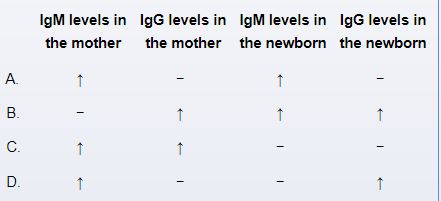
(Multiple Choice)
4.8/5 (78)
(78) A 25-year-old man comes to the office due to a 1-month history of increasing abdominal girth and swollen extremities. His BMI is 32 kg/m2. Laboratory evaluation shows decreased serum albumin and hypercholesterolemia, and urinalysis reveals heavy proteinuria and fatty casts. A renal biopsy shows findings consistent with focal segmental glomerulosclerosis. Despite aggressive medical management, the patient requires a kidney transplant from his younger sister, who is a 5 out of 6 HLA antigen match. As a part of his posttransplant immunosuppressive regimen, he takes a medication that inhibits lymphocyte proliferation by directly blocking interleukin-2 signal transduction. This mechanism best describes which of the following drugs?
(Multiple Choice)
4.8/5 (77)
(77) A 19-year-old woman is brought to the emergency department after a motor vehicle collision. The patient's medical history includes celiac disease and 3 episodes of pneumonia. Her blood pressure is 80/45 mm Hg and pulse is 130/min. Physical examination reveals pallor, and ultrasound shows a splenic laceration. She receives a blood transfusion with O-negative packed red blood cells. During transfusion, the patient develops facial swelling, generalized hives, and shortness of breath. Which of the following is the most likely diagnosis in this patient?
(Multiple Choice)
4.9/5 (81)
(81) A 28-year-old man comes to the office with a 2-month history of dull low back pain and morning stiffness. The pain had an insidious onset, and the patient does not recall any recent trauma. He attempted treatment with acetaminophen and spinal manipulation, which did not provide relief. The patient has usually slept on his back but now must lie on his side to fall asleep easily. Past medical history is unremarkable. Vital signs are normal. Physical examination shows limited anterior flexion of the spine. There is no swelling or warmth of any peripheral joints. X-rays reveal narrowing of the sacroiliac joints. Which of the following is most strongly associated with this patient's disease?
(Multiple Choice)
4.8/5 (90)
(90) A 45-year-old woman comes to the office due to a long history of joint pain, swelling, and stiffness. She recently immigrated to the United States and had little access to medical care in her original country. On physical examination, her proximal interphalangeal and metacarpophalangeal joints are tender and swollen bilaterally, and her fingers appear significantly deformed. Subcutaneous nodules are palpated near the elbow. Laboratory studies are obtained to confirm the diagnosis. This patient's serum is most likely to contain IgM antibodies against which of the following substances?
(Multiple Choice)
4.9/5 (84)
(84) A 55-year-old man is evaluated due to a nonhealing left forearm wound. The patient had an excisional biopsy of a suspicious skin lesion at the site of the wound several weeks ago. He has a history of uncontrolled type 2 diabetes mellitus and hypertension. Vital signs are within normal limits. Physical examination shows a 2.5-cm wound surrounded by erythema on the left forearm. Upregulation of which of the following would most likely improve fibroblast proliferation and reepithelization in this nonhealing wound?
(Multiple Choice)
4.9/5 (75)
(75) A newborn girl is admitted to the neonatal intensive care unit with jaundice, hepatomegaly, and generalized edema. She was born by vaginal delivery to a 32-year-old woman, gravida 2, para 2, who received minimal prenatal care. The infant's laboratory results show a hemoglobin level of 6 g/dL and a positive direct Coombs test. A peripheral blood smear shows many nucleated erythrocytes. The infant has significant respiratory distress due to pleural effusions and ascites and dies soon after birth. Autopsy shows areas of extramedullary hematopoiesis in many tissues. Which of the following is the most likely cause of this patient's condition?
(Multiple Choice)
4.7/5 (82)
(82) A 5-year-old child is brought to the emergency department by his parents for right arm pain. The patient reports that he was playing hide and seek outside and felt a sharp pain on his arm while hiding in some thick bushes. His parents suspect that something had stung him. Physical examination shows an edematous and erythematous plaque with mild central pallor. A residual stinger, located central to the lesion, is readily extracted. The physical examination is otherwise not significant. Which of the following substances is most likely directly responsible for the skin findings observed in this patient?
(Multiple Choice)
4.8/5 (76)
(76) A 10-year-old boy is brought to the emergency department by his parents due to increasing lethargy and high fever for the past 12 hours. The boy was well last night but was sluggish this morning. Over the day, his activity level and responsiveness diminished. The patient was treated for Neisseria meningitidis bacteremia 2 years ago. He has received all routine vaccinations and is developing normally. Temperature is 39.6 C (103.3 F). On examination, the patient appears ill and is poorly responsive. He is tachycardic, but heart sounds are otherwise unremarkable. Lungs are clear to auscultation. Numerous purple bruise-like markings and petechiae are noted over his extremities, which have diminished capillary refill. Blood samples are drawn for total complement (CH50) and alternative complement (AH50) measurement. Which of the following sets of results is most likely to be found in this patient? 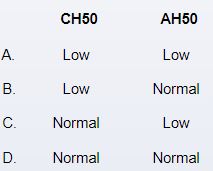
(Multiple Choice)
4.9/5 (82)
(82) A 15-year-old boy develops severe cardiomyopathy following myocarditis from Coxsackie virus and is placed on the cardiac transplant list. Two weeks following his cardiac transplantation from a matched donor, he develops dyspnea on exertion. Extensive evaluation is undertaken including cardiac catheterization and endomyocardial biopsy to assess for acute allograft rejection. Which of the following histologic findings is most consistent with this diagnosis?
(Multiple Choice)
4.8/5 (74)
(74) A 12-year-old boy is brought to the emergency department by his mother because of progressive shortness of breath, difficulty speaking, and diffuse, colicky abdominal pain for the past 3 hours. Yesterday he underwent a tooth extraction. His father and a paternal uncle have a history of repeated hospitalizations for upper airway and orofacial swelling. The patient takes no medications. His blood pressure is 112/62 mm Hg. Examination shows edematous swelling of the lips, tongue, arms, and legs; there is no rash. Which of the following studies is most likely to be abnormal?
(Multiple Choice)
4.8/5 (77)
(77) A 24-year-old, previously healthy woman is evaluated for skin rash, joint pains, and renal failure. She is found to have decreased C3 and C4 levels and a normal factor B level. Which of the following most likely triggered the complement system activation in this patient?
(Multiple Choice)
4.7/5 (80)
(80) A 13-month-old boy is brought to the emergency department due to cough and increased work of breathing. The patient's parents immigrated to the United States when he was 6 months old. He has a history of recurrent otitis media, pneumonia, and thrush as well as chronic diarrhea and failure to thrive. On physical examination, he is tachypneic and has perioral cyanosis. A chest radiograph shows bilateral interstitial opacities. The patient is admitted to the hospital and undergoes bronchoscopy. Analysis of the bronchoalveolar lavage fluid reveals Pneumocystis jirovecii. Which of the following is the most likely underlying diagnosis?
(Multiple Choice)
4.8/5 (67)
(67) A 15-month-old boy is brought to the emergency room with a fever and edema in his feet. Four days ago, the patient had edema in his right foot and a fever. Swelling of the left foot has also occurred today. A 9-month-old perianal abscess has a considerable medical history. Imaging examinations indicate osteomyelitis in both feet's metatarsal bones. Although intravenous antibiotics are given, the patient still has a fever and bilateral foot edema two weeks later. A laboratory examination reveals chronic neutrophilic leukocytosis. Staphylococcus aureus develops in bone biopsy cultures. The search for an underlying diagnosis begins; the patient's peripheral blood is stimulated with phorbol myristate acetate (PM A) and compared to a control using a rhodamine derivative. 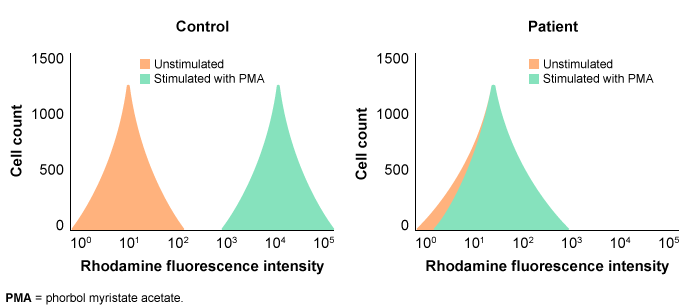 Which of the following processes is most likely impaired in this patient?
 (Multiple Choice)
4.8/5 (86)
(86) 
Filters
- Essay(0)
- Multiple Choice(0)
- Short Answer(0)
- True False(0)
- Matching(0)