



 Chat with AI
Exam 8: Immunology

Exam 1: Anatomy265 Questions
Exam 2: Behavioral Sciences178 Questions
Exam 3: Biochemistry102 Questions
Exam 4: Embryology59 Questions
Exam 5: Epidemiology, Biostatistics, and Medical Informatics94 Questions
Exam 6: Genetics88 Questions
Exam 7: Histology46 Questions
Exam 8: Immunology147 Questions
Exam 9: Microbiology and Virology330 Questions
Exam 10: Pathology817 Questions
Exam 11: Pharmacology and Toxicology509 Questions
Exam 12: Physiology339 Questions
Exam 13: Psychiatry and Psychotherapy23 Questions
Select questions type


A 21-year-old woman comes to the office due to recurrent episodes of self-limited, colicky abdominal pain. She also had an episode of facial swelling that resolved spontaneously. The patient has no other significant past medical history and takes no medications. Examination is unremarkable. Evaluation shows that her complement protein C1, even when not attached to an antigen-antibody complex, is excessively cleaving C2 and C4. Which of the following is most likely increased in this patient?
(Multiple Choice)
4.9/5  (85)
(85) A 10-year-old girl is brought to the office due to sneezing, rhinorrhea, and nasal congestion and itching. The symptoms began 2 days ago after she arrived at a family farm for a summer vacation. The patient has spent a few days visiting the farm during previous summer seasons. She had no symptoms at her first visit 2 years ago but recalls having similar symptoms last year. She has had no respiratory symptoms while residing in another state the rest of the year. The patient has no prior medical conditions and takes no medications. On physical examination, the nasal turbinates are enlarged and bluish; clear rhinorrhea is present. Allergic response to a farm allergen is suspected. Which of the following processes most likely occurred during the first farm visit 2 years ago?
(Multiple Choice)
4.8/5 (69)
(69) A 7-month-old boy is brought to the physician by his parents due to irritability and white patches in his mouth. His past medical history is significant forchronic diarrhea and failure to thrive. The child is small for his age and ill-appearing. He is found to have a low blood T-lymphocyte count and severely decreased serum immunoglobulin. After thorough evaluation, an experimental treatment is proposed to his parents. The therapy consists of infecting the patient's cells with a retroviral vector containing the gene for a protein that is deficient in this patient. Which of the following proteins is most likely coded by this gene?
(Multiple Choice)
4.9/5 (78)
(78) A 2-month-old girl is brought to the office for a well-child visit. The patient was born at term with no complications. She is exclusively formula fed and gaining weight well. Examination is unremarkable today. The mother is informed that several vaccinations are due at this visit. She becomes upset and mentions that her older son, who did follow a standard vaccine schedule, had a "bad reaction" to his last set of shots and had a cough for weeks. She wants to defer immunizations for her daughter at this time. The mother says, "I know you won't agree with me, but I have been reading that these reactions are actually very harmful to the immune system." Which of the following is the most appropriate response?
(Multiple Choice)
4.9/5 (66)
(66) A 68-year-old man comes to the emergency department with a 2-day history of fever, chills, and productive cough. His temperature is 38.9 C (102 F), blood pressure is 108/52 mm Hg, pulse is 102/min, and respirations are 26/min. Crackles and bronchial breath sounds are heard over the right lower lung. There is dullness to percussion over the same area. Chest x-ray reveals right lower lobe consolidation and a right-sided pleural effusion. The patient is started on the appropriate treatment, and a diagnostic thoracentesis is performed that shows an uncomplicated parapneumonic effusion. When a sterile sample of the inflammatory exudate is experimentally introduced into normal human tissue, rapid neutrophil locomotion is observed. Which of the following components of the exudate is most likely responsible for this observed effect?
(Multiple Choice)
4.8/5 (83)
(83) Pharmacology researchers develop a novel immunotherapy to treat malignancies. In this therapy, T lymphocytes are harvested from patients with a malignancy and genetically modified to express a chimeric antigen receptor composed of an extracellular antigen recognition domain linked with an intracellular T-cell signaling domain. These modified T cells are expanded ex vivo and then infused back into the patient, where they destroy the cancer cells. In one of the experiments, they modify the chimeric antigen receptor to recognize CD19. Use of this treatment is most likely to have which of the following potential complications?
(Multiple Choice)
4.8/5 (74)
(74) A 52-year-old woman comes to the emergency department with pain and redness affecting her left leg. The patient's symptoms began 2 days ago and have progressed to the point where she cannot walk without experiencing severe pain. Physical examination shows a large, erythematous area with indistinct margins over her left leg. The area feels hot and indurated and is exquisitely tender. She is admitted to the hospital for severe left leg cellulitis and is started on intravenous cefazolin. Several minutes after the infusion is started, she experiences shortness of breath, diffuse itching, and dizziness. Her blood pressure is 64/38 mm Hg and heart rate is 130/min. On examination, there is a diffuse erythematous skin rash and bilateral wheezing is heard on lung auscultation. Which of the following is most likely to be elevated in this patient's serum as a result of her medication reaction?
(Multiple Choice)
4.8/5 (72)
(72) A 13-year-old boy has been admitted to the hospital after suffering from fever and fatigue for the past week. The patient had a cadaveric renal transplant for glomerulonephritis, and his immunosuppressive medication regimen was increased a month ago due to early signs of rejection. The temperature is 37.7 degrees Celsius (99.9 F). The heart and lung exams are unremarkable. The liver is slightly enlarged, and the spleen tip can be felt. Adenopathy is present in the bilateral inguinal and axillary regions. A complete blood count reveals that the patient has mild leukopenia. The image below depicts histopathology findings from a biopsy of one of the enlarged lymph nodes. 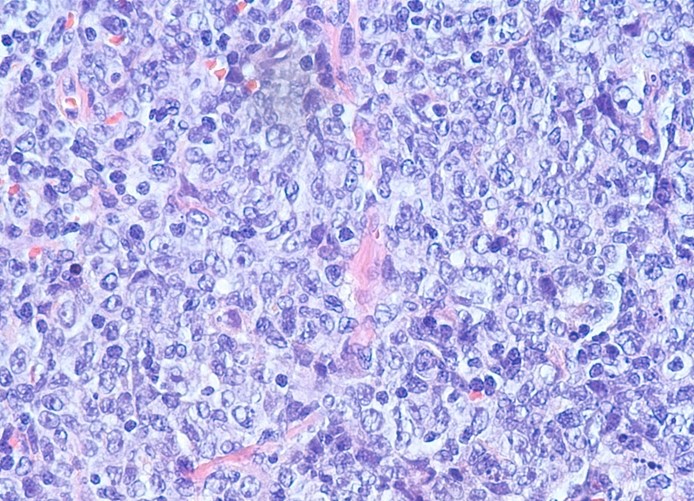 Which of the following is the most likely cause of this patient's presentation?
 (Multiple Choice)
4.8/5 (78)
(78) A 32-year-old man comes to the clinic for follow-up due to Crohn disease. The patient was initially diagnosed 3 years ago and achieved disease remission following a course of high-dose glucocorticoids. He remained in remission until 2 months ago, when he experienced an acute flare of diarrhea and abdominal pain that required a brief hospitalization and another course of high-dose glucocorticoids. The patient completed a prescribed glucocorticoid taper earlier this week and says that his symptoms have returned to "about normal." Azathioprine maintenance therapy is started to help prevent future flares. Which of the following most accurately describes the expected effects of this new medication on immune function? 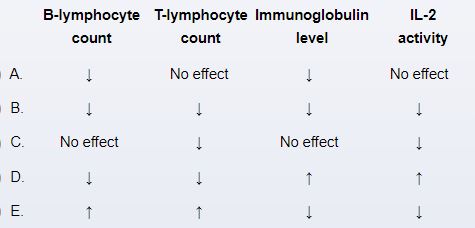
(Multiple Choice)
4.8/5 (78)
(78) A 34-year-old woman comes to the office for tuberculosis evaluation. The patient was advised to have tuberculosis testing after her father, who came to visit from Haiti a week ago and had been living with her, was found to have active pulmonary tuberculosis. She has no history of tuberculosis or any other chronic medical conditions and takes no medications. Tuberculin skin testing is performed and results 48 hours later are negative. Eight weeks later, the patient returns for follow-up and says she feels healthy and has had no fever, cough, shortness of breath, or weight loss. Physical examination shows no abnormalities. Repeat tuberculin skin testing reveals significant skin induration around the injection site at 48 hours. Chest radiograph reveals no parenchymal opacities, pleural effusion, or enlarged lymph nodes. Which of the following immune effector cells are most important for control of the pathogen responsible for this patient's skin findings?
(Multiple Choice)
4.8/5 (69)
(69) Pharmacology researchers develop a novel monoclonal antibody medication to treat the wet form of age-related macular degeneration. The antibody binds vascular endothelial growth factor, decreasing abnormal blood vessel formation in the subretinal space. In a clinical trial, the medication is found to improve visual function. During the next phase of the study, researchers use only the antigen binding fragment (Fab) of the antibody instead of the whole immunoglobulin. Which of the following is most likely to be observed with use of the antibody fragments compared to the intact immunoglobulin?
(Multiple Choice)
4.9/5 (78)
(78) A 34-year-old man comes to the office due to severe fatigue. The patient was diagnosed with paroxysmal nocturnal hemoglobinuria 3 years ago, and he has required several blood transfusions due to anemia. Treatment is initiated with a monoclonal antibody that prevents formation of the protein complex leading to hemolysis in this patient. Prophylactic pharmacotherapy will be required to prevent infection by which of the following organisms?
(Multiple Choice)
4.9/5 (85)
(85) A 24-year-old hospital phlebotomist comes to the occupational health clinic after sustaining a needlestick injury while drawing blood from a hepatitis B-positive patient. She has no medical history and received the complete hepatitis B vaccination series prior to her hospital employment a year ago. She is closely monitored over the next 6 months with repeat hepatitis B serologies and does not develop clinical or laboratory evidence of infection. Which of the following mechanisms most likely explains her immunity?
(Multiple Choice)
4.9/5 (77)
(77) Different kinds of immunoglobulins have distinct structures. Some immunoglobulins contain lengthy hinge areas between the Fab and Fc regions, whereas others do not, as seen in the graphic below: 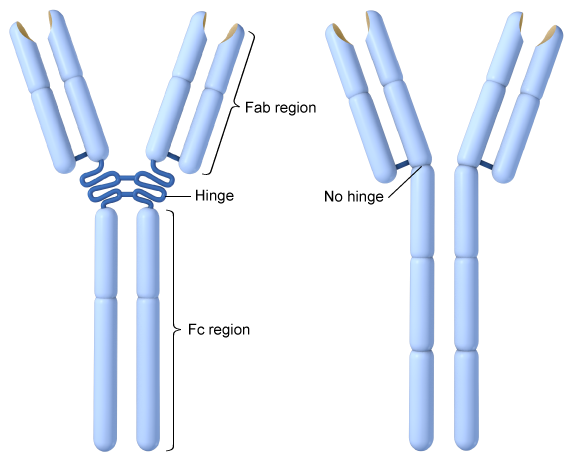 The hinge region provides movement flexibility to the Fab regions. This is most likely to affect which of the following immunoglobulin properties?
 (Multiple Choice)
5.0/5 (84)
(84) A 2-year-old boy is brought to the physician for the evaluation of fever, difficulty breathing, and coughing for the past week. In the past year, he has had four sinus infections, three upper respiratory tract infections, and an episode of severe bronchiolitis requiring hospitalization. is born with facial dysmorphia and a cleft palate. Further evaluation reveals a heart condition with a right-to-left shunt and the absence of a thymic shadow on x-ray. Examination of this patient's lymph nodes will most likely show poor development of which of the following structures?
(Multiple Choice)
4.9/5 (87)
(87) A 3-year-old girl is brought to the office after developing fever and a sore throat. The patient recently entered day care, and similar symptoms have been reported in several of the other children. Physical examination shows exudative pharyngitis and enlarged anterior cervical lymph nodes. A rapid antigen detection test confirms the diagnosis of streptococcal throat infection. Her condition resolves with antibiotic therapy. Several weeks later, she is re-exposed to Streptococcus pyogenes. The bacteria penetrating beyond the surface epithelium are immediately coated with preformed IgG antibodies. Which of the following substances acts in the most similar manner to IgG antibodies to facilitate phagocytosis?
(Multiple Choice)
4.9/5 (79)
(79) A 57-year-old man underwent lung transplantation for severe emphysema 2 years ago. Over the last 6 months, he has had increasing exertional dyspnea and dry cough. The patient has adhered to his medical regimen. He does not smoke and has no exposure to secondhand smoke. Physical examination shows scattered bilateral rales and end-expiratory squeaks. Cardiac auscultation reveals no murmurs or additional sounds. Spirometry demonstrates markedly decreased FEV1 compared with findings 6 months prior, although the FVC remains largely unchanged. Chronic lung transplant rejection is suspected, and bronchoscopy with transbronchial biopsy is planned. Histopathology is most likely to show injury predominantly involving which of the following structures?
(Multiple Choice)
5.0/5 (78)
(78) A 71-year-old man with chronic obstructive pulmonary disease (COPD) is hospitalized due to shortness of breath and wheezing. The patient is treated with bronchodilators and systemic corticosteroids for acute COPD exacerbation. His symptoms improve over the next 2 days. Before being discharged, an intramuscular vaccine containing inactivated viral components, which he normally receives annually, is administered. Several weeks later, the patient comes in close contact with an individual infected with the same virus contained in the vaccine. Which of the following is most likely to occur in this patient as a result of the vaccination?
(Multiple Choice)
4.8/5 (81)
(81) An autopsy is performed on an 8-month-old infant after his unexpected death. Prior to death, the patient had a 1-month history of poor feeding and intermittent fever, which progressed to severe lethargy and coma. The infant was adopted soon after birth, and there is limited information about his family history beyond documentation of an uncomplicated pregnancy and delivery at term gestation. Brain biopsy reveals leptomeningeal inflammation and is positive for Enterovirus by PCR. This patient would have been most likely to have which of the following laboratory findings?
(Multiple Choice)
4.9/5 (79)
(79) A 26-year-old man is brought to the emergency department due to fever and lethargy. His girlfriend says the patient abruptly began experiencing fever, chills, vomiting, and diarrhea several hours ago, which were quickly followed by lightheadedness and lethargy. He has no prior medical conditions other than an episode of epistaxis after a bar fight 3 days ago. The patient does not smoke cigarettes or use injection drugs. There is no history of exposure to sick contacts, and he has not eaten anything out of the ordinary. Temperature is 38.9 C (102 F), blood pressure is 90/60 mm Hg, and pulse is 120/min. Physical examination shows a diffuse, erythematous rash. There is an anterior nasal packing in the left nostril, removal of which shows mild mucosal erythema with a purulent discharge. Cardiopulmonary and abdominal examinations reveal no abnormalities, and signs of meningeal irritation are absent. Which of the following processes is most essential in pathogenesis of this patient's current condition?
(Multiple Choice)
4.7/5 (71)
(71) 
Filters
- Essay(0)
- Multiple Choice(0)
- Short Answer(0)
- True False(0)
- Matching(0)