



 Chat with AI
Exam 8: Immunology

Exam 1: Anatomy265 Questions
Exam 2: Behavioral Sciences178 Questions
Exam 3: Biochemistry102 Questions
Exam 4: Embryology59 Questions
Exam 5: Epidemiology, Biostatistics, and Medical Informatics94 Questions
Exam 6: Genetics88 Questions
Exam 7: Histology46 Questions
Exam 8: Immunology147 Questions
Exam 9: Microbiology and Virology330 Questions
Exam 10: Pathology817 Questions
Exam 11: Pharmacology and Toxicology509 Questions
Exam 12: Physiology339 Questions
Exam 13: Psychiatry and Psychotherapy23 Questions
Select questions type


A 2-year-old boy is brought to the physician by his mother for evaluation of recurrent infections and easy bruising. He has been hospitalized 3 times for severe skin and respiratory infections, which responded to treatment with antibiotics. Examination shows sparse silvery hair. The skin is hypopigmented and there are diffuse petechiae. Laboratory studies show a hemoglobin concentration of 8 g/dL, leukocyte count of 3000/mm3, and platelet count of 45,000/mm3. Peripheral blood smear is shown in the image below: 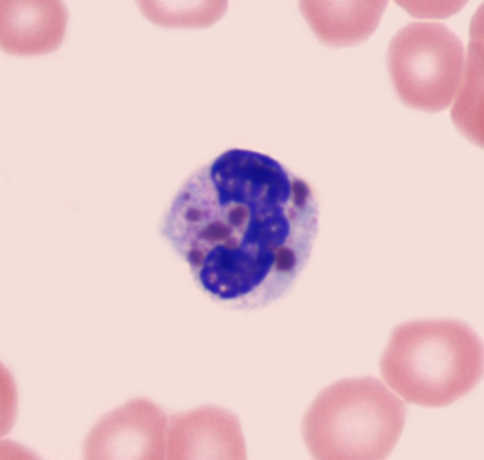 This patient most likely has which of the following disorders?
 (Multiple Choice)
4.9/5  (89)
(89) A 6-year-old boy is being evaluated in the office due to a history of recurrent infections and failure to thrive. He has been hospitalized for pneumococcal pneumonia twice and has had 5 episodes of otitis media. The patient also has a history of prolonged diarrhea caused by Giardia intestinalis. Physical examination shows a lack of tonsillar tissue, as well as minimally palpable cervical, axillary, and inguinal lymph nodes. Further evaluation shows that the patient has defective signaling between activated CD4 T cells and B cells. Which of the following laboratory findings are most likely to be found in this patient? 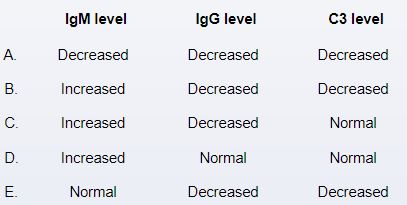
(Multiple Choice)
4.8/5 (69)
(69) A 44-year-old man with diabetic nephropathy undergoes a renal transplant. One week later, he develops low-grade fever, body aches, and decreased urine output. Temperature is 37.2 C (99 F), blood pressure is 124/76 mm Hg, and pulse is 88/min. Physical examination shows mild tenderness over the graft on palpation. Serum creatinine is 2.2 mg/dL, an increase from 1.2 mg/dL two days ago. Arterial and venous Doppler studies reveal adequate graft perfusion. Graft biopsy demonstrates dense interstitial infiltration by mononuclear cells. Which of the following is the most likely cause of this patient's current condition?
(Multiple Choice)
4.9/5 (89)
(89) A 24-year-old man comes to the urgent care clinic due to painful swelling in his left groin. The patient noticed the swelling 2 days ago, and it has progressively become more tender and painful. He has no chronic medical conditions, but he recently sustained a puncture wound to the sole of his left foot. Physical examination shows an enlarged, tender, and nonfluctuant left inguinal lymph node with erythematous overlying skin. There is a small puncture wound on the sole of the left foot, which expresses pus upon mild pressure. Which of the following histologic findings is most likely responsible for this patient's groin mass?
(Multiple Choice)
4.9/5 (82)
(82) A 28-year-old man comes to the emergency department after sustaining an accidental penetrating injury to the left eye. Examination shows left globe perforation with decreased visual acuity. The right eye is normal. The patient is otherwise healthy. Surgical treatment is performed with subsequent improvement in vision. Two months later, the patient experiences pain, photophobia, and diminished vision in the right eye. Evaluation shows leukocytes in the anterior chamber and vitreous humor and choroidal deposits consistent with granulomatous panuveitis. Disruption of which of the following immune processes is most likely responsible for this patient's current condition?
(Multiple Choice)
4.9/5 (80)
(80) A 57-year-old woman with autosomal dominant polycystic kidney disease develops end-stage renal disease and undergoes deceased-donor kidney transplantation. During the operation, the surgeon notices that the graft becomes cyanotic and mottled soon after its blood vessels are connected with those of the recipient. Blood flow to the graft ceases, and no urine is produced. Which of the following best explains the findings observed by the surgeon?
(Multiple Choice)
4.8/5 (63)
(63) A researcher is comparing surface antigens X and Y from two distinct viruses. He acquires antigen X antibodies from an animal that has previously been exposed to the virus encoding this antigen. After that, the antibodies are added to test plates. Following that, a set amount of radiolabeled X antigen is applied to the plates. Unlabeled Y antigens are then given to each plate in escalating quantities, and the plates are washed to eliminate unbound antigens. The graph below depicts radioactivity as a function of Y antigen concentration. . 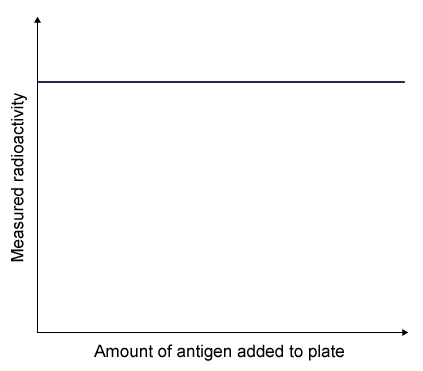 Which of the following best describes the results of this experiment?
 (Multiple Choice)
4.9/5 (88)
(88) 
Filters
- Essay(0)
- Multiple Choice(0)
- Short Answer(0)
- True False(0)
- Matching(0)