



 Chat with AI
Exam 8: Immunology

Exam 1: Anatomy265 Questions
Exam 2: Behavioral Sciences178 Questions
Exam 3: Biochemistry102 Questions
Exam 4: Embryology59 Questions
Exam 5: Epidemiology, Biostatistics, and Medical Informatics94 Questions
Exam 6: Genetics88 Questions
Exam 7: Histology46 Questions
Exam 8: Immunology147 Questions
Exam 9: Microbiology and Virology330 Questions
Exam 10: Pathology817 Questions
Exam 11: Pharmacology and Toxicology509 Questions
Exam 12: Physiology339 Questions
Exam 13: Psychiatry and Psychotherapy23 Questions
Select questions type


A 68-year-old man comes to the office for a follow-up appointment. He has a history of advanced melanoma that is unresectable and resistant to adjuvant regimens. The patient recently began receiving monoclonal antibody infusions for advanced melanoma. The monoclonal antibodies block a specific cell surface receptor found on T lymphocytes. As a result, T cells capable of recognizing tumor antigens have improved ability to destroy cancer cells. Which of the following cell surface receptors is most likely blocked by the treatment?
(Multiple Choice)
4.8/5  (84)
(84) Researchers are studying various cellular processes in normal and diseased states to find new anticancer drug targets. They develop a medication that inhibits an intracellular enzyme that converts adenosine to inosine. With drug use, accumulation of enzyme substrates in the neoplastic cells leads to DNA strand breaks and subsequent apoptosis. Which of the following malignancies is likely to be most responsive to this medication?
(Multiple Choice)
4.9/5 (73)
(73) A 56-year-old man hospitalized in the intensive care unit is being evaluated for fever. He was admitted 8 days ago with respiratory failure and has had a complicated hospital course, including mechanical ventilation, central venous line placement, and broad-spectrum antibiotic therapy. The patient has a history of HIV and a hematologic malignancy. His last chemotherapy session was 2 weeks ago. Chest x-ray does not reveal a new infiltrate, and urine cultures are negative for infection. Blood cultures grow pseudohyphae-producing yeast species with an ability to form germ tubes. Which of the following most likely directly contributed to the development of fungemia in this patient?
(Multiple Choice)
4.9/5 (79)
(79) An 8-year-old male is brought to his pediatrician's office by his mother. The child has had a runny nose, sore throat, cough, and low-grade fever for the past 24 hours. The patient's mother recalls that several of the child's friends have been ill recently with similar symptoms. The mother asks whether the child will need antibiotics for his condition. His pediatrician recommends symptomatic therapy and feels that his illness is most likely of viral etiology. Cytotoxic CD8+ lymphocytes are able to kill virus-infected nasal epithelial cells once sensitized. Cytotoxic CD8+ lymphocyte receptors recognize foreign proteins on the epithelial cell surface. Foreign proteins are presented on the epithelial cell surface by MHC molecules. These MHC molecules comprise which of the following components?
(Multiple Choice)
4.8/5 (94)
(94) An 18-year-old woman comes to the emergency department for evaluation of a rash. The patient developed mild aches involving her knees and ankles 2 days ago. Before going to sleep last night, she noticed purplish spots around her right knee. Today, the rash involves both of the lower extremities. She has had no fever, weight loss, sore throat, abdominal pain, vomiting, or diarrhea. The patient has no chronic medical conditions and takes no medications. Temperature is 37 C (98.6 F), blood pressure is 146/90 mm Hg, pulse is 90/min, and respirations are 20/min. Cardiopulmonary examination is unremarkable. The patient has pain with passive range of motion of the knees and ankles. Skin examination is seen in the exhibit.Laboratory results are as follows: 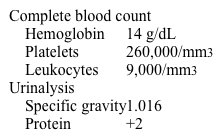 Histologic examination of the rash is most likely to show which of the following?
 (Multiple Choice)
4.9/5 (57)
(57) An 18-year-old college student is hospitalized due to a high fever and confusion. According to the patient's roommate, the symptoms started about 6 hours ago. The patient was feeling well this morning except for some nausea. She has had several episodes of pneumonia in the past and had bacterial meningitis a year ago, which was treated with ceftriaxone. Temperature is 39.1 C (102.4 F), blood pressure is 104/70 mm Hg, and pulse is 110/min. The patient is lethargic but is able to follow simple commands and give single-word answers with prompting. Physical examination reveals a petechial rash on the trunk and extremities, including the palms and soles. Neck stiffness and photophobia are also noted. Which of the following primary immune system impairments is most likely responsible for this patient's recurrent infections?
(Multiple Choice)
4.7/5 (71)
(71) A 24-year-old recent Russian immigrant describes a long history of weight loss, night sweats and nagging cough. Imaging and biopsy of his lungs reveal numerous apical granulomas with central caseous necrosis. Surrounding the necrotic areas are large cells with abundant pale cytoplasm. Which of the following surface markers is most specific for those cells?
(Multiple Choice)
4.7/5 (86)
(86) A 22-year-old woman comes to the office because of a 6-month history of increasing neck and low back pain that is most severe in the morning. Her pain improves as the day passes. The patient has no history of trauma, rashes, or urinary symptoms. Vital signs are within normal limits. Examination shows tenderness over the lumbosacral area and at the insertion site of the Achilles tendon. Forward flexion is reduced. This patient's symptoms are most likely attributable to upregulation of which of the following cytokines?
(Multiple Choice)
4.9/5 (72)
(72) A 28-year-old primigravid woman comes to the office for a routine prenatal checkup at 28 weeks gestation. The patient has no concerns and has had an uneventful pregnancy to date. Physical examination shows a uterine size concordant with ultrasound dates, and fetal cardiac activity is in the normal range. After reviewing the results of her laboratory evaluations, the physician administers an injection of anti-Rh(D) immunoglobulin. The administered antibodies most likely belong to which of the following immunoglobulin classes?
(Multiple Choice)
4.8/5 (80)
(80) A 2-week-old infant is brought to the emergency department due to fever, lethargy, grunting, and poor feeding. The patient was born at full term after an uneventful pregnancy and has had no prior medical issues. Blood samples are obtained for culture, and the patient is hospitalized for broad-spectrum antibiotic therapy. Cultures grow Escherichia coli. The patient's condition developed in part due to exposure to bacterial lipopolysaccharide, which stimulates NF-kB-induced transcription of inflammatory cytokines such as TNF-alpha, IL-1, and IL-6. This bacterial component most likely interacted with the patient's immune cells via which of the following?
(Multiple Choice)
4.9/5 (76)
(76) A 14-year-old boy is brought to the emergency department by his parents for joint pain following the acute onset of a diffuse, pruritic rash for the past 24 hours. A week ago, he was diagnosed with pharyngitis after returning home from summer camp and is currently taking antibiotics. There is no family history of serious illness. His temperature is 38.5°C (101.3°F), pulse is 90/min, and blood pressure is 110/70 mm Hg. Physical examination shows periorbital edema, generalized lymphadenopathy, and well-circumscribed, erythematous, confluent skin lesions of variable sizes up to several centimeters in width over his entire body. There is pain on passive movement of wrists and ankle joints bilaterally. Urine dipstick shows 1+ proteinuria. There is no hematuria. Which of the following findings is most likely to accompany this patient's condition?
(Multiple Choice)
4.8/5 (73)
(73) A 43-year-old man visiting the United States from Thailand comes to the emergency department due to 10 days of hemoptysis. He also has had night sweats but reports no fever or weight loss. Temperature is 37.7 C (99.9 F), blood pressure is 118/68 mm Hg, pulse is 86/min, and respirations are 18/min. Physical examination shows right-sided rhonchi and crackles. Chest x-ray shows an infiltrate in the right upper lobe. Sputum samples from 3 consecutive days are also obtained. After 72 hours of tuberculin skin test (TST) placement, there is no induration at the site; however, 2 of 3 sputum sample smears reveal acid-fast bacilli. Which of the following best explains the negative TST in this patient?
(Multiple Choice)
4.9/5 (87)
(87) A 65-year-old woman is enrolled in a clinical trial to test a new medication for rheumatoid arthritis. The patient's condition has been poorly controlled despite prolonged treatment with multiple disease-modifying antirheumatic drugs. The new medication is a CTLA4-Ig fusion protein that prevents CD28 from binding to CD80/86 on antigen-presenting cells. A month after treatment begins, the patient reports a significant reduction in joint pain and stiffness. Laboratory results reveal reduced levels of C-reactive protein and IL-2. Which of the following is the most likely underlying cause of this patient's treatment response?
(Multiple Choice)
4.8/5 (83)
(83) A 5-year-old boy is brought to the physician by his mother because of a generalized pruritic rash for 2 weeks. The itchiness often causes him to wake up at night. His father has a history of asthma. His immunizations are up-to-date. He is at the 75th percentile for length and the 70th percentile for weight. Examination shows dry and scaly patches on the face and extensor surfaces of the extremities. The groin is spared. First-line therapy for this patient's condition works by which of the following mechanisms of action?
(Multiple Choice)
4.8/5 (88)
(88) A 38-year-old woman comes to the office due to abdominal pain. For the last 2-3 weeks, she has had increasingly severe abdominal pain associated with watery diarrhea. The patient has a history of Crohn disease treated for the last year with adalimumab, which has controlled the symptoms until now. Vital signs are normal except for a temperature of 37.8 C (100 F). Examination shows moderate tenderness in the right lower quadrant with no peritoneal signs. Laboratory results show an undetectable trough adalimumab level. Which of the following is the most likely explanation for this patient's worsening symptoms?
(Multiple Choice)
4.9/5 (87)
(87) A 23-year-old woman is brought to the emergency department due to one day of fever, vomiting, diarrhea, and muscle pains. The symptoms developed rapidly over the course of the day. The patient is confused and unable to answer questions. She has no known medical problems and takes no medications. She lives with her boyfriend. The patient's temperature is 39.1 C (102.4 F), blood pressure is 88/50 mm Hg, pulse is 120/min, and respirations are 20/min. A diffuse, erythematous, macular rash resembling a sunburn is noted on dermatologic examination; pelvic examination reveals a tampon in the vagina. Laboratory results are as follows: 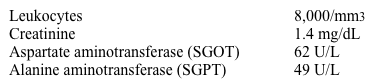 A pregnancy test is negative. Activation of which of the following cells is most likely primarily responsible for this patient's condition?
 (Multiple Choice)
4.9/5 (77)
(77) A 35-year-old woman comes to the office due to fever, headache, severe muscle aches, and sore throat for the last 4 days. Physical examination shows mild pharyngeal erythema and nasal congestion. A rapid influenza antigen test is positive. The patient's condition improves over the next several days despite receiving only symptomatic treatment. In response to the influenza virus, infected respiratory epithelial cells begin secreting increased quantities of interferons. The specific interferons secreted by these cells will most likely cause which of the following changes?
(Multiple Choice)
4.9/5 (90)
(90) A 4-year-old male is exposed to latex gloves during a minor surgical procedure and is subsequently found to produce anti-latex IgM antibodies. Several months later he develops a severe allergic reaction to latex and is found to have a high level of serum anti-latex IgE antibodies. Which of the following cytokines is most likely responsible for this anti-latex antibody isotype change?
(Multiple Choice)
4.9/5 (76)
(76) A 48-year-old woman is evaluated for a painless left breast mass. Physical examination shows a 4-cm mass with dimpling of the overlying skin; left axillary lymphadenopathy also is noted. Breast imaging reveals a spiculated soft tissue mass with microcalcifications. Biopsy of the mass demonstrates invasive ductal carcinoma. Immunohistochemistry of the tissue sample shows the tumor cells are negative for estrogen and progesterone receptors but overexpress the HER2 epidermal growth factor receptor. The patient is treated with systemic chemotherapy and a monoclonal antibody drug that binds the extracellular domain of the growth factor receptor. Repeat evaluation 6 weeks later shows a decrease in the size of the breast mass. Which of the following host factors are primarily responsible for mediating the response to the monoclonal antibody therapy?
(Multiple Choice)
4.9/5 (86)
(86) A 25-year-old woman comes to the office due to arthralgias in her hands for the last several months. The pain frequently involves her wrists and proximal finger joints bilaterally, and alternates between being worse in the wrists versus in the hands. The patient has no other medical problems and takes no medications. Complete blood count results are as follows: 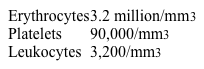 Further evaluation reveals proteinuria and red blood cell casts. Which of the following is the most likely diagnosis?
 (Multiple Choice)
5.0/5 (69)
(69) 
Filters
- Essay(0)
- Multiple Choice(0)
- Short Answer(0)
- True False(0)
- Matching(0)