
Exam 8: Acid Base Balance

arrow
  • Select Tags
search iconSearch Question
flashcardsStudy Flashcards
  • Select Tags

Sleep apnea can potentially cause which acid-base disorder?

(Multiple Choice)
4.8/5
(94)

Bases are substances that can accept or receive a hydrogen ion.

(True/False)
4.8/5
(93)

The primary buffer in extracellular fluid (ECF) is the _______________ buffer system.

(Short Answer)
4.8/5
(78)

The acute response to respiratory alkalosis (within the first 24 hours) is a shift of acid from the _______________ to the _______________ with an accompanying exchange of bicarbonate for chloride.

(Short Answer)
4.9/5
(78)

The lungs are unable to eliminate which types of acids?

(Multiple Choice)
5.0/5
(90)

Explain buffers.

(Essay)
4.9/5
(79)

Symptoms of metabolic acidosis may include changes in respiration, such as _______________ breathing.

(Short Answer)
4.9/5
(86)

breathing difficulties. He is diagnosed with pneumonia. He has a history of congestive heart failure, osteoarthritis, hypertension, gout, and coronary artery disease.


Height: 5'9"   Weight: 220 pounds
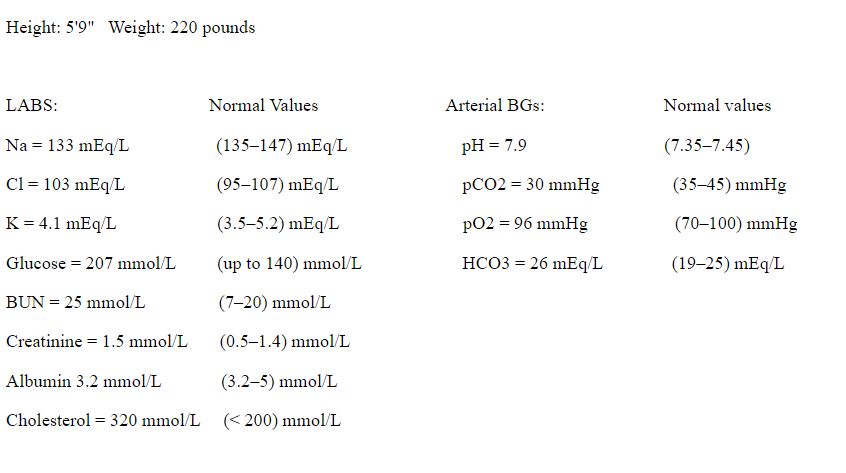
 

LABS:                                 Normal Values                            Arterial BGs:                          Normal values

Na = 133 mEq/L                   (135–147) mEq/L                         pH = 7.9                              (7.35–7.45)

Cl = 103 mEq/L                    (95–107) mEq/L                           pCO2 = 30 mmHg                (35–45) mmHg

K = 4.1 mEq/L                      (3.5–5.2) mEq/L                           pO2 = 96 mmHg                   (70–100) mmHg

Glucose = 207 mmol/L         (up to 140) mmol/L                      HCO3 = 26 mEq/L               (19–25) mEq/L

BUN = 25 mmol/L                (7–20) mmol/L

Creatinine = 1.5 mmol/L       (0.5–1.4) mmol/L

Albumin 3.2 mmol/L             (3.2–5) mmol/L

Cholesterol = 320 mmol/L     (< 200) mmol/L


Mr. X is likely to have -Mr. X is a 56-year-old male admitted to a hospital for shortness of breath and breathing difficulties. He is diagnosed with pneumonia. He has a history of congestive heart failure, osteoarthritis, hypertension, gout, and coronary artery disease. Height: 5'9"   Weight: 220 pounds breathing difficulties. He is diagnosed with pneumonia. He has a history of congestive heart failure, osteoarthritis, hypertension, gout, and coronary artery disease.</span></span> <p class=p style=font-family: Times New Roman; font-size: 11pt; color: #000000; font-weight: normal;><span style=font-size:11pt;font-family:'Times New Roman', serif;> </span> <p class=p style=font-family: Times New Roman; font-size: 11pt; color: #000000; font-weight: normal;><span style=font-size:11pt;font-family:'Times New Roman', serif;>Height: 5'9"   Weight: 220 pounds</span> <p class=p style=font-family: Times New Roman; font-size: 11pt; color: #000000; font-weight: normal;><span style=font-size:11pt;font-family:'Times New Roman', serif;> </span> <p class=p style=font-family: Times New Roman; font-size: 11pt; color: #000000; font-weight: normal;><span style=font-size:11pt;font-family:'Times New Roman', serif;>LABS:                                 Normal Values                            Arterial BGs:                          Normal values</span> <p class=p style=font-family: Times New Roman; font-size: 11pt; color: #000000; font-weight: normal;><span style=font-size:11pt;font-family:'Times New Roman', serif;>Na = 133 mEq/L                   (135–147) mEq/L                         pH = 7.9                              (7.35–7.45)</span> <p class=p style=font-family: Times New Roman; font-size: 11pt; color: #000000; font-weight: normal;><span style=font-size:11pt;font-family:'Times New Roman', serif;>Cl = 103 mEq/L                    (95–107) mEq/L                           pCO2 = 30 mmHg                (35–45) mmHg</span> <p class=p style=font-family: Times New Roman; font-size: 11pt; color: #000000; font-weight: normal;><span style=font-size:11pt;font-family:'Times New Roman', serif;>K = 4.1 mEq/L                      (3.5–5.2) mEq/L                           pO2 = 96 mmHg                   (70–100) mmHg</span> <p class=p style=font-family: Times New Roman; font-size: 11pt; color: #000000; font-weight: normal;><span style=font-size:11pt;font-family:'Times New Roman', serif;>Glucose = 207 mmol/L         (up to 140) mmol/L                      HCO3 = 26 mEq/L               (19–25) mEq/L</span> <p class=p style=font-family: Times New Roman; font-size: 11pt; color: #000000; font-weight: normal;><span style=font-size:11pt;font-family:'Times New Roman', serif;>BUN = 25 mmol/L                (7–20) mmol/L</span> <p class=p style=font-family: Times New Roman; font-size: 11pt; color: #000000; font-weight: normal;><span style=font-size:11pt;font-family:'Times New Roman', serif;>Creatinine = 1.5 mmol/L       (0.5–1.4) mmol/L</span> <p class=p style=font-family: Times New Roman; font-size: 11pt; color: #000000; font-weight: normal;><span style=font-size:11pt;font-family:'Times New Roman', serif;>Albumin 3.2 mmol/L             (3.2–5) mmol/L</span> <p data-keepme=true style=font-family: Times New Roman; font-size: 11pt; color: #000000; font-weight: normal;><span style=font-size:11pt;font-family:'Times New Roman', serif;border:none;>Cholesterol = 320 mmol/L     (< 200) mmol/L</span> <p data-keepme=true style=font-family: Times New Roman; font-size: 11pt; color: #000000; font-weight: normal;><span style=font-size:11pt;font-family:'Times New Roman', serif;border:none;> </span> <p data-keepme=true style=font-family: Times New Roman; font-size: 11pt; color: #000000; font-weight: normal;><span style=font-size:11pt;font-family:'Times New Roman', serif;border:none;><span style=font-size:11pt;font-family:'Times New Roman', serif;border:none;>Mr. X is likely to have  -Mr. X is a 56-year-old male admitted to a hospital for shortness of breath and breathing difficulties. He is diagnosed with pneumonia. He has a history of congestive heart failure, osteoarthritis, hypertension, gout, and coronary artery disease. Height: 5'9   Weight: 220 pounds   What factor is contributing most to his acid-base disorder? What factor is contributing most to his acid-base disorder?

(Multiple Choice)
4.9/5
(78)

The assessment of acid-base balance requires more than simply examining laboratory values.

(True/False)
4.8/5
(81)

Which of the following ions cannot cross the blood-brain barrier?

(Multiple Choice)
4.8/5
(78)

What is the normal value for oxygen saturation in arterial blood gas?

(Multiple Choice)
4.7/5
(71)

Describe the groups of acids found in the human body.

(Essay)
4.9/5
(81)

What does the hemoglobin buffer system primarily buffer against?

(Multiple Choice)
4.9/5
(75)

Describe the abbreviation pK.

(Essay)
4.9/5
(91)

List four types of acid-base disorders.

(Essay)
4.8/5
(82)

Identify the equation that is used to calculate the anion gap.

(Multiple Choice)
4.9/5
(76)

What do acidic substances "donate" in chemical reactions?

(Multiple Choice)
4.8/5
(63)

The term hypercapnia indicates that there is ____.

(Multiple Choice)
4.9/5
(75)

Respiratory alkalosis is generally a result of conditions that cause ____.

(Multiple Choice)
4.8/5
(90)

The protein buffer system acts in the same fashion as which other buffer system?

(Multiple Choice)
4.8/5
(84)
Showing 41 - 60 of 80
close modal

Filters

  • Essay(0)
  • Multiple Choice(0)
  • Short Answer(0)
  • True False(0)
  • Matching(0)