



 Chat with AI
Exam 46: Gas Exchange

Exam 1: A View of Life72 Questions
Exam 2: Atoms and Molecules: the Chemical Basis of Life75 Questions
Exam 3: The Chemistry of Life: Organic Compounds75 Questions
Exam 4: Organization of the Cell76 Questions
Exam 5: Biological Membranes73 Questions
Exam 6: Cell Communication73 Questions
Exam 7: Energy and Metabolism73 Questions
Exam 8: How Cells Make Atp: Energy-Releasing Pathways75 Questions
Exam 9: Photosynthesis: Capturing Light Energy79 Questions
Exam 10: Chromosomes, Mitosis, and Meiosis78 Questions
Exam 11: The Basic Principles of Heredity87 Questions
Exam 12: DNA: The Carrier of Genetic Information83 Questions
Exam 13: Gene Expression92 Questions
Exam 14: Gene Regulation86 Questions
Exam 15: DNA Technology and Genomics98 Questions
Exam 16: Human Genetics and the Human Genome82 Questions
Exam 17: Developmental Genetics90 Questions
Exam 18: Introduction to Darwinian Evolution66 Questions
Exam 19: Evolutionary Change in Populations72 Questions
Exam 20: Speciation and Macroevolution72 Questions
Exam 21: The Origin and Evolutionary History of Life71 Questions
Exam 22: The Evolution of Primates73 Questions
Exam 23: Understanding Diversity: Systematics70 Questions
Exam 24: Viruses and Subviral Agents55 Questions
Exam 25: Bacteria and Archaea63 Questions
Exam 26: Protists76 Questions
Exam 27: Seedless Plants76 Questions
Exam 28: Seed Plants76 Questions
Exam 29: The Fungi78 Questions
Exam 30: An Introduction to Animal Diversity71 Questions
Exam 31: Sponges, Cnidarians, Ctenophores, and Protostomes114 Questions
Exam 32: The Deuterostomes79 Questions
Exam 33: Plant Structure, Growth, and Development94 Questions
Exam 34: Leaf Structure and Function90 Questions
Exam 35: Stem Structure and Transport91 Questions
Exam 36: Roots and Mineral Nutrition105 Questions
Exam 37: Reproduction in Flowering Plants107 Questions
Exam 38: Plant Developmental Responses to External and Internal Signals113 Questions
Exam 39: Animal Structure and Function: an Introduction106 Questions
Exam 40: Protection, Support, and Movement75 Questions
Exam 41: Neural Signaling76 Questions
Exam 42: Neural Regulation81 Questions
Exam 43: Sensory Systems83 Questions
Exam 44: Internal Transport119 Questions
Exam 45: The Immune System: Internal Defense93 Questions
Exam 46: Gas Exchange123 Questions
Exam 47: Processing Food and Nutrition127 Questions
Exam 48: Osmoregulation and Disposal of Metabolic Wastes111 Questions
Exam 49: Endocrine Regulation87 Questions
Exam 50: Reproduction121 Questions
Exam 51: Animal Development117 Questions
Exam 52: Animal Behavior91 Questions
Exam 53: Introduction to Ecology: Population Ecology99 Questions
Exam 54: Community Ecology91 Questions
Exam 55: Ecosystems and the Biosphere101 Questions
Exam 56: Ecology and the Geography of Life99 Questions
Exam 57: Biological Diversity and Conservation Biology82 Questions
Select questions type


Match the air quantity term with its definition or value.
Premises:
Amount of air moved into and out of lungs with each normal breath
Responses:
Tidal volume
Residual volume
Vital capacity
Correct Answer: Verified
Premises:
Responses:
(Matching)
4.8/5  (80)
(80) Figure 46-4
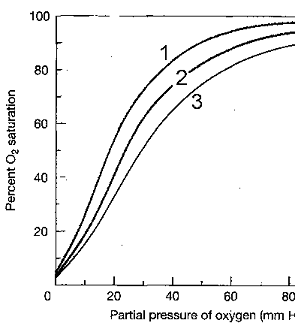 Oxygen-hemoglobin dissociation curves at three different pH levels
The phenomenon illustrated in the accompanying figure is known as:
Oxygen-hemoglobin dissociation curves at three different pH levels
The phenomenon illustrated in the accompanying figure is known as: (Multiple Choice)
4.8/5 (86)
(86) What is the approximate maximum thickness of an animal that allows oxygen to diffuse quickly enough through the layers of cells to support life?
(Multiple Choice)
4.9/5 (82)
(82) Match the respiratory surface with its organism or definition.
Premises:
Cats, slugs, frogs
Responses:
Lungs
Body surface
Tracheal tubes
Correct Answer:Verified
VerifiedPremises:
Responses:
(Matching)
4.9/5 (83)
(83) Which of the following animals have lungs that have millions of alveoli that increase the surface available for gas exchange?
(Multiple Choice)
4.7/5 (90)
(90) Arrange the structures through which air passes upon entering the body in the proper sequence. 1) Alveoli
2) Bronchi
3) Larynx
4) Bronchioles
5) Pharynx
6) Trachea
(Multiple Choice)
4.8/5 (73)
(73) Match the part of the human respiratory system with its description.
Premises:
After leaving the larynx, inhaled air passes into this structure.
Responses:
Nasal cavity
Alveoli
Bronchiole
Correct Answer:Verified
VerifiedPremises:
Responses:
(Matching)
4.8/5 (82)
(82) Match the respiratory surface with its organism or definition.
Premises:
May be internal or external; supported by buoyancy of water
Responses:
Gills
Body surface
Lungs
Correct Answer:Verified
VerifiedPremises:
Responses:
(Matching)
4.8/5 (100)
(100) Match the medical terms below with their symptoms or causes.
Premises:
Characterized by obstructed airflow
Responses:
Pulmonary emphysema
Bronchial constriction
Chronic obstructive pulmonary disease
Correct Answer:Verified
VerifiedPremises:
Responses:
(Matching)
5.0/5 (83)
(83) During respiratory exchange, carbon dioxide moves from the blood into the alveoli due to:
(Multiple Choice)
4.9/5 (82)
(82) Figure 46-2
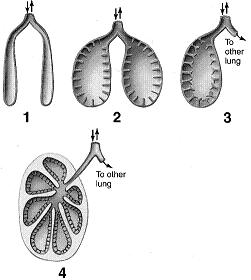
Refer to the accompanying figure. Which of these lungs would be found in reptiles?
Refer to the accompanying figure. Which of these lungs would be found in reptiles? (Multiple Choice)
5.0/5 (81)
(81) Specialized chemoreceptors in the medulla, walls of the aorta, and the walls of the carotid arteries are sensitive to SMALL changes in the arterial concentration of which of the following substances?
(Multiple Choice)
4.8/5 (95)
(95) Mitochondria use respired oxygen as an electron acceptor in the process known as:
(Multiple Choice)
4.8/5 (70)
(70) Match the medical terms below with their symptoms or causes.
Premises:
Alveoli lose elasticity and walls between alveoli are destroyed
Responses:
Bronchial constriction
Chronic obstructive pulmonary disease
Pulmonary emphysema
Correct Answer:Verified
VerifiedPremises:
Responses:
(Matching)
4.8/5 (71)
(71) During exhalation, air moves from the bronchi directly into the alveoli.
(True/False)
4.8/5 (86)
(86) Match the medical terms below with their symptoms or causes.
Premises:
Patients may also have chronic bronchitis and/or asthma
Responses:
Pulmonary emphysema
Bronchial constriction
Chronic obstructive pulmonary disease
Correct Answer:Verified
VerifiedPremises:
Responses:
(Matching)
4.8/5 (72)
(72) The single most preventable cause of disease in the United States is:
(Multiple Choice)
4.8/5 (72)
(72) 
Filters
- Essay(0)
- Multiple Choice(0)
- Short Answer(0)
- True False(0)
- Matching(0)