



 Chat with AI
Exam 57: Biological Diversity and Conservation Biology

Exam 1: A View of Life72 Questions
Exam 2: Atoms and Molecules: the Chemical Basis of Life75 Questions
Exam 3: The Chemistry of Life: Organic Compounds75 Questions
Exam 4: Organization of the Cell76 Questions
Exam 5: Biological Membranes73 Questions
Exam 6: Cell Communication73 Questions
Exam 7: Energy and Metabolism73 Questions
Exam 8: How Cells Make Atp: Energy-Releasing Pathways75 Questions
Exam 9: Photosynthesis: Capturing Light Energy79 Questions
Exam 10: Chromosomes, Mitosis, and Meiosis78 Questions
Exam 11: The Basic Principles of Heredity87 Questions
Exam 12: DNA: The Carrier of Genetic Information83 Questions
Exam 13: Gene Expression92 Questions
Exam 14: Gene Regulation86 Questions
Exam 15: DNA Technology and Genomics98 Questions
Exam 16: Human Genetics and the Human Genome82 Questions
Exam 17: Developmental Genetics90 Questions
Exam 18: Introduction to Darwinian Evolution66 Questions
Exam 19: Evolutionary Change in Populations72 Questions
Exam 20: Speciation and Macroevolution72 Questions
Exam 21: The Origin and Evolutionary History of Life71 Questions
Exam 22: The Evolution of Primates73 Questions
Exam 23: Understanding Diversity: Systematics70 Questions
Exam 24: Viruses and Subviral Agents55 Questions
Exam 25: Bacteria and Archaea63 Questions
Exam 26: Protists76 Questions
Exam 27: Seedless Plants76 Questions
Exam 28: Seed Plants76 Questions
Exam 29: The Fungi78 Questions
Exam 30: An Introduction to Animal Diversity71 Questions
Exam 31: Sponges, Cnidarians, Ctenophores, and Protostomes114 Questions
Exam 32: The Deuterostomes79 Questions
Exam 33: Plant Structure, Growth, and Development94 Questions
Exam 34: Leaf Structure and Function90 Questions
Exam 35: Stem Structure and Transport91 Questions
Exam 36: Roots and Mineral Nutrition105 Questions
Exam 37: Reproduction in Flowering Plants107 Questions
Exam 38: Plant Developmental Responses to External and Internal Signals113 Questions
Exam 39: Animal Structure and Function: an Introduction106 Questions
Exam 40: Protection, Support, and Movement75 Questions
Exam 41: Neural Signaling76 Questions
Exam 42: Neural Regulation81 Questions
Exam 43: Sensory Systems83 Questions
Exam 44: Internal Transport119 Questions
Exam 45: The Immune System: Internal Defense93 Questions
Exam 46: Gas Exchange123 Questions
Exam 47: Processing Food and Nutrition127 Questions
Exam 48: Osmoregulation and Disposal of Metabolic Wastes111 Questions
Exam 49: Endocrine Regulation87 Questions
Exam 50: Reproduction121 Questions
Exam 51: Animal Development117 Questions
Exam 52: Animal Behavior91 Questions
Exam 53: Introduction to Ecology: Population Ecology99 Questions
Exam 54: Community Ecology91 Questions
Exam 55: Ecosystems and the Biosphere101 Questions
Exam 56: Ecology and the Geography of Life99 Questions
Exam 57: Biological Diversity and Conservation Biology82 Questions
Select questions type


Match these conservation biology terms with their corresponding description or example.
Premises:
Preserves diversity in nature
Responses:
Biosphere reserves
In situ conservation
Biodiversity hotspot
Correct Answer: Verified
Premises:
Responses:

Free
(Matching)
5.0/5  (72)
(72) Correct Answer:Verified
VerifiedWhen the death of species is less imminent, but the population of a particular species is quite small, it is defined as being
Free
(Multiple Choice)
4.9/5 (87)
(87) Correct Answer:Verified
VerifiedD
State two reasons why tropical rain forests are being destroyed today.
Free
(Essay)
4.9/5 (92)
(92) Correct Answer:Verified
VerifiedIncreasing human population near tropical rain forests mean that more food is needed to sustain those populations. Often, people in these regions resort to slash-and-burn agriculture for the subsistence farming needs. Other reasons include governmental incentives (e.g., the Brazilian government cutting a highway through the Amazon basin) and economic incentives (e.g., farmers turn tropical rain forests into pasture land to maintain a larger herd). A prime economic incentive is commercial logging and commercial plantations.
Which animal is incorrectly matched with its desired product?
(Multiple Choice)
4.7/5 (81)
(81) Which of the following is reported to cause deformities in amphibians in the Sierra Nevadas of California?
(Multiple Choice)
5.0/5 (81)
(81) Match these species with their definition or an example.
Premises:
Not in imminent danger of extinction but has a small population
Responses:
Threatened species
Extinct species
Endangered species
Correct Answer:Verified
VerifiedPremises:
Responses:
(Matching)
4.7/5 (88)
(88) A threatened species is a species in imminent danger of extinction.
(True/False)
4.8/5 (66)
(66) Match these species with their definition or an example.
Premises:
In imminent danger of extinction throughout its range
Responses:
Extinct species
Threatened species
Endangered species
Correct Answer:Verified
VerifiedPremises:
Responses:
(Matching)
4.8/5 (86)
(86) Greenhouse gases contribute to global warming by absorbing UV radiation.
(True/False)
4.7/5 (79)
(79) Setting aside areas for parks and reserves is an example of ______.
(Multiple Choice)
4.8/5 (64)
(64) Match these conservation biology terms with their corresponding description or example.
Premises:
Helps isolated habitats maintain more native species
Responses:
In situ conservation
Biosphere reserves
Ex situ conservation
Correct Answer:Verified
VerifiedPremises:
Responses:
(Matching)
4.9/5 (79)
(79) Perhaps the biggest problem associated with the Endangered Species Act as it currently stands is that it
(Multiple Choice)
4.8/5 (75)
(75) Match these conservation biology terms with their corresponding description or example.
Premises:
Allows for continued human use while also protecting biodiversity
Responses:
Habitat corridors
Ex situ conservation
In situ conservation
Correct Answer:Verified
VerifiedPremises:
Responses:
(Matching)
4.8/5 (78)
(78) The use of the principles of ecology to return a degraded environment to as functional a state as possible is called
(Multiple Choice)
4.8/5 (77)
(77) Match these conservation biology terms with their corresponding description or example.
Premises:
Mostly tropical in nature
Responses:
Biosphere reserves
In situ conservation
Ex situ conservation
Correct Answer:Verified
VerifiedPremises:
Responses:
(Matching)
4.7/5 (79)
(79) Figure 57-1
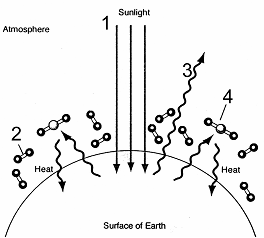
In the accompanying figure, the process labeled as 3 illustrates an action that is reduced by greenhouse gas accumulation. What is this action?
In the accompanying figure, the process labeled as 3 illustrates an action that is reduced by greenhouse gas accumulation. What is this action? (Multiple Choice)
4.8/5 (85)
(85) The ability to meet humanity's current needs without compromising the ability of future generations to meet their needs is
(Multiple Choice)
4.8/5 (92)
(92) 
Filters
- Essay(0)
- Multiple Choice(0)
- Short Answer(0)
- True False(0)
- Matching(0)