



 Chat with AI
Exam 46: Gas Exchange

Exam 1: A View of Life72 Questions
Exam 2: Atoms and Molecules: the Chemical Basis of Life75 Questions
Exam 3: The Chemistry of Life: Organic Compounds75 Questions
Exam 4: Organization of the Cell76 Questions
Exam 5: Biological Membranes73 Questions
Exam 6: Cell Communication73 Questions
Exam 7: Energy and Metabolism73 Questions
Exam 8: How Cells Make Atp: Energy-Releasing Pathways75 Questions
Exam 9: Photosynthesis: Capturing Light Energy79 Questions
Exam 10: Chromosomes, Mitosis, and Meiosis78 Questions
Exam 11: The Basic Principles of Heredity87 Questions
Exam 12: DNA: The Carrier of Genetic Information83 Questions
Exam 13: Gene Expression92 Questions
Exam 14: Gene Regulation86 Questions
Exam 15: DNA Technology and Genomics98 Questions
Exam 16: Human Genetics and the Human Genome82 Questions
Exam 17: Developmental Genetics90 Questions
Exam 18: Introduction to Darwinian Evolution66 Questions
Exam 19: Evolutionary Change in Populations72 Questions
Exam 20: Speciation and Macroevolution72 Questions
Exam 21: The Origin and Evolutionary History of Life71 Questions
Exam 22: The Evolution of Primates73 Questions
Exam 23: Understanding Diversity: Systematics70 Questions
Exam 24: Viruses and Subviral Agents55 Questions
Exam 25: Bacteria and Archaea63 Questions
Exam 26: Protists76 Questions
Exam 27: Seedless Plants76 Questions
Exam 28: Seed Plants76 Questions
Exam 29: The Fungi78 Questions
Exam 30: An Introduction to Animal Diversity71 Questions
Exam 31: Sponges, Cnidarians, Ctenophores, and Protostomes114 Questions
Exam 32: The Deuterostomes79 Questions
Exam 33: Plant Structure, Growth, and Development94 Questions
Exam 34: Leaf Structure and Function90 Questions
Exam 35: Stem Structure and Transport91 Questions
Exam 36: Roots and Mineral Nutrition105 Questions
Exam 37: Reproduction in Flowering Plants107 Questions
Exam 38: Plant Developmental Responses to External and Internal Signals113 Questions
Exam 39: Animal Structure and Function: an Introduction106 Questions
Exam 40: Protection, Support, and Movement75 Questions
Exam 41: Neural Signaling76 Questions
Exam 42: Neural Regulation81 Questions
Exam 43: Sensory Systems83 Questions
Exam 44: Internal Transport119 Questions
Exam 45: The Immune System: Internal Defense93 Questions
Exam 46: Gas Exchange123 Questions
Exam 47: Processing Food and Nutrition127 Questions
Exam 48: Osmoregulation and Disposal of Metabolic Wastes111 Questions
Exam 49: Endocrine Regulation87 Questions
Exam 50: Reproduction121 Questions
Exam 51: Animal Development117 Questions
Exam 52: Animal Behavior91 Questions
Exam 53: Introduction to Ecology: Population Ecology99 Questions
Exam 54: Community Ecology91 Questions
Exam 55: Ecosystems and the Biosphere101 Questions
Exam 56: Ecology and the Geography of Life99 Questions
Exam 57: Biological Diversity and Conservation Biology82 Questions
Select questions type


Match the part of the human respiratory system with its description.
Premises:
Inhaled dirt and bacteria are pushed toward the throat.
Responses:
Nasal cavity
Bronchus
Bronchiole
Correct Answer: Verified
Premises:
Responses:
(Matching)
4.9/5  (93)
(93) Match the part of the human respiratory system with its description.
Premises:
Exhaled air passes from the bronchioles directly into this structure.
Responses:
Bronchiole
Pharynx
Alveoli
Correct Answer:Verified
VerifiedPremises:
Responses:
(Matching)
4.8/5 (102)
(102) Match the air quantity term with its definition or value.
Premises:
Averages 500 mL
Responses:
Tidal volume
Residual volume
Vital capacity
Correct Answer:Verified
VerifiedPremises:
Responses:
(Matching)
4.7/5 (80)
(80) Match the medical terms below with their symptoms or causes.
Premises:
Most common in cigarette smokers
Responses:
Bronchial constriction
Pulmonary emphysema
Chronic obstructive pulmonary disease
Correct Answer:Verified
VerifiedPremises:
Responses:
(Matching)
4.9/5 (74)
(74) Match the air quantity term with its definition or value.
Premises:
Averages 1200 mL
Responses:
Tidal volume
Vital capacity
Residual volume
Correct Answer:Verified
VerifiedPremises:
Responses:
(Matching)
5.0/5 (69)
(69) Figure 46-1
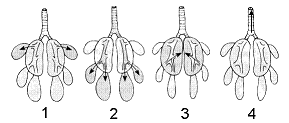
Refer to the accompanying figure. The structures receiving air in Figure 1 are known as:
Refer to the accompanying figure. The structures receiving air in Figure 1 are known as: (Multiple Choice)
4.9/5 (90)
(90) Figure 46-2
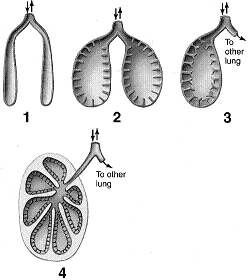
Refer to the accompanying figure. Which of these lungs would be best for an animal that is fairly active?
Refer to the accompanying figure. Which of these lungs would be best for an animal that is fairly active? (Multiple Choice)
4.9/5 (68)
(68) The amount of air that is moved with each ventilation is referred to as:
(Multiple Choice)
4.8/5 (74)
(74) Define ventilation, and explain how this process is carried out in terrestrial vertebrates.
(Essay)
4.8/5 (75)
(75) Match the respiratory surface with its organism or definition.
Premises:
Gas exchange across the entire animal
Responses:
Tracheal tubes
Gills
Body surface
Correct Answer:Verified
VerifiedPremises:
Responses:
(Matching)
4.8/5 (93)
(93) The amount of oxygen or carbon dioxide that diffuses across the membrane of an alveolus depends both on the differences in partial pressure on both sides of the membrane and on the surface area of the membrane. This describes which of the following?
(Multiple Choice)
4.9/5 (72)
(72) Molecular oxygen attaches to the iron atoms in a hemoglobin molecule.
(True/False)
4.8/5 (92)
(92) Match the part of the human respiratory system with its description.
Premises:
Inhaled air is brought to body temperature within this structure.
Responses:
Nasal cavity
Pharynx
Alveoli
Correct Answer:Verified
VerifiedPremises:
Responses:
(Matching)
4.8/5 (84)
(84) Match the part of the human respiratory system with its description.
Premises:
During swallowing, the epiglottis closes off the top of this structure.
Responses:
Larynx
Bronchiole
Bronchus
Correct Answer:Verified
VerifiedPremises:
Responses:
(Matching)
4.9/5 (71)
(71) Match the air quantity term with its definition or value.
Premises:
Maximum amount of air that can be exhaled
Responses:
Vital capacity
Tidal volume
Residual volume
Correct Answer:Verified
VerifiedPremises:
Responses:
(Matching)
5.0/5 (80)
(80) Dalton's law of partial pressures states that the total pressure of a mixture of gases is equal to the sum of the pressures of the individual gases.
(True/False)
4.8/5 (83)
(83) 
Filters
- Essay(0)
- Multiple Choice(0)
- Short Answer(0)
- True False(0)
- Matching(0)