



 Chat with AI
Exam 9: Photosynthesis: Capturing Light Energy

Exam 1: A View of Life88 Questions
Exam 2: Atoms and Molecules: the Chemical Basis of Life85 Questions
Exam 3: The Chemistry of Life: Organic Compounds95 Questions
Exam 4: Organization of the Cell68 Questions
Exam 5: Biological Membranes77 Questions
Exam 6: Cell Communication73 Questions
Exam 7: Energy and Metabolism76 Questions
Exam 8: How Cells Make Atp: Energy-Releasing Pathways90 Questions
Exam 9: Photosynthesis: Capturing Light Energy80 Questions
Exam 10: Chromosomes, Mitosis, and Meiosis91 Questions
Exam 11: The Basic Principles of Heredity75 Questions
Exam 12: Dna: the Carrier of Genetic Information80 Questions
Exam 13: Gene Expression76 Questions
Exam 14: Gene Regulation77 Questions
Exam 15: Dna Technology and Genomics79 Questions
Exam 16: Human Genetics and the Human Genome78 Questions
Exam 17: Developmental Genetics79 Questions
Exam 18: Introduction to Darwinian Evolution70 Questions
Exam 19: Evolutionary Change in Populations79 Questions
Exam 20: Speciation and Macroevolution91 Questions
Exam 21: The Origin and Evolutionary History of Life89 Questions
Exam 22: The Evolution of Primates87 Questions
Exam 23: Understanding Diversity: Systematics79 Questions
Exam 24: Viruses and Subviral Agents41 Questions
Exam 25: Bacteria and Archaea55 Questions
Exam 26: Protists92 Questions
Exam 27: Seedless Plants80 Questions
Exam 28: Seed Plants78 Questions
Exam 29: The Fungi87 Questions
Exam 30: An Introduction to Animal Diversity79 Questions
Exam 31: Sponges, Cnidarians, Ctenophores, and Protostomes146 Questions
Exam 32: The Deuterostomes90 Questions
Exam 33: Plant Structure, Growth, and Development86 Questions
Exam 34: Leaf Structure and Function76 Questions
Exam 35: Stem Structure and Transport74 Questions
Exam 36: Roots and Mineral Nutrition84 Questions
Exam 37: Reproduction in Flowering Plants89 Questions
Exam 38: Plant Developmental Responses to External and Internal Signals95 Questions
Exam 39: Animal Structure and Function: an Introduction96 Questions
Exam 40: Protection, Support, and Movement101 Questions
Exam 41: Neural Signaling87 Questions
Exam 42: Neural Regulation88 Questions
Exam 43: Sensory Systems111 Questions
Exam 44: Internal Transport104 Questions
Exam 45: The Immune System: Internal Defense85 Questions
Exam 46: Gas Exchange109 Questions
Exam 47: Processing Food and Nutrition119 Questions
Exam 48: Osmoregulation and Disposal of Metabolic Wastes94 Questions
Exam 49: Endocrine Regulation82 Questions
Exam 50: Reproduction104 Questions
Exam 51: Animal Development98 Questions
Exam 52: Animal Behavior77 Questions
Exam 53: Introduction to Ecology: Population Ecology97 Questions
Exam 54: Community Ecology74 Questions
Exam 55: Ecosystems and the Biosphere88 Questions
Exam 56: Ecology and the Geography of Life105 Questions
Exam 57: Biological Diversity and Conservation Biology66 Questions
Select questions type


The chlorophyll molecule has a porphyrin ring that contains a single atom of:
(Multiple Choice)
4.8/5  (83)
(83) Match the component of the Calvin cycle with its description:
a.ATP
d.NADPH
b.RuBP
e.Rubisco
c.G3P
-Propose an appropriate solvent to be used in the extraction of photosynthetic pigments from chloroplasts.Explain your choice.
(Essay)
4.9/5 (82)
(82) The electron transport chain of photosynthesis is located in the:
(Multiple Choice)
4.9/5 (81)
(81) When photosynthetic pigments are extracted from the chloroplasts of green plants, they have a higher tendency to fluoresce than pigments within intact chloroplasts.Explain this phenomenon.
(Essay)
4.8/5 (85)
(85) Explain the origin, location, and function of the proton gradient in the process of photosynthesis.
(Essay)
4.8/5 (82)
(82) Chlorophyll and accessory photosynthetic pigments are associated with the:
(Multiple Choice)
4.7/5 (80)
(80) MATCHING
Match the photosynthetic component with its description.
a.P680
d.chlorophyll b
b.P700
e.antenna complex
c.carotenoids
-reaction center for photosystem I
(Essay)
4.9/5 (92)
(92) Match the component of the Calvin cycle with its description:
a.ATP
d.NADPH
b.RuBP
e.Rubisco
c.G3P
-two of these molecules leave the Calvin cycle and react, forming glucose or fructose
(Essay)
4.9/5 (73)
(73) The first step in the Calvin cycle is the attachment of carbon dioxide to:
(Multiple Choice)
4.8/5 (84)
(84) In C4 plants, reactions that fix CO2 into four-carbon compounds occur in:
(Multiple Choice)
4.8/5 (68)
(68) How many electrons are needed to reduce one molecule of NADP+ to NADPH?
(Multiple Choice)
4.8/5 (76)
(76) An absorption spectrum indicates the relative effectiveness of different wavelengths of light.
__________________
(True/False)
4.8/5 (68)
(68) MATCHING
Match the photosynthetic component with its description.
a.P680
d.chlorophyll b
b.P700
e.antenna complex
c.carotenoids
-reaction center of photosystem II
(Essay)
4.9/5 (79)
(79) Electrons that are excited to a higher energy level may be transferred to an electron acceptor or may return to a ground state.If the latter occurs, energy will be released in a process known as:
(Multiple Choice)
4.8/5 (79)
(79) The __________ of a chlorophyll molecule is(are) responsible for absorbing light.
(Multiple Choice)
5.0/5 (81)
(81) Figure 9-1
Use the figure to answer the corresponding question(s). 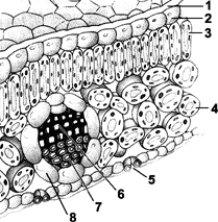 -The primary function of the leaf structure labeled 5 in Figure 9-1 is:
 (Multiple Choice)
4.8/5 (84)
(84) Even though the steps of photosynthesis that actually produce sugar molecules are part of the carbon fixation reactions, the light-dependent reactions are absolutely essential for sugar synthesis.Explain the role of the light-dependent reactions in the formation of the end products of photosynthesis.
(Essay)
4.8/5 (80)
(80) What is the C4 pathway? Briefly explain how this adaptation increases the effectiveness of photosynthesis in these plants.
(Essay)
4.9/5 (87)
(87) 
Filters
- Essay(0)
- Multiple Choice(0)
- Short Answer(0)
- True False(0)
- Matching(0)