



 Chat with AI
Exam 26: Protists

Exam 1: A View of Life88 Questions
Exam 2: Atoms and Molecules: the Chemical Basis of Life85 Questions
Exam 3: The Chemistry of Life: Organic Compounds95 Questions
Exam 4: Organization of the Cell68 Questions
Exam 5: Biological Membranes77 Questions
Exam 6: Cell Communication73 Questions
Exam 7: Energy and Metabolism76 Questions
Exam 8: How Cells Make Atp: Energy-Releasing Pathways90 Questions
Exam 9: Photosynthesis: Capturing Light Energy80 Questions
Exam 10: Chromosomes, Mitosis, and Meiosis91 Questions
Exam 11: The Basic Principles of Heredity75 Questions
Exam 12: Dna: the Carrier of Genetic Information80 Questions
Exam 13: Gene Expression76 Questions
Exam 14: Gene Regulation77 Questions
Exam 15: Dna Technology and Genomics79 Questions
Exam 16: Human Genetics and the Human Genome78 Questions
Exam 17: Developmental Genetics79 Questions
Exam 18: Introduction to Darwinian Evolution70 Questions
Exam 19: Evolutionary Change in Populations79 Questions
Exam 20: Speciation and Macroevolution91 Questions
Exam 21: The Origin and Evolutionary History of Life89 Questions
Exam 22: The Evolution of Primates87 Questions
Exam 23: Understanding Diversity: Systematics79 Questions
Exam 24: Viruses and Subviral Agents41 Questions
Exam 25: Bacteria and Archaea55 Questions
Exam 26: Protists92 Questions
Exam 27: Seedless Plants80 Questions
Exam 28: Seed Plants78 Questions
Exam 29: The Fungi87 Questions
Exam 30: An Introduction to Animal Diversity79 Questions
Exam 31: Sponges, Cnidarians, Ctenophores, and Protostomes146 Questions
Exam 32: The Deuterostomes90 Questions
Exam 33: Plant Structure, Growth, and Development86 Questions
Exam 34: Leaf Structure and Function76 Questions
Exam 35: Stem Structure and Transport74 Questions
Exam 36: Roots and Mineral Nutrition84 Questions
Exam 37: Reproduction in Flowering Plants89 Questions
Exam 38: Plant Developmental Responses to External and Internal Signals95 Questions
Exam 39: Animal Structure and Function: an Introduction96 Questions
Exam 40: Protection, Support, and Movement101 Questions
Exam 41: Neural Signaling87 Questions
Exam 42: Neural Regulation88 Questions
Exam 43: Sensory Systems111 Questions
Exam 44: Internal Transport104 Questions
Exam 45: The Immune System: Internal Defense85 Questions
Exam 46: Gas Exchange109 Questions
Exam 47: Processing Food and Nutrition119 Questions
Exam 48: Osmoregulation and Disposal of Metabolic Wastes94 Questions
Exam 49: Endocrine Regulation82 Questions
Exam 50: Reproduction104 Questions
Exam 51: Animal Development98 Questions
Exam 52: Animal Behavior77 Questions
Exam 53: Introduction to Ecology: Population Ecology97 Questions
Exam 54: Community Ecology74 Questions
Exam 55: Ecosystems and the Biosphere88 Questions
Exam 56: Ecology and the Geography of Life105 Questions
Exam 57: Biological Diversity and Conservation Biology66 Questions
Select questions type


Members of which group are one of the most important producers in marine ecosystems, although sometimes they form blooms known as red tides?
(Multiple Choice)
4.7/5  (79)
(79) Late blight of potatoes that caused the Irish potato famine is caused by members of the genus __________.
(Multiple Choice)
4.7/5 (81)
(81) Figure 26-2
Use the figure to answer the corresponding question(s). 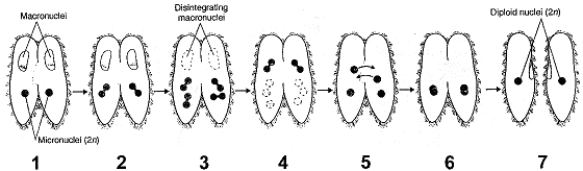 -The outcome of the process illustrated in Figure 26-2 is:
 (Multiple Choice)
4.8/5 (73)
(73) Backpackers' diarrhea, a common infection among campers and hikers, is caused by drinking untreated water.Consequently, backpacker's diarrhea is due most likely to __________ in the water.
(Multiple Choice)
4.9/5 (63)
(63) Ancestors of __________ may have possessed mitochondria which were lost or reduced during evolutionay history.
(Multiple Choice)
5.0/5 (65)
(65) The __________ are excavates that lack functional mitochondria and Golgi.
(Multiple Choice)
5.0/5 (86)
(86) Which group of algae are a commercial source of agar and carrageenan?
(Multiple Choice)
4.8/5 (82)
(82) Figure 26-1
Use the figure to answer the corresponding question(s). 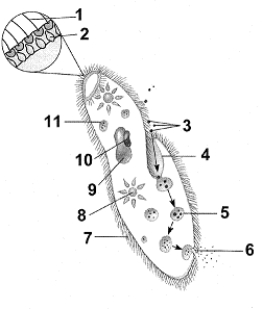 -Individuals in this group often have intracellular shells of interlocking plates.
 (Multiple Choice)
4.8/5 (74)
(74) Members of the __________ are thought to have given rise to plants.
(Multiple Choice)
4.8/5 (70)
(70) According to the serial endosymbiosis hypothesis, the ancestors of mitochondria are thought to be purple bacteria.
____________________
(True/False)
4.9/5 (71)
(71) MATCHING
Match the supergroup with the representative clade.
a.Rhizarians
d.Archaeplastids
b.Unikonts
e.Chromalveolates
c.Excavates
-Discuss the uncertainties and available evidence related to the evolutionary relationships among the following algal protists: brown algae, golden algae, red algae, and green algae.Include in your discussion how they relate to the plants.
(Essay)
4.8/5 (82)
(82) The protist that causes malaria belongs to the genus Macrocystis.
___________________
(True/False)
4.9/5 (72)
(72) Coralline forms of members of this group are ecologically important in the formation of coral reefs.
(Multiple Choice)
4.8/5 (84)
(84) _______ are characterized by having a micronucleus and a macronucleus.
(Multiple Choice)
4.8/5 (67)
(67) You find a protist that has a single flagellum surrounded by a collar of microvilli.You correctly conclude that this organism is:
(Multiple Choice)
4.9/5 (92)
(92) Name the two main clades of Rhizaria, then list one way of distinguishing one of those clades from the other.
(Essay)
4.8/5 (72)
(72) MATCHING
Match the supergroup with the representative clade.
a.Rhizarians
d.Archaeplastids
b.Unikonts
e.Chromalveolates
c.Excavates
-Forams and actinopods
(Essay)
4.7/5 (81)
(81) You find a unicellular organism that forms lobe-like pseudopodia.When you expose the cells to cAMP, they aggregate into a slug like structure.Based on this information, you correctly conclude that this organism is:
(Multiple Choice)
4.9/5 (74)
(74) 
Filters
- Essay(0)
- Multiple Choice(0)
- Short Answer(0)
- True False(0)
- Matching(0)